Category: General

  • Launch a One-Person AI Agency in 30 Days

    Launch a One-Person AI Agency in 30 Days

    Your First $10K AI Client—In 30 Days or Less

    You don’t need another course. Or a massive team. Or a computer science PhD. What you need is a game plan.

    Here’s the deal: AI is exploding, but most businesses are still using it like it’s 2022. That’s your edge. Deliver a small, punchy solution that saves them time or boosts revenue, and you’re on track to land your first $10K+ client in 30 days.

    Sound big? It is—but it’s also totally doable.

    This post breaks it down week by week: from picking a winning niche, to closing the deal. Let’s get into it.


    A playful, 3D render featuring various icons related to the theme of 'Niche Focus.' The image includes a laptop displaying a webpage, a clipboard with 'Week 1: Niche Focus' written on it, and symbols representing finance, collaboration, love, justice, and gifts, all arranged on a wooden table.

    Week 1 – Pick a Profitable Niche (and Stick to It)

    This step pays the most—and kills the most dreams when skipped.

    You’re not solving “AI problems.” You’re solving business problems… using AI.

    Use these 5 filters to choose your sweet spot:

    1. Cash-rich buyers – A company billing $100K/month won’t blink at a $10K invoice. A startup still finding product-market fit? Not so much.
    2. Existing relationships – Know people in a certain industry? That’s a head start most don’t have. Use it.
    3. Relevant experience – Degrees, jobs, even side projects count. Instant trust-check.
    4. Genuine interest – You’re about to talk to these folks a lot. Don’t niche into boredom.
    5. Ethical fit – Work with people doing things you respect. Life’s too short otherwise.

    Target the repeat offenders

    Every business bleeds time somewhere. Find that bottleneck, and you’ve got an offer.

    Some examples:

    • Law firms writing the same docs again and again
    • Marketing agencies stuck in Canva purgatory
    • E-commerce stores answering the same 14 support questions daily

    You’re not “selling GPT.” You’re selling “I just won back your Tuesday.”

    Powerful starting offers

    • Drafting automation for lawyers
    • Real-estate deal screeners
    • Creative content generators for ad agencies
    • Voice/chat agents for online stores
    • Virtual research assistants for consultants

    Each one solves a repeat pain. Niche it down. Make it real.


    illustration

    Week 2 – Build (or Borrow) the Tech Muscle

    No need to go full nerd. Just solve one painful thing better than anyone else.

    Option 1: Build it yourself

    • Code-based: JavaScript + NestJS or Python + FastAPI + OpenAI/Anthropic/Mistral APIs
    • Low-code/no-code: Bubble, FlutterFlow, Superblocks
    • Voice AI: Combine Vapi.ai or ElevenLabs with OpenAI
    • Automations: n8n or Make.com

    Pick one stack and move fast.

    Option 2: Outsource (and profit)

    • Land a $10K contract
    • Hire top talent from Türkiye, Egypt, Pakistan, or India for $2K
    • Keep the $8K margin

    You don’t need to be the engineer. You just need to be the solution-finder. Many solo consultants scale this way—fast.

    Bottom line: clients don’t care if you used Python or Bubble. They care if it’s fast, reliable, and gives them their weekend back.


    Colorful illustration depicting tools for building a client acquisition strategy, featuring a checklist labeled 'Warm Leads', a calendar marking 'Week 3', social media icons (LinkedIn, YouTube, Slack), a laptop, stacks of books, coins, and a megaphone.

    Week 3 – Build Pipeline Like You Mean It

    Getting your first 3 clients isn’t about mass cold outreach. It’s about going warm before you ever go cold.

    Start with your circle

    Mine these:

    • LinkedIn connections
    • Uni alumni databases
    • Trade associations
    • Industry newsletters
    • Friends-of-friends with business budgets

    Build a list. Aim for 50 names. Then do what no AI ever will—reach out like a human.

    Warm intros → short messages → short calls. This works.

    Get loud (in the right places)

    Silence is slow death. Start showing up where your clients already scroll.

    Pick your channel:

    • LinkedIn: still king for B2B
    • YouTube (shorts or long form): nothing beats showing the thing work

    Post 3x a week minimum.

    Winning topics:

    1. Fresh AI upgrades, applied to your niche (“How GPT-4o slashes contract review time”)
    2. Real case studies (“Saved a dental clinic 30 admin hours/week”)
    3. Quick demos (“Watch this AI draft a listing in 11 seconds”)

    ⚡ Pro move: post early on brand-new model drops. You’ll ride the surge in curiosity—and inbox pings.

    Join the right rooms

    Slack groups. Discord communities. Founder masterminds. These are deal factories.

    Just one “Need help with a RAG implementation—$15K budget. DM me.” and boom: you’ve got a month paid for.


    illustration

    Week 4 – Land the Deal (and Get Paid)

    You’ve got leads. Time to turn conversations into contracts.

    Step 1: Run a bulletproof discovery call (15–30 min)

    Ask smart questions:

    • Where are you losing the most time right now?
    • What does that cost your team (cash or clients)?
    • What could you be doing with that time back?

    Pre-vet with a form. Use tools like Calendly or Cal.com to keep it smooth.

    Step 2: Craft a no-brainer proposal

    Hop on a second call 2–3 days later.

    In between, map out this:

    • Phase 1: Quick-win MVP
    • Phase 2: Integrate and scale
    • Phase 3: Ongoing optimization

    Charge per phase. Get paid after each one delivers real results. It’s win-win—and feels low-risk to the buyer.

    Use DocuSign for zero-friction signatures. Time kills deals.

    Smart pricing with the value-multiplier formula

    Do this math:

    1. Hourly rate → say, $75/hr for a junior-mid specialist
    2. Estimated hours → add 25% buffer
    3. Attach a “value multiplier” → tie price to the outcome

    Example:
    Solution saves 200 hours/month. That’s $6K saved monthly, or $72K/year.
    You charge $7.5K for a build that delivers a 10x ROI.

    Nobody says no to that math.


    illustration

    One Month, One Client, Infinite Leverage

    The AI rush isn’t coming—it’s here. Businesses are desperate for help turning buzz into results. You can be that help.

    Block off 4 weeks. Pick one niche. Build one tight offer. Talk to real people. Follow up like a Pro.

    The first $10K client is the hardest. After that? It’s referrals, examples, confidence—and momentum.

    Your move. 🚀


    Want a shortcut to mastering AI?
    Check out Tixu – a beginner-friendly platform that turns AI into actual skills, fast.
  • Build a $1K AI Business in 30 Days

    Build a $1K AI Business in 30 Days

    Want to Make Your First $1,000 with AI? Don’t Build—Serve.

    You’ve seen the headlines.

    “AI Side Hustle Makes $10K/Month With No Experience.”
    “ChatGPT Printed Me a Passive Income Stream.”

    Yeah… no.

    If you’ve got no audience, no runway, and no clue what the market wants, here’s your reality check: AI is not a vending machine for cash. It’s a tool. A powerful one—but only in steady hands.

    So if you’re serious about that first $1,000? Stop selling widgets and start solving problems. Let’s talk service.


    illustration

    Why Product Hustles Keep You Broke (At First)

    Templates. SaaS tools. Etsy downloads. Info products.

    They look appealing. They promise freedom. But here’s what they don’t tell you:

    • You’ll sink cash into development, ads or inventory—fast.
    • You’ll wait weeks (or months) for your first sale.
    • You’ll compete with 500 copycats doing the exact same thing.

    Sound familiar?

    Products scale. Eventually. But services fund the journey.


    illustration

    Why Services Get You Paid (Fast)

    Instead of trying to launch the next Notion template empire, what if you helped busy business owners automate boring stuff?

    That’s where service wins:

    • Low start-up cost – just you, your laptop, and Google-fu.
    • Quick feedback – one convo tells you more than 100 YouTube videos.
    • Leapfrog learning – deliver value, collect testimonials, raise rates.

    Best part? You earn while building market insight, portfolio pieces, and real-world chops.


    illustration

    Launch a Lean AI Automation Agency

    Let’s flip the traditional agency model on its head.

    Instead of hiring a team, you use no-code and AI-powered tools to get the same (or better) results—faster and cheaper.

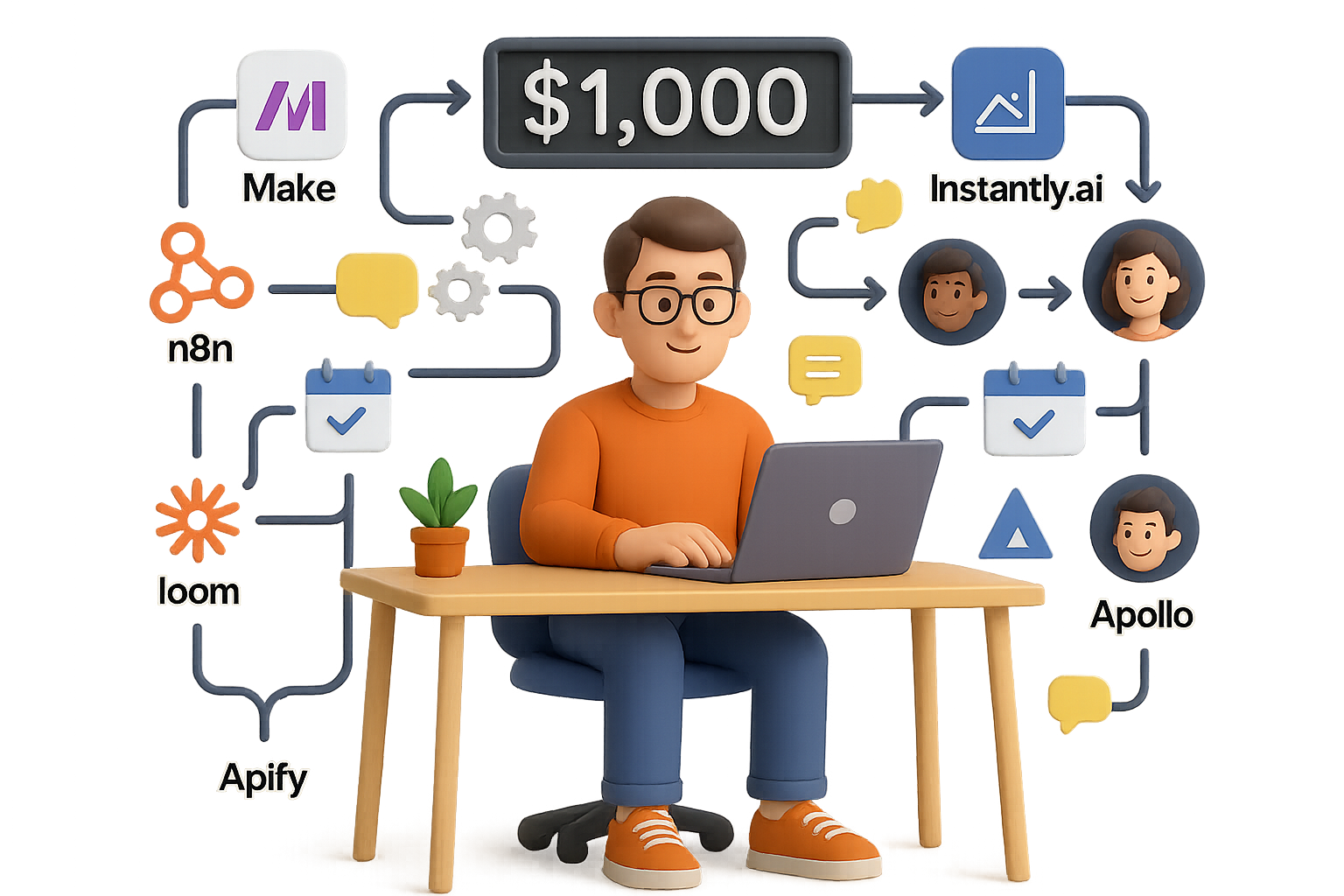
    Platforms like Make.com and n8n.io let you automate tasks that used to take developers days. Now? Drag, drop, connect. Done.

    Why this model works:

    • High-value solutions – think CRM syncs, report automations, email workflows.
    • Fat margins – 70%+ profit isn’t unusual with cloud-powered automations.
    • Repeatable templates – build once, tweak 20%. Reuse, re-sell.

    You’re not just freelancing. You’re productizing your services—one build at a time.


    illustration

    The Tools You Actually Need

    Don’t burn out chasing shiny SaaS objects. Your starter stack:

    • Make.com or n8n.io – visual automation builders
    • Instantly.ai – send cold emails at scale without getting flagged
    • Apify.com – scrape leads or market data
    • Apollo.io – B2B contact goldmine
    • Upwork.com – land your first few gigs without a personal brand
    • Loom.com – pitch clients in 90-second videos with major trust impact

    Spend less time stacking tools, more time stacking wins.


    illustration

    Your $1,000 in 30 Days: Week-by-Week Plan

    What’s doable in 4 weeks? A lot more than you think.

    Week 1: Skill Sprint

    • Crush a Make or n8n 101 course (YouTube at 1.5× speed = 4 hours).
    • Build 3–5 simple zaps: Gmail → Slack, Airtable syncs, basic ChatGPT commands.
    • Record everything. Future content + portfolio gold.

    Week 2: Position & Prospect

    • Pick one clear offer (e.g., “We automate follow-ups for mortgage brokers.”)
    • Set your Upwork profile up like a product page, not a résumé.
    • Draft 5-email cold outbound sequence. Target 100 solid leads from Apollo.

    Weeks 3 & 4: Pipeline → Payment

    Daily checklist:

    1. Apply to 5 Upwork jobs with a short Loom explainer.
    2. Send 100 cold emails. Yes, daily.
    3. Track opens/replies in a sheet.
    4. Follow up twice minimum before moving on.

    One close = $1,000–$2,000. Deliver. Get feedback. Rinse and raise.


    illustration

    Power Moves: Daily Habits That Compound

    • 60–90 mins of lead-gen, first thing. Non-negotiable.
    • Follow-up 3–5×. Half of sales happen after touch #3.
    • Embed value in every message—quick Loom audit, process map, or morning idea.
    • Tweak constantly. Offers, copy, targets. It’s a live experiment.
    • Log everything. Iterate like a startup CEO.

    It’s effective.


    illustration

    What’s Blocking You Isn’t AI—It’s Avoiding Sales

    Early on, your biggest gap isn’t skills. It’s conversation volume.

    You don’t need to be the smartest person in the room. Just the most helpful. Sell your time to fund your freedom. Then buy it back later with better automations, better clients and better systems.

    This is the messy part. But it’s also the flywheel stage. Push through once, and you’ll never have to start from zero again.


    illustration

    The Takeaway

    AI isn’t your shortcut. It’s your superpower—but only if you wield it to help others.

    If you want real income in 30 days, forget the overnight success reels. Sell a solution, serve a client, and let AI carry the heavy lifting in the back.

    And if you’re new to AI and don’t know where to start?

    Check out Tixu — a beginner-friendly AI learning platform built to show you the ropes.

    Ready when you are.

  • Build an AI App From Idea to $42K MRR in 90 Days

    Build an AI App From Idea to $42K MRR in 90 Days

    From Side Project to $42K MRR: How One Founder Built, Validated, and Scaled in 90 Days

    What if your next idea didn’t just survive—but compounding revenue within 3 months?

    That’s not a motivational tweet. It’s what CJ Zafir pulled off with CodeGuide.dev, an AI-powered tool for developers wrangling hallucination-prone code from ChatGPT. No giant team. No funding. Just a killer problem, smart systems, and a spicy little hustle.

    You’re about to see exactly how he did it—without wasting time on code no one asked for.

    illustration

    Pain First. Then Product.

    He had built MVPs for years—freelancing, running agencies, burning out on rinse-and-repeat technical docs.

    His tipping point? Spending 10+ hours coaxing acceptable code snippets out of ChatGPT for every new client project. He finally stitched together a workaround with Make.com and slashed the time per project by 70%.

    “It was like I found a cheat code,” CJ said. So, he did two things:

    • Built a landing page in 30 minutes
    • Shared the workflow on X (Twitter)

    No code. Just proof of pain—and how he solved it.

    Two weeks later, 1,800 devs had joined the waitlist.

    illustration

    How To Validate Without Touching a Line of Code

    If you’re thinking: “I want that kind of validation!”—good news. Here’s CJ’s pre-build playbook:

    1. Show, Don’t Tell

    • Recorded a no-frills screen share demo.
    • Posted it with a hook: “Stop AI hallucinations in your code—here’s the exact flow that saved me 7 hours.”

    2. Make Action Friction-Free

    • All posts pointed to a minimal waitlist page: name and email. That’s it.

    3. DM Like You Mean It

    • Personally messaged every engager.
    • Asked about their workflows. Confirmed his system was 10x simpler.

    Only after all that… did CJ write a single line of production code.

    A playful 3D illustration featuring a calendar marked 'Dec 24', a laptop displaying an interface, a cup of coffee, checklists, a pencil, and a gift box, symbolizing a project launch on December 24 during a 14-day sprint.

    Built in 14 Days, Shipped by Christmas Eve

    CJ didn’t wait for perfect. He aimed for usable:

    • Full front-end designed upfront in Figma.
    • He handled the UI and marketing. A friend took backend and support.
    • Two-week all-in sprint = launch on Dec 24 with 100 users testing live.

    Yeah, while the rest of us were picking out pajamas, CJ was launching.

    illustration

    The Zero-Ad Content Engine: Tutorial Marketing

    CJ’s growth play was delightfully low-tech—and massively effective.

    Weekly Content Cadence:

    • 4 threads + 3 long-form posts on X every week.
    • Each post walks through:
      1. The pain: “AI still hallucinates code.”
      2. The fix: Demo the workaround.
      3. The hint: “Here’s how CodeGuide automates it.”

    Why It Works:

    • Bookmark-worthy content nudges the X algorithm.
    • All CTAs go to the waitlist—not to a paywall.
    • Warm leads = 10x conversion downstream.

    Result:
    • $42,000 MRR in less than 90 days
    • ~4,800 devs in the community
    • $0 spent on ads

    Colorful 3D illustrations of pricing details including a calendar with 'DEC 24,' a price tag of '$29/month,' a '%40 off annual' sticker, and icons representing partner perks and additional pricing tiers.

    Pricing That Pays for Itself

    CJ didn’t play the freemium game. LLM calls are pricey—and real solutions are worth paying for.

    • Starting price: $29/month
    • Premium plans ($39–49) coming soon
    • Annual option with 40% off and partner perks via Cursor.sh & other top AI IDEs

    Clear, fair, and sustainable. That’s the whole model.

    illustration

    Peek Under the Hood

    Here’s what powers it all:

    • Front-end: Next.js
    • Back-end/DB: Supabase (PostgreSQL)
    • Deployment: Vercel + Hetzner
    • Auth: Clerk.dev
    • Email: ConvertKit
    • IDE: Cursor
    • LLMs: OpenAI (main bill ≈ $2.8k/month), Claude (Anthropic), Gemini Flash
    • Bonus tools: Make.com for automations, Figma/Canva for visuals

    Infra runs at ≈ $3.5k/month—leaving room for healthy margins.

    illustration

    A Day in the Life

    Here’s CJ’s real growth hack: relentless focus.

    • 5:00 AM — Wake, pray, shower
    • 5:30–8:00 — Deep Work #1 (strategy, product)
    • 8:00 — Walk + coffee
    • 9:00–14:00 — Deep Work #2 (design, content, code)
    • Afternoons — Community chats, calls
    • Evenings — Podcast, read, prep
    • 22:00 — Sleep

    No supplements, no standing desks. Just discipline.

    A 3D illustration featuring a laptop displaying text, a checklist clipboard, a calendar marking '90 days,' a megaphone, warning signs, and coins, symbolizing productivity and project management.

    Build Smarter with AI: 5 Takeaways

    Want to repeat a win like CJ’s? Here’s what matters:

    • Validate first, code later. Demos get faster feedback than building blind.
    • Pick a sharp pain. For CJ: LLM hallucinations inside dev workflows.
    • Repeatable + teachable = scalable. His threads are how-to manuals that market themselves.
    • English is your dev stack. Prompting can carry you from design → copy → app launch.
    • Margins are freedom. Keep infra lean; invest where it compounds.

    The playbook’s open. The tools are in your hands.

    You’ve got 90 days. What’s stopping you?


    Want to learn how to build with AI—without needing a PhD or 10k GitHub stars?
    Check out Tixu—an AI learning platform made for beginners who still want to ship pro-level results.

  • Earn $5,000 in 5 Days Using AI Shorts

    Earn $5,000 in 5 Days Using AI Shorts

    The 5-Day, $5k YouTube Shorts Blueprint (No Camera Needed)

    Imagine waking up, checking your phone, and seeing $5,000 earned in five days—without filming a single video.

    That’s not a unicorn fantasy. It’s a repeatable AI-powered playbook built on YouTube Shorts. If you’ve got a laptop, Wi-Fi, and a touch of hustle, you’re already halfway there.

    Over the next few minutes, you’ll learn exactly how to:

    • Set up 10 cash-ready YouTube channels
    • Repurpose viral content using simple AI tools
    • Monetize with built-in affiliate offers
    • Scale from a side hustle into serious income

    Let’s break it down, step by step.


    illustration

    Build a Mini-Network of Niche Channels

    Skip the “pick one perfect niche” trap.

    Instead, spread your bets across 10 channels. Each one taps a proven, high-traffic theme:

    • Motivation hits
    • Sports highlights
    • Tech facts
    • Self-improvement
    • Celebrity soundbites

    No idea where to start? Ask ChatGPT to brainstorm channel names based on each topic. Then spin up a free logo and banner set in Canva using pre-built templates. No design skills needed.

    In 60 minutes, you’ve got a small empire ready to post.


    illustration

    Turn One Video Into 15 Shorts

    The hack? You don’t create content—you harness it.

    Here’s how:

    1. Find viral long-form content – Think of speeches, podcasts, or interviews with millions of views. High engagement = high clip potential.
    2. Use Opus Clip to auto-edit – Paste the YouTube link, click “Generate,” and boom—AI slices the video into ready-to-publish Shorts, complete with captions.
    3. Post at scale – Two Shorts/day across 10 channels = 140 videos/week. Even if only 10% stick, you’re still winning.

    Volume isn’t spam if the content hooks. And at this pace, one breakout Short can rack up 100k+ views in a day.


    illustration

    Keep YouTube’s Originality Police Happy

    You can ride trends—just don’t trip monetization filters.

    Here are two fast ways to remix content and stay compliant:

    1. Compilation Method

    • Use InVideo to mash together 2–4 Shorts into a mini reel.
    • Add a 5-second branded intro and a quick outro.

    That’s enough change to trigger “original content” flags—without killing the virality.

    2. Mix-and-Match Method

    • Swap a few seconds with royalty-free B-roll from InVideo’s library.
    • Layer in text overlays, emojis, or sound cues to punch it up.

    Each one takes about 10 minutes. You’ll pass YouTube’s originality check—and keep monetization flowing.


    illustration

    Craft Titles & Thumbnails That Get Clicked

    You don’t need clickbait. You just need clarity, curiosity, and contrast.

    • Keep titles under 75 characters. Say what they’ll get: “LeBron Explains Mamba Mentality in 30 Seconds ”
    • Use Canva for thumbnails. High-contrast colors and bold fonts win the scroll war.
    • Be predictable—in a good way. Upload 2 Shorts, per channel, every single day. YouTube rewards consistency like clockwork.

    Let your thumbnails do the talking and your titles seal the click.


    illustration

    Plug In Affiliate Offers for Extra Income

    Yes, Shorts ad revenue is real. But affiliate commissions are where things scale fast.

    Here’s how you sneak in an additional stream:

    1. Head to ClickBank, Digistore24, or another marketplace.
    2. Pick offers that align with your niche—e.g., a fitness tracker for a gym motivation channel.
    3. Add your affiliate link in the Short’s pinned comment and video description.

    Bonus move: Test 2–3 offers per channel. Track what converts, swap out duds weekly, and double down on winners.


    illustration

    Grow From Side Hustle to Full Stack Business

    Once your channels are bringing in passive income? Level up.

    • Use the same framework to spin up more channels.
    • When a channel passes 1k subs, consider investing in simple long-form videos to unlock higher RPM.
    • Think 12 months out. 10 successful channels today could become 6 figures/year by next spring.

    This isn’t a get-rich-with-zero-effort scheme. But with steady uploads and smart tools, it’s absolutely a get-compensated-for-being-consistent system.


    illustration

    Let’s Recap

    Here’s your playbook, in plain English:

    • Use AI to clone content creation – Let Opus Clip and ChatGPT do the heavy lifting.
    • Nail originality the easy way – Minor edits = major monetization unlock.
    • Monetize with more than ads – Affiliate links multiply your earnings-per-view.
    • Scale with systems – 10 channels today, 20 next month. Repeat what’s working.

    Ready to start building yours? The power’s in your pocket.

    Want step-by-step tutorials and beginner-friendly AI toolkits?
    Head over to Tixu.ai — it’s built for creators like you.

  • Launch a $10K/Month Affiliate Business in 90 Days

    Launch a $10K/Month Affiliate Business in 90 Days

    Why Affiliate Marketing Is Still the Easiest First Business

    No inventory. No customer service nightmares. No late-night product fulfillment. Affiliate marketing skips all of that—but still pays.

    You earn a slice of the sale every time someone buys through your link. And here’s the kicker: you can start with zero cash up front.

    Compared to launching a full-blown e-commerce store or building SaaS from scratch, affiliate marketing is ridiculously beginner-friendly:

    • Low-risk – no products to ship, no ads required to start
    • Highly scalable – $500/month or 7 figures; your effort sets the ceiling
    • Learn-it-this-week skills – short content, simple setup, and a focused strategy

    In this post, I’ll walk you through a 7-step plan that’s generated millions in commissions for affiliate pros. Stick to it, and you’ll skip months of trial-and-error newbies usually trip over.


    illustration

    Step 1: Pick a Niche That Solves a Pain

    Before you fall down a keyword rabbit hole—start with what you know or obsess over.

    Maybe that’s:

    • Gaming accessories
    • Gut-friendly baking
    • Budget hacks for single parents

    Now, run your shortlist through Google Trends. You’re looking for topics people actively need help with—not just browsing for fun.

    Tip: Phrases like “fat-loss workouts for busy moms” beat generic terms like “home fitness.” Specific pain = higher conversions.


    illustration

    Step 2: Choose Your Identity—Face or No Face?

    You’ve got two lanes:

    • Personal brand – Show your face, speak directly to your audience, build faster trust. Big upside long-term.
    • Faceless brand – Stay off-camera. Use stock footage, text-only visuals, or AI avatars. Great for privacy or multiple sites.

    No wrong answer here. Success happens in both lanes. Just pick the one you’ll actually stick with.


    illustration

    Step 3: Lock in High-Paying Affiliate Programs

    Not all offers are worth your time. Good ones pay well and solve real problems.

    Start with these two:

    • ClickBank – Recurring commissions. Think digital fitness programs, self-help, software.
    • Impact.com – Big brand offers like Canva, Shopify, and NordVPN.

    Look for deals that pay at least 30% or $50+ per sale. Anything less? Hard to scale without ads.

    Pro tip: If you actually use the product you’re promoting, your content hits way harder.


    illustration

    Step 4: Build a Lean Site and Blog That Converts

    You don’t need a 37-page funnel. Just the essentials:

    • A home page that clearly tells people what they’ll get
    • A few landing pages tied to your main offers
    • A blog packed with useful, problem-solving content

    Use tools like WordPress, Webflow, or Shopify’s starter plans—the tech is dead simple now.

    For every blog post, follow this format:

    1. Solve a problem: “How to Save Big at Checkout Without Hunting Coupons”
    2. Deliver value quickly: Share a tip like installing Honey or browser extension hacks
    3. Drop your rec: Link to Rakuten (with your referral link, of course)

    Let the content sell the click—don’t just drop affiliate links like confetti.


    illustration

    Step 5: Drive Traffic with Short Videos + Pinterest

    You’ve got a shiny blog. Now it needs eyeballs.

    Short-form video (TikTok, IG Reels, YouTube Shorts):

    1. Pick one ultra-specific pain point
    2. Show a 5–10 second solution or example
    3. Point people to your link in bio

    Want help making those clips fast?

    • InVideo AI – Turns your script into a polished video with music, text, and visuals
    • HeyGen – Create AI-powered talking head videos without showing your face

    Pinterest:

    Perfect for niches like DIY, beauty, food, travel, and personal finance.

    1. Use Canva to design vertical pins (tons of free templates).
    2. Add a snappy headline (“Save $300 This Month With This One App”).
    3. Link every pin back to a relevant blog post.

    Pinterest sends steady evergreen traffic—no dancing required.


    illustration

    Step 6: Start That Email List

    Every social media algorithm eventually turns on you. Your email list? It’s all yours.

    Capture names with:

    • A free “cheat sheet” or mini guide
    • A quick quiz with personalized results
    • Free product alerts or weekly hacks

    Tools like Beehiiv, MailerLite, and ConvertKit are beginner-friendly and scale-ready.

    Then, send one helpful tip + one affiliate product per week. Even with 5,000 subscribers, you could be seeing consistent 4-figure months.

    Example: “Jenny, a niche email creator in the self-care space, built to 3,200 subs and hit $1.6K her fourth month—no paid ads.”


    illustration

    Step 7: Scale and Automate the Boring Stuff

    Once organic traffic starts bringing commissions, run this upgrade checklist:

    • Start ads targeting buyer-ready keywords on Google or Pinterest
    • Outsource the grind (video editing, pin design, article formatting) via Fiverr or Upwork
    • Document your process—turn it into SOPs, so you spend more time finding winners and less time repeating tasks

    That’s how you turn a side hustle into real revenue: by systematizing what already works.


    Real Talk Moment

    Affiliate marketing isn’t push-button easy.

    You might need a few months of publishing, testing, and adjusting before the money turns on. You’ll mess up here and there. That’s normal.

    But compared to shipping products, managing ads, or building custom software?

    This is the lowest-risk launch pad for online income—especially now that AI tools handle half your workload.


    Your First Move?

    ✅ Pick a niche
    ✅ Join two affiliate programs
    ✅ Launch a blog post solving one problem
    ✅ Record one video sending traffic to it

    That’s day one. If you take small steps every week, your future self will thank you—loudly.

    Oh, and if you want a smarter way to level up your AI skills while building your business, check out Tixu—the beginner-friendly AI learning platform built to help you skip the fluff and get results.

    Ready when you are.

  • Build a $100K AI Persona Business in 2025

    Build a $100K AI Persona Business in 2025

    Launch a High-Margin AI Persona Service (Without Writing Code or Chasing Unicorns)

    AI tools are sprinting. Teams are shrinking. And if you’ve asked “Where do I even start?”—you’re not the only one in Slack wondering the same thing.

    Here’s the kicker: You don’t need to build the next ChatGPT clone to win. You just need a smart offer built around AI personas—custom AI assistants trained on a client’s voice to write, strategize, and sell.

    This blog breaks it down into 7 clear moves you can take to build your own scalable, high-margin service business in months—not maybe, one day, eventually.

    Let’s roll.


    illustration

    Step 1: Niche down like your income depends on it (because it does)

    Going broad sounds logical. Feels safer. But in practice? It’s a fast-track to overwhelm.

    Instead, target a niche that’s:

    • Easy to find online (LinkedIn filters, hashtags, niche groups)
    • Willing to spend (already paying for content + strategy help)
    • Feeling real competition (urgency = budget)
    • Capable of fast wins (ideal for AI assistance)

    Hot right now:

    • Fitness coaches
    • Boutique law firms
    • Niche SaaS startups
    • Multi-location dental practices

    Even the greats started small—Amazon with books, Facebook on Ivy-League campuses. Master one vertical. Then expand.


    illustration

    Step 2: Build an offer with 90–95% profit margins

    AI personas aren’t toys. When set up right, they can replace:

    • An email copywriter
    • A social media manager
    • Even a junior sales strategist

    Translation: You offer the result of a whole content team—with zero payroll.

    The profit math works:

    • ChatGPT Plus or Claude Pro = ~$20/month
    • Your service? Starts at $2k and scales to $15k+
    • Zero logistics, low overhead, huge margins

    The Service Ladder:

    • Level 1 – Persona Setup: One task-training persona — $2,000–$5,000
    • Level 2 – Full Stack Personas: 5–10 roles (email, socials, sales) — $5,000–$15,000
    • Level 3 – Training & Templates: Teach clients or sell plug-and-play prompt packs

    You’re selling capability in a box. That’s power.


    A computer screen displaying search options for AI content, featuring buttons for 'ChatGPT help' and 'automation', surrounded by icons of social media platforms like LinkedIn, Facebook, and Discord, along with educational materials and resources.

    Step 3: Find clients already craving AI solutions (they’re everywhere)

    Avoid convincing people AI works. Work with folks already convinced—it just isn’t working for them yet.

    Look for business owners who:

    • Post things like “Any tips for using ChatGPT for content?”
    • Bought tools like Jasper and got mediocre results
    • Complain about content bottlenecks—and staff burnout

    Where they hang out:

    • LinkedIn (search keywords like “AI content,” “automation help”)
    • Facebook & Discord groups (industry-centric and AI-focused)
    • Referrals from boutique agencies not doing AI in-house (they’ll send clients your way)

    You’re not selling hype. You’re offering rescue.


    Illustration of five AI personas including an Email Writer, Social Media Manager, Sales Copywriter, LinkedIn Ghostwriter, and Script Creator, highlighting a $2,000 starter kit priced option.

    Step 4: Package your “AI Writing Dream Team”

    Nobody wants another tool. They want results.

    So position your offer like this:

    “You’ll get five hyper-trained AI personas that write all your content in your exact voice.”

    1. Email Newsletter Writer
    2. Social Media Manager
    3. Sales Page Copywriter
    4. LinkedIn Ghostwriter
    5. Long-Form Script Creator (webinars, podcasts, YouTube)

    Pricing:

    • 3-persona starter kit: $2,000
    • Full five-persona system: $5,000
    • Optional ongoing support: $1,000/month for fresh prompts + updates

    🎯 Why it hits: A part-time content hire = $2,500–$4,000/month. You’re offering an entire virtual team for a one-time fee.


    A colorful 3D illustration featuring various digital marketing elements, including a persona card, marketing analytics charts, a clipboard with 'FREE SAMPLE' text, stacks of documents, and gift boxes, symbolizing an AI persona service.

    Step 5: Close with a free sample persona

    Nothing sells like “Whoa, it sounds exactly like me.”

    Here’s the simple close-any-deal flow:

    1. Ask for 20–30 pieces of existing content (emails, posts, scripts)
    2. Spend 2–4 hours crafting their sample persona
    3. Deliver within 24 hours with this line:
      “Love it? Let’s build the rest. Hate it? It’s yours to keep, free.”

    This works. Expect 70%+ conversion if you nail the voice and tone.

    (Remember: one freebie → $5,000 client. Worth it.)


    A colorful 3D illustration depicting a desktop setup for manual delivery tasks, featuring a checklist with time estimates, a coffee mug with a dinosaur design, and various icons representing communication and organization.

    Step 6: Deliver manually… at first

    Shortcuts are tempting early on. Hold off.

    The first 5–10 clients teach you more than any prompt guide. Here’s your manual delivery timeline:

    🛠️ Rough breakdown (per client):

    • Content audit: 3–5 hours
    • Persona training: 3–6 hours
    • Prompt design: 2–4 hours
    • Testing + Delivery: 2–4 hours

    → Total: 10–20 hours
    → Revenue: Up to $15,000/client

    Stay hands-on early to spot patterns—and perfect your system before scaling.


    illustration

    Step 7: Template your way to scale

    Here’s where it gets fun.

    Patterns will pop:

    • Coaches use a warm, story-driven tone
    • SaaS folks love data + brevity
    • Lawyers? They speak disclaimer

    Turn those findings into rinse-and-repeat templates.

    Three ways to monetize:

    • Template Store: Industry-specific prompt packs (sell on Gumroad or direct)
    • Done-For-You Service: Same premium pricing, faster fulfillment
    • Hybrid Model: Templates for solopreneurs, white-glove for agencies or high-end clients

    More templates = less labor = bigger margins.


    illustration

    Fast Facts & Reality Checks

    • You’re not building a new app. You’re configuring existing chat models—with expertise.
    • High-margin businesses do best when you reinvest. Use 50% of profit to build your lead-gen flywheel.
    • Being early matters. You’ll get the testimonials, referrals, and authority latecomers can’t fake.
    • AI isn’t magic. It supercharges real business skills. You still need effort, communication, and iteration.

    illustration

    Do This Next

    1. Block 30 minutes today. List five industries you know well.
    2. Choose one. Reach out to a friendly contact and ask for 30 pieces of real content.
    3. Make a free sample persona using ChatGPT or Claude. Send it with confidence.

    Then repeat. Refine. Raise those prices.

    AI won’t replace you. But someone using AI smarter than you? That’s another story.

    Want step-by-step guides, mini-courses, and templates to build your first AI persona business—without digging through Reddit for scraps? 🔗 Check out Tixu—a beginner-friendly AI learning platform built just for you.

  • Automate Viral Sleep Story Videos in Under 60 Minutes

    Automate Viral Sleep Story Videos in Under 60 Minutes

    Turn Faceless YouTube Videos into Passive Income with This 1-Tool AI Workflow

    Struggling to break into YouTube without showing your face—or spending hours editing?

    Good news: there’s a wildly effective, AI-powered format that’s blowing up faceless channels right now. Think long-form, ultra-relaxing “sleepless historian” videos. Two hours of immersive, historical storytelling wrapped in calming soundscapes. Users binge these as sleep aids… and creators rake in the mid-roll ad revenue.

    Even better? You only need two things: CapCut’s AI Video Maker and a little ChatGPT magic.

    Let’s flip the script: This isn’t about going viral. It’s about building a binge-worthy content engine that works while you sleep.

    You’ll walk away with:

    • A repeatable, AI-driven 5-step workflow
    • Tools to generate 2+ hour videos with zero on-camera work
    • Everything built for beginner-level ease—and maximum passive income

    illustration

    Why This Niche is a Gold Mine (No Face, No Fuss)

    Sleep content. History storytelling. Ambient soundscapes.

    Combine all three, and you’ve got an evergreen niche with:

    • Nonstop demand for sleep + ASMR-style content
    • Deep-watching history nerds who love immersive narratives
    • ~2-hour runtimes = More mid-roll ad slots = Higher CPMs
    • 100% faceless = ideal for automation or outsourcing

    Let’s dive into the workflow—and yes, you can knock out an entire video over your lunch break.


    illustration

    Step 1: Generate Binge-Worthy Topics with ChatGPT

    Goal: Start with a list of 10 juicy video concepts.

    Open ChatGPT and drop this prompt:

    “Give me 10 immersive, first-person historical scenarios ideal for a calming bedtime story. Focus on vivid sensory details, serene settings, and universally recognizable eras.”

    Repeat or tweak until you’ve got a list that makes you want to disappear into a different century. Examples that perform well?

    • “An Evening Feast in the Mughal Imperial Kitchen”
    • “Walking the Forum of Ancient Rome at Dawn”
    • “Boating Through Han Dynasty Canals Under Lantern Light”

    You get the idea—historical ASMR, but with a narrative arc.


    illustration

    Step 2: Script a 2-Hour Story—Fast

    CapCut works best when you input full-length text. That means ~12,000 words per video.

    Here’s what to say to ChatGPT:

    “Write a 12,000-word, second-person bedtime story about [topic]. Divide the story into four parts. Use soothing language, gentle pacing, and detailed ambient descriptions.”

    If the output pauses mid-way, just ask:

    • “Continue.”
    • “Please expand Part 2 by 20%.”
    • “Add more ambient detail to the final scene.”

    Don’t stress perfection. You’re building atmosphere, not literature.


    illustration

    Step 3: Let CapCut’s AI Handle the Heavy Lifting

    Here’s the sweet part—AI does the editing for you.

    1. Open CapCut → AI Video Maker → Instant AI Video
    2. Paste in Part 1 of your story
    3. Pick a relevant visual style (Roman, Neoclassic, etc.)
    4. Choose 16:9 aspect ratio
    5. Select a chill, royalty-free AI voice
    6. Hit Generate

    Boom. CapCut will:

    • Break the text into scenes
    • Create matching AI art
    • Voice the narration
    • Add auto-subtle camera pans + captions

    Repeat for Parts 2–4. If any part hits 100+ scenes, let CapCut generate the overflow in tiny bursts (takes less than a minute per fix).


    illustration

    Step 4: Polish and Assemble Your Masterpiece

    Final tweaks before upload:

    • Stitch all four parts into one timeline
    • Delete captions (it’s sleep content, after all)
    • Add gentle FX → Elements → Sound FX → Medium
    • Overlay a crackling fire loop (Pixabay has great royalty-free ones) at 5–10% volume
    • Optional: Use “Vapor” or “Spark” filters for dreamy haze

    Export at 1080p or higher. You’re good to go.


    illustration

    Step 5: Design a High-Click Thumbnail That Speaks ASMR

    Thumbnails matter—especially in this space.

    1. Describe a rich, specific image: “Mughal chef ladling saffron broth by torchlight”
    2. Ask ChatGPT for an AI image prompt
    3. Use DALL·E, Midjourney, or Adobe Firefly to generate it
    4. Drop the art into Canva or Photopea

    Then:

    • Add large serif text—3 words max
    • Boost contrast to make faces/glow pop
    • Use icons like moons, candles, or mist to whisper “soothing content this way”

    illustration

    Can’t Get CapCut to Work?

    Try this:

    • Use a VPN to access CapCut’s web version
    • Swap to DaVinci Resolve or Premiere if you’re up for more manual work
    • Hire an editor on Fiverr or Upwork—rates are surprisingly affordable

    Automation is nice, but options = freedom.


    illustration

    Launch, Learn, Repeat

    Upload daily, or schedule weekly drops. Lean into runtime (90+ minutes is ideal) and keep TikTok-style hacks out of your process. This is long-form, not quick scroll bait.

    With just a few uploads in your playlist, fans will start cueing them up every night—which means longer sessions, better CPMs, and compounding revenue.

    No face needed. No gear required. And sleep content? Doesn’t go out of style.

    Take the first step now by exploring tools like ChatGPT and CapCut.

    Want more beginner-friendly AI tutorials to build your next creator income stream?

    Check out Tixu → your coach in AI-powered creativity and get started in minutes.

  • Earn Real Income from These 10 Easy AI Hustles

    Earn Real Income from These 10 Easy AI Hustles

    10 AI Side Hustles You Can Start Today (No Coding Needed)

    AI isn’t just for tech bros and big companies. It’s for you—the curious, the creative, the “I just need a little extra income” crowd. And yes, you can get started without any fancy degrees or expensive gear.

    Below are 10 beginner-friendly AI side hustles that turn a few smart prompts and simple tools into real cash. Whether you’ve got 20 minutes a day or you’re planning your escape from that endless Zoom calendar, there’s something here for you.

    Let’s break it down. 👇


    A playful arrangement of a laptop displaying design tools, featuring a magnifying glass, images, and art supplies, symbolizing digital creation and editing.

    1. Bring Old Photos Back to Life

    You know that shoebox full of blurry, faded Polaroids in your grandma’s closet? Those can be your goldmine.

    Quick tools:

    • DeepAI Image Colorization
    • DeOldify (Runs free in Google Colab)
    • Photoshop Neural Filters

    Here’s your fast launch:

    1. Scan or snap old prints.
    2. Use a tool to restore or add color.
    3. Share jaw-dropping before/afters on Fiverr, Facebook Groups, or Etsy.
    4. Offer packages for full family albums.

    💰 Restoring a single image can net you $20–$50. An album? That’s $300 to $1,000+—and a few tears of joy from grateful clients.


    illustration

    2. Be Everyone’s Background Fixer

    Product photos. Profile pics. YouTube thumbnails. Clean, crisp images convert—and most folks don’t know how to remove a background without rage-quitting.

    Tools you’ll love:

    • Remove.bg
    • Canva Pro Background Remover
    • Removal.AI

    Offer per-image pricing or bundle 10+ into a package. Throw in light edits and you’re an instant upgrade from DIY.


    3. Watermarks

    Ecomm sellers want watermarks gone. Bloggers want them added. You just want to get paid.

    Tools:

    • WatermarkRemover.media.io
    • DrWatermark.com

    ⚡ Pro tip: Offer both services. A $15 gig can turn into a recurring gig when sellers need a hundred images cleaned…fast.


    4. Write + Publish AI Children’s Books

    No plot? No problem. GPT and Midjourney have your back.

    Here’s the workflow:

    1. Research bestselling themes on Amazon (“Look Inside” helps).
    2. Use ChatGPT to write a 600–800 word story (K–2 reading level is gold).
    3. Create illustrations with Midjourney or Stable Diffusion.
    4. Assemble in Canva or Affinity, then upload to Amazon KDP.

    🎨 Bonus idea: coloring books. Just tweak your prompts for black-and-white line art.

    One breakout book = passive profit for years.


    illustration

    5. Spin Up a Niche Blog That Pays

    “Blogging is dead.” Right…and yet niche sites still rake in thousands a month with solid content + smart SEO.

    Starter stack:

    • ChatGPT for outlines + first drafts.
    • Jasper.ai for zippy intros + sales pages.
    • SurferSEO or Ahrefs for keywords.

    Make money with:

    • Ads (AdThrive, Google AdSense)
    • Affiliate links
    • Sponsored posts

    Target micro-niches (think “indoor succulent care” over “gardening”) and aim for 30 well-optimized articles.

    📈 Result? Many hit $300–$1,000/month in under six months.


    illustration

    6. Turn AI into Your Course Assistant

    Structured info sells—even if it’s free elsewhere. People want hand-holding and outcomes.

    Platforms to host:

    • Udemy or Skillshare for built-in traffic.
    • Teachable or Kajabi if you want control.

    AI can help you:

    • Plan a course curriculum with ChatGPT.
    • Design slideshow decks with Gamma.app.
    • Add voice and visuals in minutes.

    🎯 Go niche. “Tech tools for art teachers” > “How to be more productive.”


    illustration

    7. Freelance as a Script or Content Writer

    Creators are strapped for time. If you can write decent copy with an AI boost, you’re in.

    How-to queue clients:

    1. Choose a high-paying niche (finance, tech, health).
    2. Create 3–5 portfolio pieces using ChatGPT + your edits.
    3. Send value-packed pitches to YouTubers and podcasters.
    4. Deliver polished copy, fast.

    Even at $75/article, four a week means $1,200/month. And yep, many hit that within two months.


    illustration

    8. Sell Words That Actually Sell (Copywriting)

    Emails. Ads. Landing pages. Great words = more sales. Brands will pay for that magic.

    Juice your workflow with:

    • Jasper.ai AIDA & PAS templates
    • Copy.ai for instant pitch ideas
    • ChatGPT to brainstorm headlines or offers

    You can charge project fees or even a cut of sales commissions if you’re bold.


    illustration

    9. Create & Sell AI Art Packs

    Wall prints, stickers, clip art packs—all from text prompts? That’s the side hustle dream.

    Where to sell:

    • Etsy for printables
    • Gumroad or Lemon Squeezy for downloads
    • OpenSea for NFTs (if you’re crypto-curious)

    Dial in your art style using Midjourney or Stable Diffusion. Bundle assets by theme and sell commercial-use licenses for a premium.


    Colorful 3D illustration of an AI store featuring a mug, a t-shirt with a rainbow design, books, an art palette, and a packaging box labeled 'PRINT ON DEMAND'.

    10. Build a Store. Let AI Design Your Merch.

    Don’t want piles of inventory? Use AI to create designs—then let print-on-demand do the rest.

    Your stack:

    • Shopify or Etsy for your store
    • Printful or Printify to fulfill
    • Midjourney for designs, ChatGPT for product blurbs
    • Airdev.co or DocoWeb if you’re not keen on web design

    🏆 Example: A mug with custom text has pulled in seven figures on Amazon. Add some AI flair and you’ve got your own product line, no warehouse required.


    illustration

    Your Fast-Action Checklist

    Want to get from “idea” to income?

    Do this next:

    1. Pick one hustle from the list.
    2. Learn the core AI tool (YouTube is your BFF).
    3. Create 3–5 solid sample pieces.
    4. Post them on at least two platforms (Fiverr, Etsy, Reddit, etc.).
    5. Refine your offer and scale with batching or automation.

    No shortcuts, no smoke. Just simple tools + real work = side income on your terms.

    Want help getting started? Explore AI tutorials and beginner playbooks at Tixu.ai. The future-builder in you is welcome there.

  • 10 Scalable AI Income Streams to Start Today

    10 Scalable AI Income Streams to Start Today

    How to Let AI Pay the Bills – 10 Business Models You Can Spin Up This Year

    You don’t need to be an AI expert to bank on it. You just need a browser, a strategy, and a bit of curiosity.

    Here’s the truth: AI isn’t just about working faster—it’s about building assets that earn while you sleep, walk your dog, or sip overpriced lattes. We’re talking repeatable income, low overhead, and smart automations that do the heavy lifting.

    Below are ten business models you can launch this year—no PhD, VC funding or code bootcamp required.


    illustration

    License Beats, Not Time

    AI-generated music doesn’t sound like corporate hold tunes anymore.

    Tools like Suno, Boomy, Soundraw, and AIVA now pump out near-radio-quality tracks in minutes. That means your next passive income project could be a lo-fi beat empire. Here’s how:

    • Pick a niche: think focus music, game soundtracks, or kids’ app jingles.
    • Batch 10–20 tracks, clean up the mixes, export different versions.
    • Sell them royalty-free on Artlist, Pond5, or your own Gumroad or Notion page.

    Pro freelancers charge $50–$150/hour for custom loops. You’re offering the same vibe—for a fraction of the cost and time.


    illustration

    Run a Content Repurposing Studio

    Most creators aren’t short on content—they’re short on distribution.

    A single 20-minute video can turn into:

    • 10 short-form clips (Reels, TikTok, Shorts)
    • 5 Twitter/X threads
    • 3 LinkedIn/Instagram carousels
    • 1 blog post and email blast

    Tools like OpusClip, Descript, and your LLM of choice handle slicing, dicing, and rewriting. Add stock visuals from Storyblocks, then charge a chunky flat fee to help creators stay visible—without lifting a finger.


    illustration

    Rent Out AI Spokespeople

    Some businesses want a face—but not their face—on video.

    That’s where tools like Synthesia, HeyGen, and D-ID tag in. With just one short recording, you can spin up:

    • AI avatars for websites (multilingual, naturally)
    • Training and onboarding videos
    • Customer support explainers

    Package it as “Personality-as-a-Service”: you script it, avatar it, brand it. Embed-ready. Predictable, scalable, and four-figure monthly retainers are already on the board.


    illustration

    Validate Ideas, Fast

    Most founders are stuck guessing.

    Tools like VenturusAI and DimeADozen run competitive and market analysis in minutes. Pair that data with ChatGPT for copy, and Midjourney or Ideogram for visuals.

    You don’t just hand them a report. You hand them a launchpad:

    1. Market research
    2. Value proposition
    3. Landing page copy + visuals
    4. A/B testing roadmap

    Sell it as a “Validation Kit”; charge a flat fee. Help entrepreneurs skip the 6-month spiral in week one.


    illustration

    Automate Workflows Like a Pro

    Small businesses need systems more than staff. You can be the one who builds those.

    Map messy processes, then stitch together tools like Zapier, Make, n8n, Notion, Airtable, or good old Google Sheets—with GPT-powered logic in the middle.

    Win conditions look like:

    • Zero-touch client onboarding
    • Weekly auto-reports delivered to inboxes
    • Internal bots that answer team FAQs from Notion docs

    Consultants charge $3k–$10k for these builds—and tack on monthly retainers for support.


    illustration

    Be an “AI Engineer” Without the Code

    You don’t work at OpenAI? No problem.

    If you can plug models into tools and ship results, clients will line up. This stuff pays—often at $100+/hr.

    Use low-code tools like:

    • Streamlit for live dashboards
    • Replit and Bubble for mini apps
    • LlamaIndex / LangChain for “chat with your data” features

    Build once, reuse forever. Especially for SaaS integrations or internal ops.


    illustration

    Coach Better Prompts

    Bad prompts = bad output. And most teams are clueless.

    That’s where you step in. Offer sessions that teach marketers, sales reps, and founders how to think in prompts.

    Deliverables might be:

    • Prompt playbooks broken down by role
    • Custom GPTs trained on internal docs
    • Monthly “prompt hygiene” updates via screenshare

    Coaches already charge $30–$100/hr for this—and clients walk away with compound productivity gains.


    illustration

    Deliver AI Training That Sticks

    92% of companies want to use AI more. Only 1% are doing it well.

    Run team audits, find wins, and teach the tools that stick. Popular training modules include:

    • Marketing: repurpose posts, generate ads, research personas
    • Sales: auto-proposals, CRM updates, prospecting sequences
    • Ops: document processing, reports, knowledge hubs

    Even a 4-hour workshop can earn $2k–$5k. Layer on checklists, templates, and async support for recurring revenue.


    illustration

    Launch a “Done-for-You” Automation Agency

    Combine your process-mapping brain with your AI tool belt.

    You’re not just building automations—you’re creating entire systems. Niche hard (real estate agents, life coaches, therapists). Solve needle-moving stuff like:

    • Booking + intake + reminders → booked calendar
    • Leads in → emails out
    • Meetings → blogs, posts, newsletters

    Typical packages start around $3k and scale fast. Best part? What works for one vertical often clones beautifully.


    illustration

    Build Micro-SaaS That Prints

    Gone are the days of six-month dev sprints. AI tools let you build an MVP in a weekend.

    With Replit, Bubble, or your preferred stack, spin up tools like:

    • Client portals for course creators
    • CRM light tools for real estate reps
    • AI podcast clip generators

    Find a pain point. Build a $19–$99/month solution. Stack 3–5 of these, and you’ve got a portfolio, not just a side hustle.


    illustration

    Bottom Line: It’s All Working Already

    Every one of these models? Someone, somewhere, is cashing in.

    Want that to be you?

    Pick one play. Solve a real problem. Deliver results. Then let AI take over the tedious while you focus on your next strategic move.

    Ready to get started but still feeling a little “new to all this”? We’ve got your back.

    👉 Learn AI the easy way at Tixu – step-by-step guides, zero mumbo jumbo.

  • Build a Profitable AI-Powered Store in 10 Minutes

    Build a Profitable AI-Powered Store in 10 Minutes

    Launch a Shopify Dropshipping Store with AI (in Under an Hour)

    You’ve probably seen the TikToks: people sipping oat milk lattes while their “AI store” racks up sales in the background. Overhyped? Some are. But here’s the real deal—you can absolutely launch a branded dropshipping store today, with zero inventory, almost no upfront cost, and help from tools so smart they should have names.

    No coding, no sourcing stress, no design paralysis. Just a punchy playbook and a few AI tools doing the heavy lifting.

    Let’s get you from idea to online store in under an hour.


    illustration

    Why AI + Dropshipping = Your Shortcut to Selling

    Old-school dropshipping already took care of one giant headache: inventory.

    Now, AI eliminates the next two:

    • Building your store from scratch
    • Researching and launching winning products (and the ads to sell them)

    Instead of Googling “how to write product descriptions,” you’re clicking twice and letting automation do it all—branding, copy, fulfillment, even voiceovers.


    Illustration of a computer display surrounded by icons representing Shopify, AutoDS, TikTok Ads, and ARCads.ai with a '$1 STARTUP' label.

    Your AI-Powered Toolkit (Mostly Free or $1)

    Here’s the stack that’ll take you from zero to store—with almost no spend:

    1. Shopify
      • The OG. Still the easiest and cleanest storefront builder around.
      • Get started for just $1/month for 3 months, plus $5,000 in ad and app credits.
    2. AutoDS
      • Fulfills orders for you, updates prices automatically, and syncs inventory in real-time.
      • Think of it as your behind-the-scenes logistics team.
    3. TikTok Ads
      • The holy grail of impulse buys.
      • New accounts can unlock up to $2,400 in free ad credits.
    4. ARCads.ai
      • An AI tool that churns out scroll-stopping TikTok-style product videos complete with virtual actors, voiceovers, and multiple variations.

    illustration

    5-Minute Store Setup (No Joke)

    Here’s how to go from “idea” to “live store” before your coffee gets cold:

    1. Grab the Shopify Deal
      • Use a fresh email (Shopify doesn’t allow duplicate trials).
      • Skip the biz setup questions—they’re optional.
    2. Fire Up an AI Store Builder
      • Tools like Beacons, GemPages, or Zipify can generate a theme, upload products, and set your color palette in minutes.
      • Pick any placeholder visuals for now—we’ll tune them up next.
    3. Connect AutoDS
      • Copy your store URL and paste it into AutoDS to authorize.
      • Browse the “Hand-Picked Products” section and tap Import—products with images, titles, and descriptions land in Shopify automatically.
    4. Activate the $1 Shopify Plan
      • Free trials pause checkout. Grab the $1/month plan so your cart actually works.
    5. Snag Those TikTok Ad Credits
      • Open a TikTok Ads Manager account, verify it, and link a payment method.
      • Credits usually appear after your first funded campaign.

    illustration

    Make It Look Like a Brand (10–15 Minute Tune-Up)

    An AI-built store works fast—but to build trust and conversions, polish it up:

    • Swap banners for lifestyle images that speak to your niche.
    • Rewrite product copy in plain language: fewer specs, more benefits.
    • Whip up a logo in Canva (free and frictionless).
    • Add pages customers always check—like Shipping and Returns.

    You’re not faking it. You’re framing it like a legit brand (because it is one).


    illustration

    No Video? Let AI Do the Filming

    ARCads.ai is your personal video ad agency that never sleeps.

    Just do this:

    1. Paste in a short product blurb (what it is + why it rocks).
    2. Pick your AI actor (yes, seriously—choose the look and setting).
    3. Click Generate Videos.
    4. Download. Launch in TikTok Ads with your targeting.

    Each 15–30 second clip is optimized for scroll-stopping and can moonlight as Reels, Pinterest Pins, PDP videos, or email content.

    You could have five viral-ready assets before lunch.


    illustration

    Optimize. Launch. Scale Up.

    This is where most people stall. You’re not most people.

    Here’s how to keep momentum:

    • Track your Shopify Analytics. If your conversion rate’s low, test new offers or headlines.
    • Use AutoDS’s smart pricing rules to protect margins when supplier prices shift.
    • Install the TikTok Pixel (and Meta Pixel later). Every visit trains your future ads to hit harder.

    Bonus move: Collect emails or offer discounts with a popup from day one—because traffic without follow-up is money left on the table.


    illustration

    Let AI Do the Boring Stuff So You Can Focus on Growth

    Starting an online store used to feel like a second job. Now? AI chops it down to a few clicks and smart choices:

    • Store setup: 5 minutes
    • Products imported: 2 clicks
    • Videos live: under 30 minutes
    • Your ad is running while you make a sandwich
    • Cost: Less than your UberEats order

    AI won’t replace your hustle—but it will save you from the tech headaches that used to make people quit before they ever got started.

    Try it for yourself—and if you want to learn AI tools hands-on with zero jargon, Tixu has your back. Step-by-step tutorials, real projects, and help when you get stuck.

    Ready when you are.