
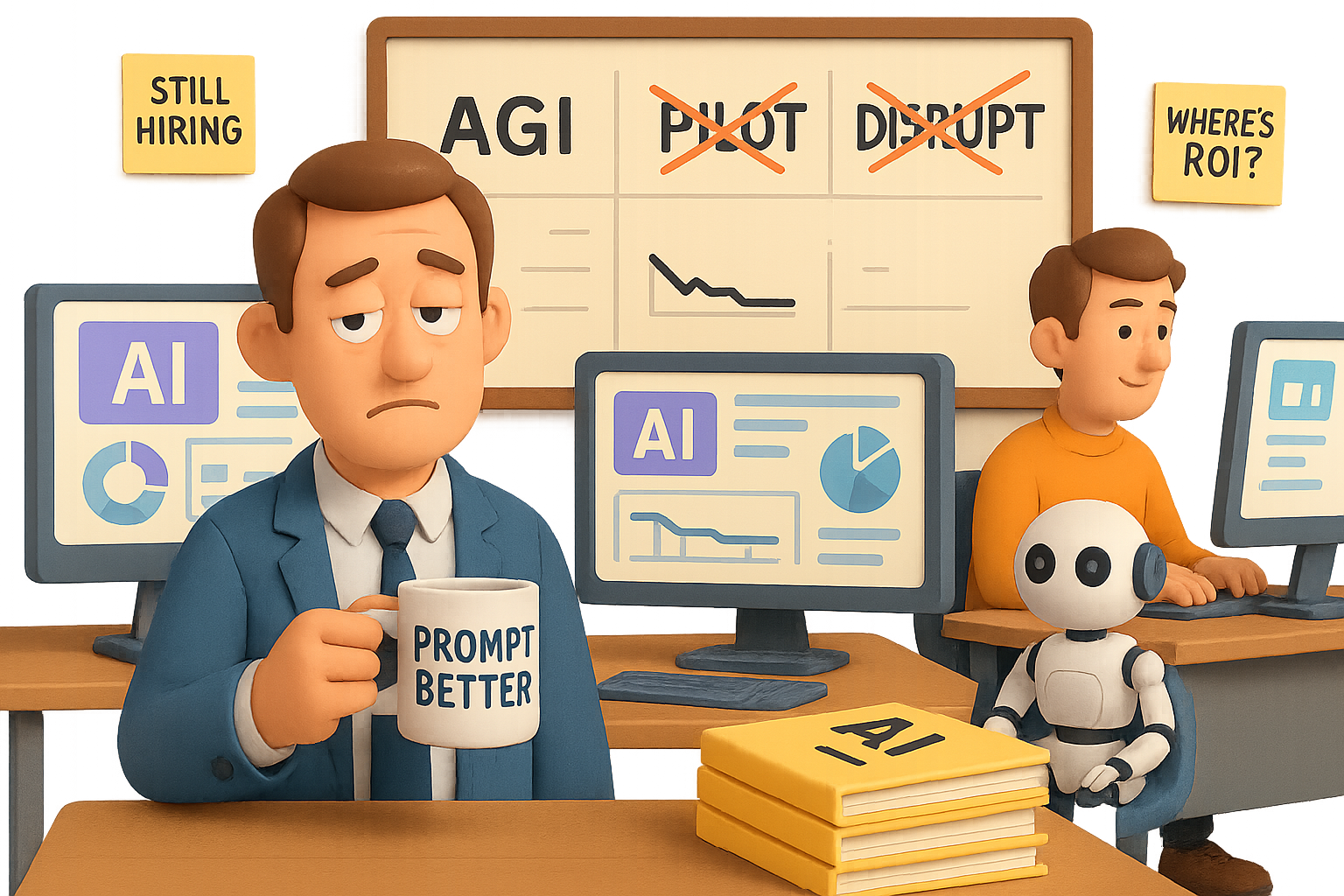
AI Didn’t Take Your Job. Fear Did.
Remember back in 2023 when it felt like AI might steal everyone’s job by lunch? Headlines screamed doom, execs made bold calls, and you may have wondered if your résumé belonged on a hard drive or in a museum.
Fast-forward to 2026. GenAI is here, but the reality? A lot less Terminator, a lot more tired middle manager asking if you’ve tried prompting ChatGPT better.
Let’s cut through the noise. Here’s a no-BS look at what really happened, where AI actually made a dent, and how you can keep yourself not just employed—but indispensable.

First Came the Bold Claims
You weren’t imagining it. The top players bet big—and loud—on AI reshaping work fast:
- Meta boasted that AI engineers would write most of the app code by 2025.
- Sam Altman (OpenAI): “We know how to build AGI”—not someday, but this year.
- A think tank of safety researchers predicted personal AI assistants by 2025, full coding automation by 2027, and possible human extinction by 2030.
- Dario Amodei (Anthropic) forecasted that AI might wipe out half of all entry-level white-collar jobs.
Spoiler: none of this came from anonymous forum users. These were leaders inside the AI labs. So how did it go?
The Numbers Called Their Bluff
Turns out, reality had a different script.
- In 2025, U.S. companies laid off 1.17 million workers—the most since COVID. Only ~55,000 layoffs (under 5%) were attributed to AI, according to Challenger, Gray & Christmas.
- Klarna bragged that one customer-service bot replaced 700 agents. Soon after, it started re-hiring humans—customer satisfaction had cratered.
- Salesforce hyped up AI “doing 30–50% of the work.” What actually happened? A few role reshuffles. No robot uprising.
- MIT’s 2025 study found that 95% of AI initiatives had “little to no measurable impact.”
- Deloitte’s executive survey? Sure, 60% of companies tried AI agents. But only 10% saw a big ROI.
So why didn’t the apocalypse arrive? Because AI implementation is messy, business politics are stickier than code, and pilots rarely scale without people steering the ship.

Enter: AI-Washing
You’ve been marketed to. A lot.
When companies over-hired during the 2020–2022 boom and reality hit, “Oops, our bad planning” didn’t land well with investors.
But saying “We’re pivoting to an AI-first strategy”? That hits the vision quota.
AI-washing means crediting AI for anything and everything—from innovation to layoffs—even when it’s just a smokescreen. Here’s how it plays out:
- Hiring freezes
- Quiet attrition (jobs just… disappear)
- Offshoring under the AI banner
Analyst firm Forrester expects half of AI-related layoffs to be replaced by cheaper labor abroad. So who’s really being replaced?
Why You Might Still Feel Stuck
Here’s the catch: jobs aren’t vanishing en masse, but entry points are.
Companies now require teams to prove why an AI couldn’t do the role before opening it up. Promotions stall. Job descriptions balloon.
The New York Fed reports:
- 5.8% unemployment for new grads (age 22–27)
- 41.8% working jobs that don’t require a degree
That’s not just frustrating—it’s dangerous. A talent pipeline without juniors eventually runs dry. Innovation slows, mentorship dries up, institutional memory fades.

Inside the AI FOMO Loop
C-suite logic lately has gone something like this:
- CEOs warn: AI will change everything.
- Boards greenlight sky-high AI budgets—can’t afford to be left behind.
- First projects flop or get stuck in “pilot purgatory.”
- Leadership doubles down: we need more AI.
It’s a hype hamster wheel. And because no one likes admitting they bought into over-promises, AI becomes the catch-all excuse for both disruption and dysfunction.

Okay, So What Can You Actually Do?
The good news: there’s no robot overlord. The better news—there’s plenty you can do to stay professionally future-proof.
Here’s your playbook:
- Use the damn tools
Get hands-on with ChatGPT, Copilot, Midjourney—whatever fits your role. Even if they don’t replace you, they can extend you. Think of them as interns that never sleep. - Learn the domain, not just the tech
LLMs can summarize a supply chain. They can’t run one without real-world context. That deep understanding? Still your edge. - Talk better
Prompting is communication. Communication drives teams. Want influence? Become the person who translates between messy business goals and clean execution. - Document like a teacher, think like a mentor
As junior hire pipelines dry up, the folks who can teach and share scale themselves and their value. - Build income buffers
Side hustle. Contract gig. Startup equity. Even a few add-ons reduce your reliance on a single org’s mood swings.

Your Real Competition? A Better-Adapted You
AI didn’t take your job—buy-side FOMO and some creative storytelling almost did. The real risk isn’t automation—it’s stagnation.
Here’s the mindset shift:
AI won’t replace you. But someone good at using AI might.
So get good.
You don’t need to pivot into prompt engineering overnight. Instead, layer AI fluency on top of your existing skills, keep learning, and stay loud with your value.
Need help getting started with AI?
Try Tixu—a beginner-friendly, no-jargon platform to help you build hands-on AI skills without drowning in theory.
Ready when you are.

Leave a Reply