
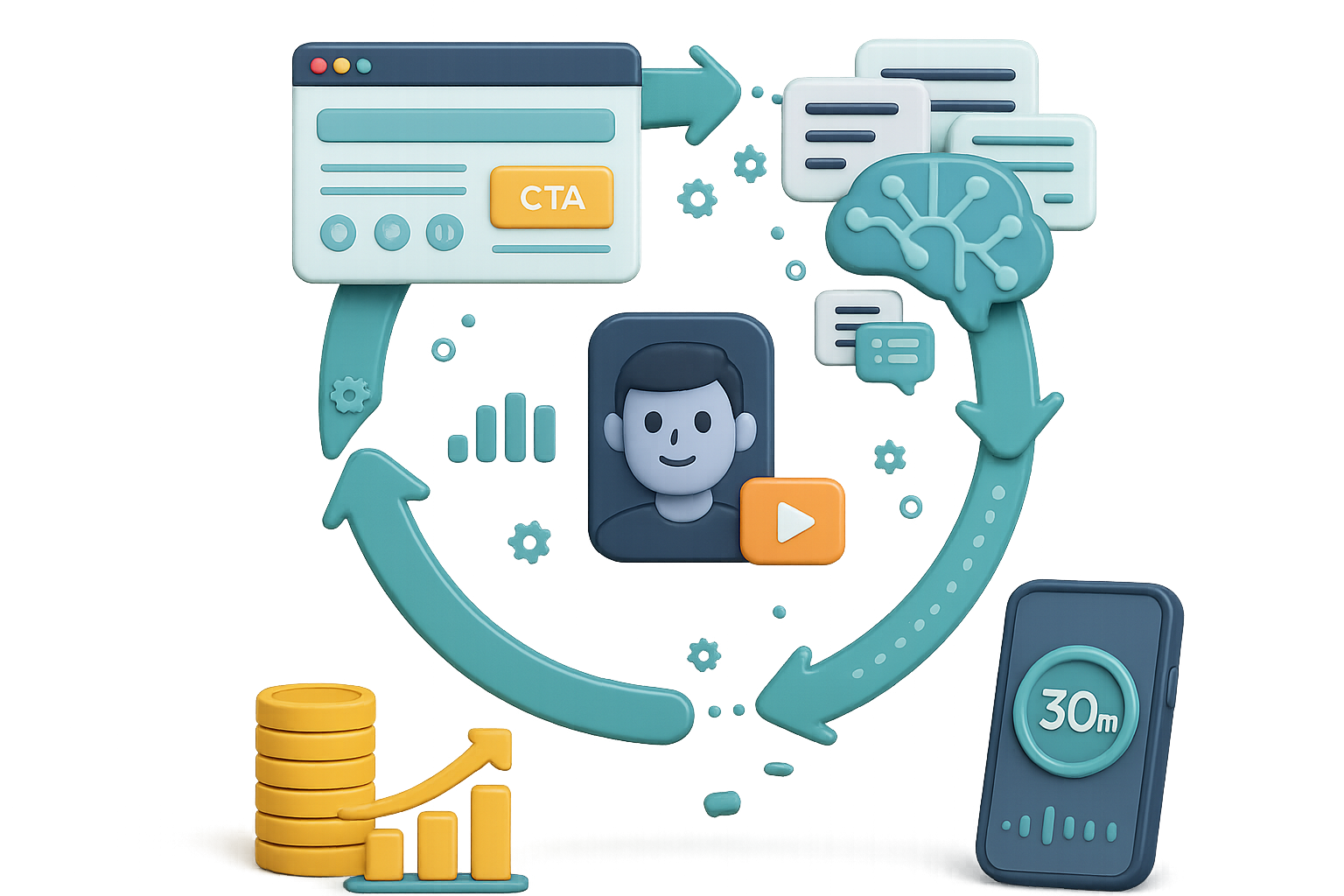
Stop Hustling, Start Scaling: The Three-System Blueprint for a 30-Minute Workday
Why does “automation” still feel like a full-time job? You have subscriptions, dashboards, and posting schedules—but revenue flatlines when you step away. That’s not you failing. It’s the architecture. Fix the architecture and a seven-figure business becomes a machine you check for 30 minutes a day. This post hands you a tight, three-system blueprint: website that sells, your personal AI copywriter, and an AI video clone. Follow the roadmap and you trade chaos for a compounding flywheel.

The Three Fatal Gaps Killing Your Time
- No foundation: pretty site, zero conversions.
- Disconnected tools: chatbot, CRM, email—on islands.
- No traffic engine: dependent on algorithm luck, not compounding reach.
Fix these gaps and you get a self-sustaining flywheel.

Build a website that sells (so you can run a 30-minute workday)
Your site must be a 24/7 salesperson. Treat it like revenue, not brochure art.
- Identify your money pages
- Home, core product/service, pricing, high-intent landing pages.
- Use analytics to find the pages that actually make money.
- Optimize ruthlessly
- Value prop above the fold.
- Social proof where people decide.
- CTAs that match intent: “Book a 15‑min strategy call,” not “Contact us.”
- Fast, mobile-first load. Every second counts.
- Add an AEO blog engine
- AEO = Answer Engine Optimization. Write to surface in ChatGPT, Perplexity, and Google’s AI overviews.
- Use WordPress or Webflow and automate posting.
- Train a small GPT workspace on your brand voice so articles publish with minimal oversight.
- Install an AI chatbot
- Tools like Intercom or ChatBot.com ingest FAQs and CRM data.
- The bot qualifies leads and books calls at 2 a.m.
Outcome: you own traffic, capture leads instantly, and watch authority compound. Quick stat: sites optimized this way typically cut lead friction by 30–60%.

Make an AI copywriter that replaces grunt work (but keeps your voice)
This isn’t “write me a post.” It’s building a content brain that outputs consistent, on-brand copy.
- Curate training data
- Collect best emails, top-performing posts, video transcripts, and your origin story.
- Build the brain
- Create a project in Claude.ai or a custom GPT; feed it voice, tone, and persona rules.
- Keep instructions tight. The model should know when to be short, funny, or formal.
- Create battle-tested templates
- Email sequences, carousel posts, YouTube scripts, long-form articles—each template maps to a conversion goal.
- Delegate production
- A trained writer at US $10–30/hr (OnlineJobs.ph or Upwork) can run content 5–7 hours/week.
- Result: every channel stays active without you typing a line.

Make an AI video clone (so you never set foot on camera)
YouTube drives discovery. Video builds trust faster than text. But you don’t need to be on camera.
- Clone creation
- HeyGen for a talking-head avatar (creator plan ≈ US $29/mo).
- ElevenLabs for a lifelike voice (creator plan ≈ US $22/mo).
- ChatGPT or Claude for scripts. Tooling total ≈ US $71/mo.
- Production workflow
- Batch topics. Feed outlines to your AI copywriter for 3–5 minute scripts. Render in HeyGen and export.
- Hire one rockstar editor
- Pay ≈ US $1,500/mo. They polish long-form video, create shorts, repurpose transcripts into blogs, and schedule publishing.
- Publish for compounding reach
- Start with 3 videos/week (12–15 per month). Optimize titles, thumbnails, and descriptions for search intent.
- Link viewers to your money pages from System 1.
Reality check: traditional studio setups can cost US $9–14k/month plus 60–90 hours of your time. The clone method cuts costs about 50–60% and saves on-camera hours.

The compounding flywheel (how the three systems work together)
- AI clone videos drive YouTube traffic.
- Visitors land on optimized money pages.
- AI chatbot answers questions and books calls.
- AEO blog articles and email nurtures (from your AI copywriter) build trust.
- Conversions fund more content, which restarts the loop.
Each asset compounds. You invest once, and authority stacks instead of resetting daily.
Quick wins you can do this week
- Audit: check your top 5 pages—do they convert?
- Tool tidy-up: list all logins and map data flow between tools.
- Content seed: pick 10 topics for AEO posts and 12 video ideas matching buyer intent.

Do this next
- Run a two-hour site conversion audit. Fix one CTA and one load issue.
- Create a “voice folder” with five winning messages for your AI copywriter.
- Outline three short video scripts and choose one to render with HeyGen.
- Hire an editor for a 30-day trial to repurpose those assets.

DIY or done-for-you? Both win
- DIY if you like learning. Expect a 6–12 month ramp and lots of testing.
- Hire specialists if you want speed: 6–8 weeks to install site, chatbot, AI writer, clone, and workflows. You approve, they build, you monitor.
Build the three systems in sequence: site, copy brain, video clone. Then let the flywheel run.
Ready when you are. If you want a beginner-friendly place to learn the AI fundamentals and start building these systems, check out tixu.ai — practical AI courses for makers and teams.

Leave a Reply