
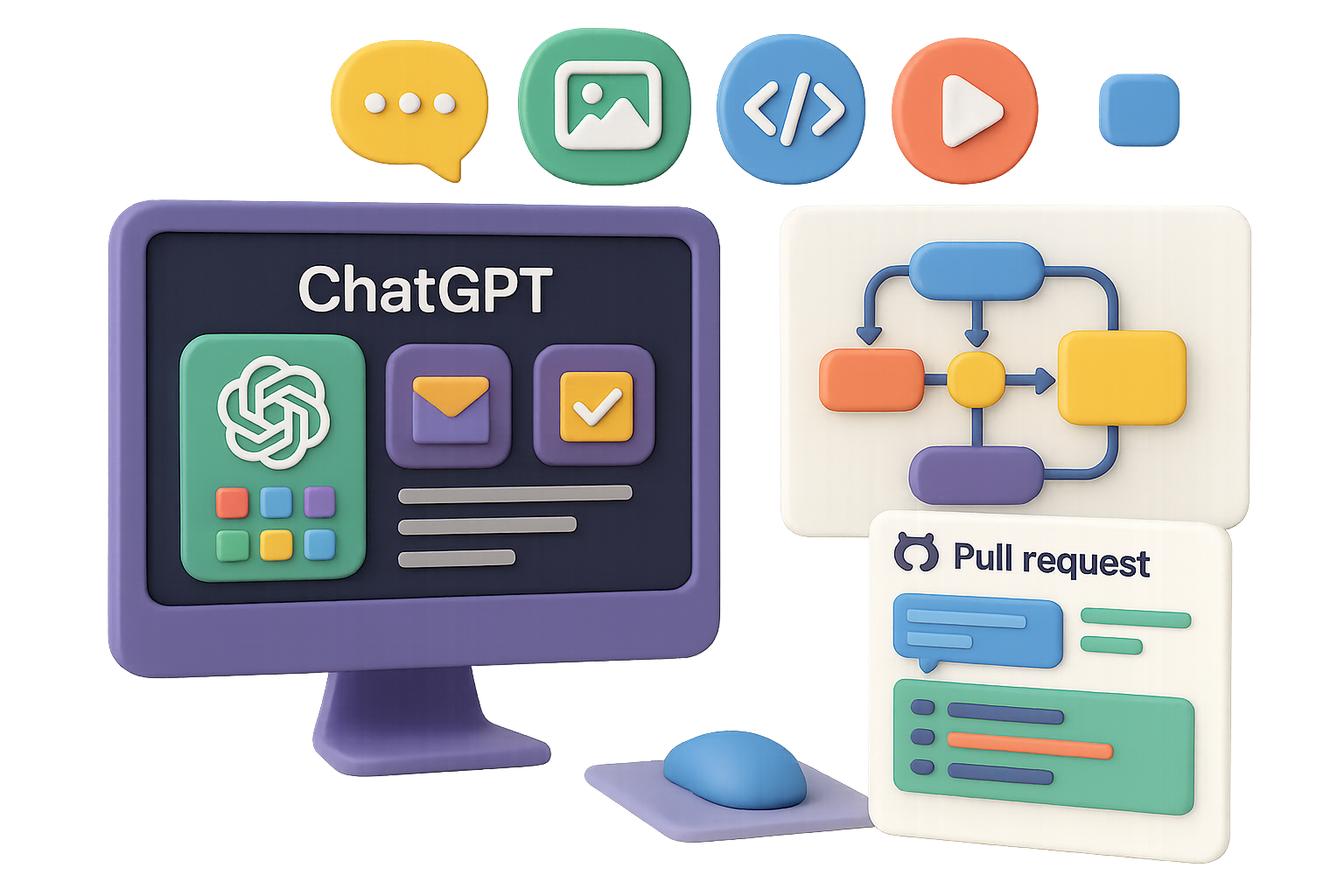
OpenAI Dev Day Recap: What Matters, What’s Hype, and What to Build Next
You didn’t just miss another launch event. OpenAI Dev Day dropped updates that could rewire your entire dev stack. New tools. Cheaper APIs. App interfaces buried straight in ChatGPT. It’s not just “cool AI stuff” anymore—it’s a roadmap to building smarter, faster… and skipping the glue-code grind.
This post walks you through what’s real, what’s rough, and where you might leap ahead if you move early.
Let’s dive in.

ChatGPT Becomes an App Platform (No, Really)
If you’ve ever dreamed of ditching login screens and menus entirely, your moment’s here.
Apps now live inside ChatGPT. That means users can trigger your product just by typing. No downloads. No redirects.
Imagine someone saying:
“Book a room in Miami under $200/night” → your travel app kicks in.
“Order my usual pizza” → it’s en route.
The math gets interesting fast:
- 800M weekly ChatGPT users
- One native interface
- Zero learning curve
Yep. That’s serious distribution power.
A quick reality check: If your product depends on a rich visual UI—design tools, dashboards, immersive games—this probably isn’t your lane. But data-heavy or action-triggering apps? You’ve found new real estate.

Faster, Cheaper, Smarter APIs (Translate: More Experiments)
OpenAI quietly slid four model upgrades across the table:
- GPT-5 Pro (flagship language model) – Not the official name, but it’s what everyone’s calling it.
- Sora 2 (text-to-video) – Crisp, realistic outputs. Still pricey. Still experimental.
- Budget audio + image models – Stripped-down and sweet for high-volume, low-cost tasks.
Key stat: Top-tier video still costs big, but basic visual/audio tasks? Easily 50–70% cheaper now.
For devs and indie hackers, that means fewer “Oops, blew the budget” moments—and way more room to test weird, wonderful stuff without breaking the bank.

GitHub Codex Action: Senior Dev Eyes, 24/7
Chasing teammates for code reviews = yesterday’s problem.
Codex now reviews every PR the second you open it.
It flags:
- Code smells
- Security gaps
- Missing docs
Whether you’re flying solo or leading a junior-heavy team, this is pure leverage.
Imagine pushing clean, production-ready code every day—without waiting for Larry to return from PTO.

AgentKit: No-Code Workflows That Actually Scale (Sorta)
Here’s the pitch: Drop blocks on a canvas.
Link them up like digital Lego.
Trigger an entire AI agent with one tap.
AgentKit gives you a visual builder for smart flows:
- Hit an API
- Parse an email
- Schedule a Slack update
And yes, you can export it for custom dev once you outgrow the blocks.
Flip side: No-code tools often hit a ceiling. Complexity still needs code. But if you’re prototyping fast—or looped into a non-dev team—this is a rocket booster.

Juni from JetBrains: The AI That Sees the Whole Forest
VS Code gets the headlines, but JetBrains just pulled a pretty slick move.
Meet Juni, the newest AI assistant built directly into IntelliJ-based IDEs. This isn’t just a “fix this line” helper—it’s context-rich, async-task-savvy, and deeply wired into your GitHub flow.
Top perks:
- Understands your entire codebase, not just the open tab
- Handles multiple jobs in parallel (ask it to draft tests, refactor, and update docs at once)
- Auto-syncs with pull requests, comments, and task lists
Beta testers say it’s slightly slower than Copilot, but if you work in giant enterprise repos, the added accuracy stacks up fast.

Signals to Watch Next
The shiny stuff’s exciting, but here’s where the long-term value shakes out:
- Do people really want “apps via chat”?
If user behavior shifts, the new app store is ChatGPT. If not? It’s a fun sidebar.
- When does AI video get cheap enough to use daily?
Crossing the $10/minute threshold unlocks content teams, marketers, and makers of all stripes. Sora 2’s watching that line.
- Can AgentKit build an ecosystem?
Zapier didn’t win by being drag-and-drop—it won by connecting everything. Plugins, templates, and open-source extensions will make or break this.
- The IDE AI war is on.
Copilot, Juni, and a few dark horses are racing to be the default sidekick. Expect rapid leaps in capability.

The Bottom Line
OpenAI’s latest drops aren’t wild stunts—they’re deep infrastructure plays.
- Developers get faster feedback loops.
- Teams cut costs without cutting corners.
- Everyday folks get closer to building AI-powered apps—no PhD required.
Will the ChatGPT-as-platform vision stick? Maybe. But the tooling already clears a lot of friction. And friction-free = more shipped features, more finished projects, more signal in the noise.
So yeah, things just got interesting.
Want to start building with AI, minus the jargon headache?
Check out Tixu.ai — it’s a beginner-friendly learning platform focused on helping you go from “just curious” to launching real AI projects. No fluff, no gatekeeping—just hands-on lessons built to grow with you.

Leave a Reply