
Ditch the Guesswork: Build a Smart Portfolio with AI (No Coding Required)
Impulse trades are fun—until they aren’t. Scrolling through Robinhood, chasing gains, and then realizing your rent, vacation, or kid’s future is riding on vibes alone? Yeah… not ideal.
Let’s flip the script.
Instead of gambling, you’re going to use AI—yes, even if you’ve never written a line of code—to build a portfolio backed by data, not dopamine. You’ll get a step-by-step breakdown, a peek at my real numbers, and a cheat sheet of 10 prompts to uncover your own edge.
Ready when you are.

Go From Hunch to Hypothesis in Under 60 Minutes
The idea that sparked it all: founder-led companies with network effects tend to crush the S&P 500.
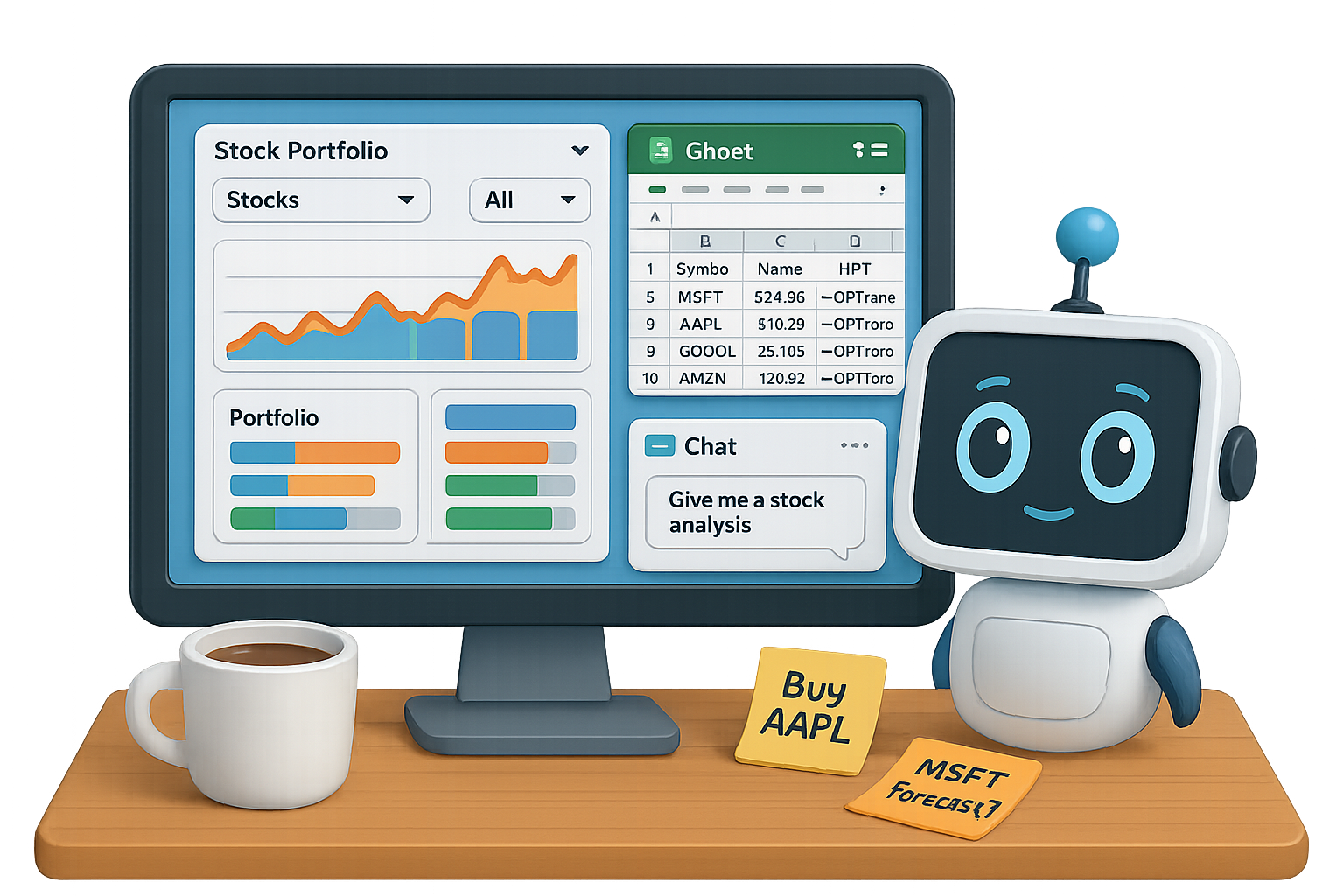
Armed with that thesis and a few AI sidekicks, I built a live portfolio tracker—complete with filterable metrics, crisp charts, and zero-code setup. Here’s how it came together.

Build the Data Engine First
These are your ingredients. You’ll use AI to pull company data, Sheets to structure it, and a sprinkle of automation to fill in the gaps.
1. Ask ChatGPT (or any LLM):
“Which S&P 500 companies are founder-led and benefit from strong network effects?”
Result: 26 tickers.
2. Fire up Google Sheets:
- Company name
- Ticker
- IPO date
- IPO price
- Today’s price (use =GOOGLEFINANCE())
- Market Cap
- P/E ratio
- Year Founded
- Date added to S&P
- Two ratings scored from 1–10: Founder Influence and Network Effects
3. Automate the scoring with GPT for Sheets:
Install the GPT Sheets plug-in and use prompts like: =GPT(“On a scale of 1–10, how strong are the network effects for ”&A2&“?”)
One drag down the column = instant ratings, all for a few cents per row.

Turn Your Sheet into a Real App (No-Code Style)
Now that your data’s clean, it’s time to make it sing.
Replit’s AI Agent v0.3 helped me spin up a full portfolio dashboard—charts, filters, S&P comparison—all in about 45 minutes of back-and-forth.
Here’s what the flow looked like:
1. Set the scene:
Prompt: “Build a portfolio tracker that lets me upload trades via CSV and shows my performance across 1-day to 20-year timeframes in a line chart.”
2. Feed your own data:
Shared a public Google Sheet link and explained the column structure. Told the AI to ditch dummy CSVs and run off my live data.
3. Clean it up:
- Added dropdown filters for founder scores, P/E ratios, market cap ranges
- Displayed numbers beautifully (commas, %, one decimal max)
- Confirmed all math behind line charts matched expectations
After an hour, I had a working app: nStocks.com —and you can test it live.

What the Numbers Show (Spoiler: It Works)
Filtering for companies with ≥8 scores in both Founder Influence and Network Effects, and tracking them over the last 10 years:
- 6 companies made the cut
- 5 had full IPO data
- S&P 500 return (weighted): 9%
- S&P 500 return (unweighted): 12%
- Thesis-based portfolio return: 22.4%
Visualized? That high-trust green line glides miles above the red S&P benchmark.

Steal These 10 AI Prompts for Your Own Thesis
No need to start from scratch. Grab any of these to explore unique slices of the market:
- “List U.S. micro-cap stocks with strong moats, ROIC > 15%, under-covered by Wall Street.”
- “Companies where insiders bought ≥ $1M of shares AND stock is down 20%+ from 52-week highs.”
- “Stocks with free cash flow yield > X% and P/E below their sector median.”
- “Which industries have structural growth tailwinds the market undervalues?”
- “Compare disruptors vs. incumbents—balance sheets, cash, and trends.”
- “Stocks with short interest >10% and rising gross margins for 3+ quarters.”
- “High-recurring-revenue businesses with low EV/S multiples and sticky customers.”
- “Under-the-radar stocks about to hit a growth inflection point.”
- “Public companies trading below their breakup or private-market value.”
- “‘Boring’ sectors protected by scale or regulation that repel new entrants.”
Drop them into ChatGPT, narrow your dataset, and let your thesis unfold.

Wrap-Up: From Reddit YOLOs to Real Strategy
You just saw how modern tools can turn ideas into interactive dashboards without writing code or hiring devs.
The rough recipe:
- Start with a plausible thesis
- Collect + structure the data with LLMs and Sheets
- Pass it to an AI dev agent to build your visual tool
- Test, tweak, and track your actual results
No “finance bro” vibes here—just modern workflows replacing gut feelings with frameworks.
Curious to learn more about how to use AI like this (without the jargon or overwhelm)? Explore beginner-friendly how-to’s, curated prompts, and bootcamp-style projects over at Tixu.ai. It’s like gym class for your AI muscle—and yes, you’re already strong enough to start.

Leave a Reply