
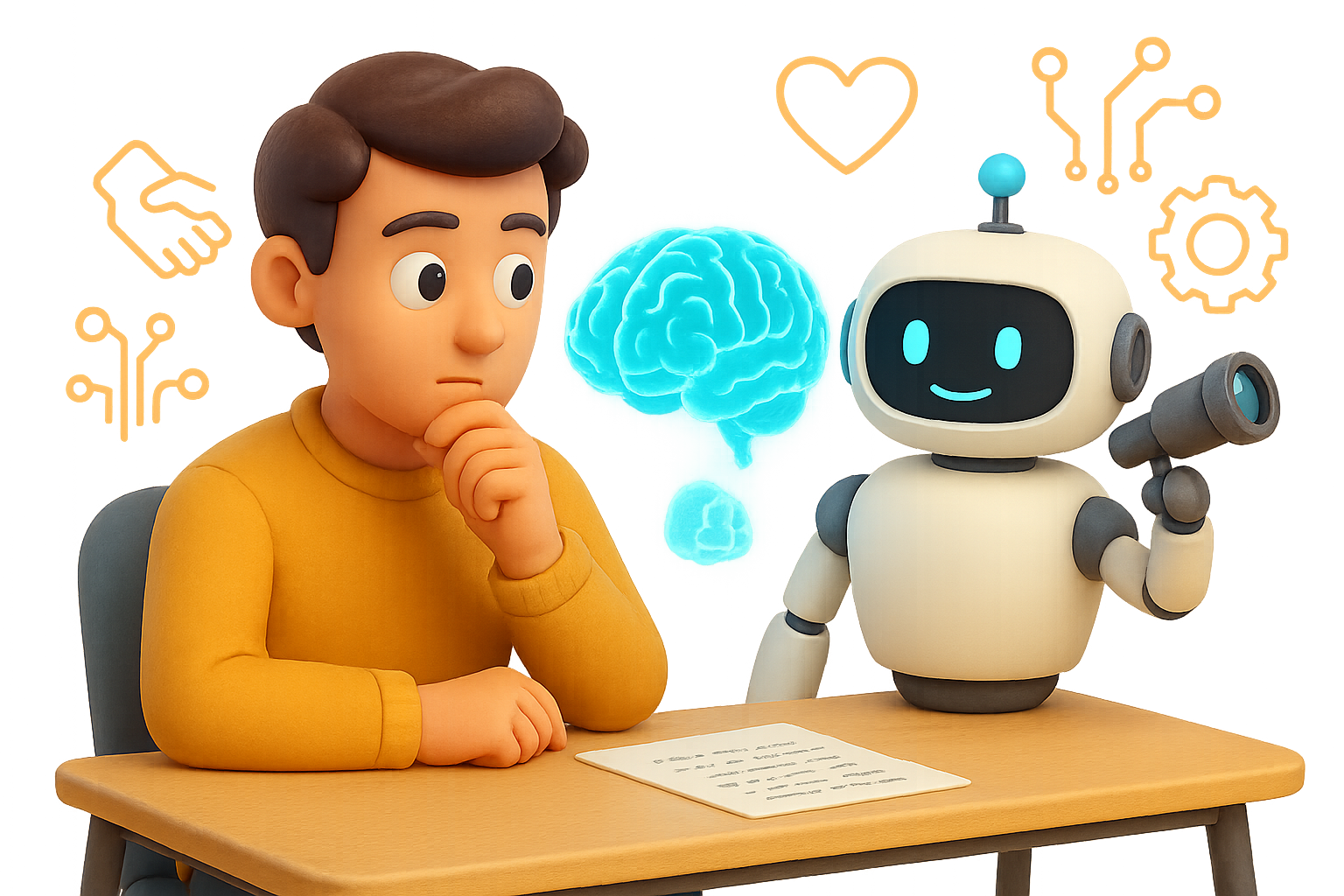
AI Can Out-Create You. It Can’t Out-Care You.
Poetry? Solved. Math Olympiad logic? Child’s play. AI tools today can churn out surprisingly strong content—and frankly, it’s a bit unsettling. If an algorithm can pass your classes and get your job interview, what’s left?
Plenty. The kicker? Your biggest edge isn’t creativity. It’s caring—deeply, deliberately, and with purpose.
In this post, you’ll get a sharper take on how to stay relevant as AI levels up, why authentic communication still rules, and how to build a skill set that helps others, not just your resume. Let’s flip the script.

Use AI Like a Telescope—Not a Crutch
A large language model, like ChatGPT or Claude, is a linguistic beast. It’s read a trillion words written by real humans. It can finish your sentences, write your essays, even mimic your tone.
But here’s the thing: it doesn’t care about truth or meaning. This isn’t a knock—it just wasn’t built to. You, on the other hand, have skin in the game. You live with the consequences of your choices. That makes your perspective irreplaceable.
Ready when you are.

Why You Still Need to Write Your Own Essays
Yeah, it’s tempting. Paste a prompt, get a shiny essay in 10 seconds. Feels like progress. But it’s cheating—yourself.
Using AI for your homework is like taking a cab to run laps:
- No intellectual cardio – your reasoning muscles waste away.
- No bias detection – you internalize any error or assumption it makes.
- No communication reps – your teamwork and leadership chops stagnate.
Turns out reading, writing, and arguing aren’t school busywork—they’re your prefrontal gym. Every essay you write, every idea you untangle, wires your brain for the next challenge IRL. Skip these reps now, and you’ll stumble when it counts.

Stack This Skill Set If You Want to Stay Valuable
Want long-term leverage in an AI world? Then it’s time to layer human-first skills over your language prowess.
Here’s the stack that sticks:
- Empathy – spot what others actually feel, not just what they say.
- Motivation to serve – orient toward actions that lift others.
- Cross-domain thinking – connect insights across unrelated industries.
- Ego-free iteration – test, scrap, and rebuild fast.
In short: build like a human, think like a scientist, collaborate like you mean it. That blend attracts the kind of teams—and opportunities—you actually want.
Want to Get Smart Fast? Push “World Simulation”
High-leverage thinkers run mental what-ifs like a game of speed chess.
“If we launch feature X, how will users respond?”
“What might break at 100x demand?”
“Who’s winning, who’s losing, and why?”
Example: Say you hear a street performer in Nashville who gives you goosebumps. You’re curious—how would they make it onto Broadway?
Don’t just daydream. Fire up your favorite AI model and prompt for:
- Venue booking data
- Audition requirements
- Common setlists
- Pay insights from performers
Cross-check sources, poke holes, connect dots. Suddenly, you’re not guessing—you’re building a real mental map. That’s simulation in action.
Stop Trying to Win. Start Trying to Serve.
Look, we get it. You grew up chasing grades, awards, and being “the best.” But check the fine print—pure competition has a glass ceiling. It often leads to burnout instead of breakthroughs.
Here’s a pivot: focus on how many people you help.
- Five happy users turn into 500.
- That classroom impact spreads school-wide.
- One intern mentored might build the next billion-dollar platform.
Being mission-driven isn’t soft; it’s scalable.
A Real-Life Blueprint: Scalable Wisdom + Empathy
One online education program hacked the bottleneck of critical-thinking education—and it worked like a charm.
How?
- Teen mentors (15–18) coached younger students (10–13) live.
- Actors and comedians trained the teens during sessions—boosting clarity, energy, and trust.
The result?
- Middle schoolers got magnetic lessons.
- Teens leveled up as teachers, learners, and humans.
- Artists got paid gigs that matter.
And guess what? This co-mentoring system now produces some of the most thoughtful problem-solvers in the pipeline. AI tools help them scale. But the magic? That’s still human.
The Two-Step Habit of Smart Builders
Want better ideas? Try this quick-fire mental loop every day:
- Idea Flood – blast out 10+ funky ways to solve a task, the wilder the better.
- Idea Stress Test – then, channel your inner skeptic: What’s wrong with it? Cost? Culture? Risk?
Most ideas? Gone in 60 seconds.
But the gem that survives? That one’s got teeth.

Bias Is Built-In—So Actively Rotate
Every AI model has baked-in perspective. So here’s your move: don’t trust, triangulate.
- Ask the same question to ChatGPT, Claude, and Gemini.
- Place their answers side-by-side—where do they agree? Where do they clash?
- Read why. Not just what.
True critical thinking isn’t about being right—it’s about asking better.

You Can’t Automate Humanity
Here’s your playbook:
- Write more. It’s brain training for life’s hard problems.
- Use AI as your telescope—not your steering wheel.
- Serve first; success will follow.
- Seek smart, curious allies. Build stuff with heart.
- Iterate fast. Kill your darlings. Let winners rise.
Do that, and AI won’t replace you—it’ll amplify you.
Looking for a launchpad to sharpen those skills? Tixu has your back. The platform makes learning AI beginner-friendly, human-first, and dare we say—kind of fun.

Leave a Reply