
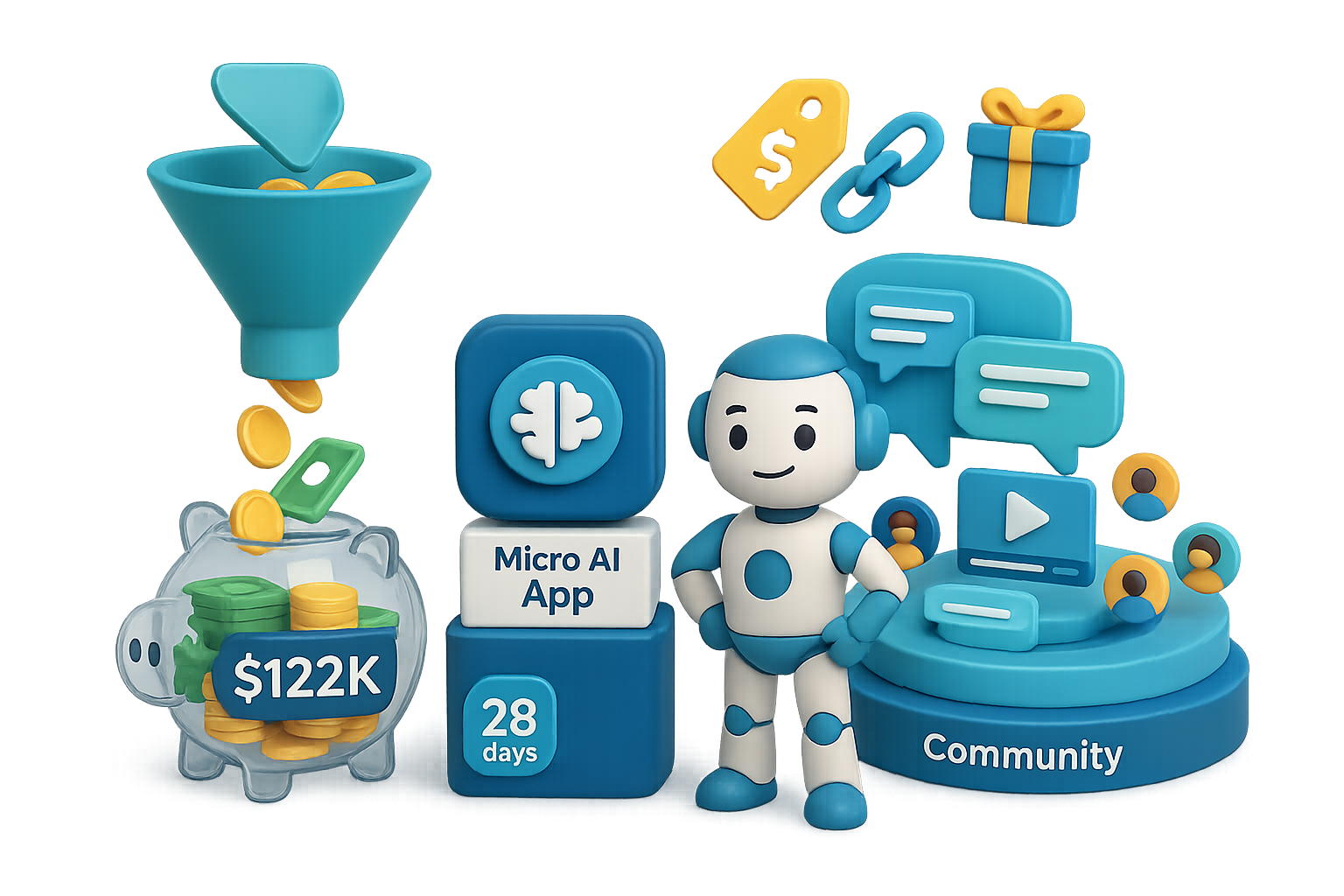
Why a Tiny AI App Beats a Giant SaaS Every Time
You feel buried by big SaaS roadmaps. Too many features. Too much waiting. Meanwhile, a one-function tool quietly earns real cash. Build small. Ship fast. Repeat.

Find the loud pain
- Open Google Trends, Exploding Topics, TikTok Discover, X and Reddit. Scan for spikes.
- Spot a big wave (example: “AI video”).
- Carve a sub-niche where demand is loud and competition is quiet (example: “ultra-realistic AI influencers”).
- Talk to people. DM, read comments, join Discords. Find the one friction that keeps coming up.
People don’t buy tools. They buy a solved problem. Nail the pain and the product idea writes itself.

Ship one single-purpose AI utility
Keep the scope tiny. Solve one clear problem.
How to build fast:
- Draft the tool spec in ChatGPT. Example prompt: “Generate a Base44 prompt that outputs Midjourney-ready text for hyper-realistic avatars. Inputs: age, gender, hair, eye color, camera model, color grading. Output: final prompt + usage tips.”
- Paste the prompt into Base44 (a zero-code AI app builder that handles hosting, auth, and database).
- Tweak labels, colors and copy. Hit Publish.
Total build time: under an hour. No engineers needed. No excuses.

Don’t let your URL die of loneliness — build the Alpha System
A lone app doesn’t sell itself. The Alpha System bundles your tool with community, training and upsells. That’s where perceived value lives.
Inside a typical Alpha System:
- A chat feed where users post wins and questions. That social proof fuels growth.
- Short video tutorials that remove the learning curve. Use HeyGen or Synthesia if you don’t want to be on camera. (Those tools make talking-head videos from text.)
- The utility app, embedded or linked with one click.
- Optional extras: swipe files, checklists, weekly live calls.
Platforms like Skool or Wop.com make this drag-and-drop simple. Wop.com gets roughly 15 million visitors a month, many already hunting for solutions—so you get discoverability without paid ads.

Three monetisation levers that actually scale
- Front-end subscription ($9–$49/month). Charge for the hub plus the tool. People tolerate a small monthly fee for a helpful community.
- In-app affiliate links. Integrate products users already need and earn commissions. The avatar tool links to HeyGen for video creation and earns a cut on signups.
- Upsells and workshops. Offer deep training, templates or consults. These lift average order value without building new product features.
Why this combo works: subscriptions give predictable MRR, affiliates monetize usage, and upsells capture high-intent buyers.

Traffic without paid ads (first 30–90 days)
- List your hub on community marketplaces (Skool, Wop.com). They funnel organic visitors.
- Turn in-hub wins into social posts—X threads, Reels, LinkedIn snippets.
- Use your AI avatar or an AI clone of yourself to present the offer 24/7 on a lightweight landing page in Base44.
This playbook gets you initial traction while you iterate on product-market fit.

Why the model snowballs
- Each micro-tool takes hours, not months. Build many, compound revenue.
- Every new tool lives inside the same paid hub, so your MRR scales faster than standalone apps.
- Affiliate income grows as usage grows. No proportional support load.
- Community conversations surface the next pain. You build what users actually ask for.

Action plan for this week
- Spend 30 minutes on Google Trends and pick a sub-niche.
- Collect complaints from comments and forums. Circle the loudest pain.
- Describe a one-function solution in ChatGPT and generate a Base44 prompt.
- Build and publish the MVP in Base44.
- Wrap it in a Skool or Wop.com community. Add chat and a 5-minute tutorial.
- Share the launch link across places you already hang out online.

Checklist — ship in one hour:
- Idea: one clear pain? ✓
- Prompt: ChatGPT -> Base44? ✓
- Landing page + hub entry? ✓
- First content or tutorial? ✓

Specific beats broad. Utility beats polish. Bundle beats standalone. Launch a tiny AI app, wrap it in community, and watch revenue stack.
Do this next: pick one pain and ship an MVP this week. Want a friendly crash course on building and monetising micro AI apps? Start with Tixu — a beginner-friendly AI learning platform that walks you through prompts, no-code builders, and community-first launches.
Ready when you are.

Leave a Reply