
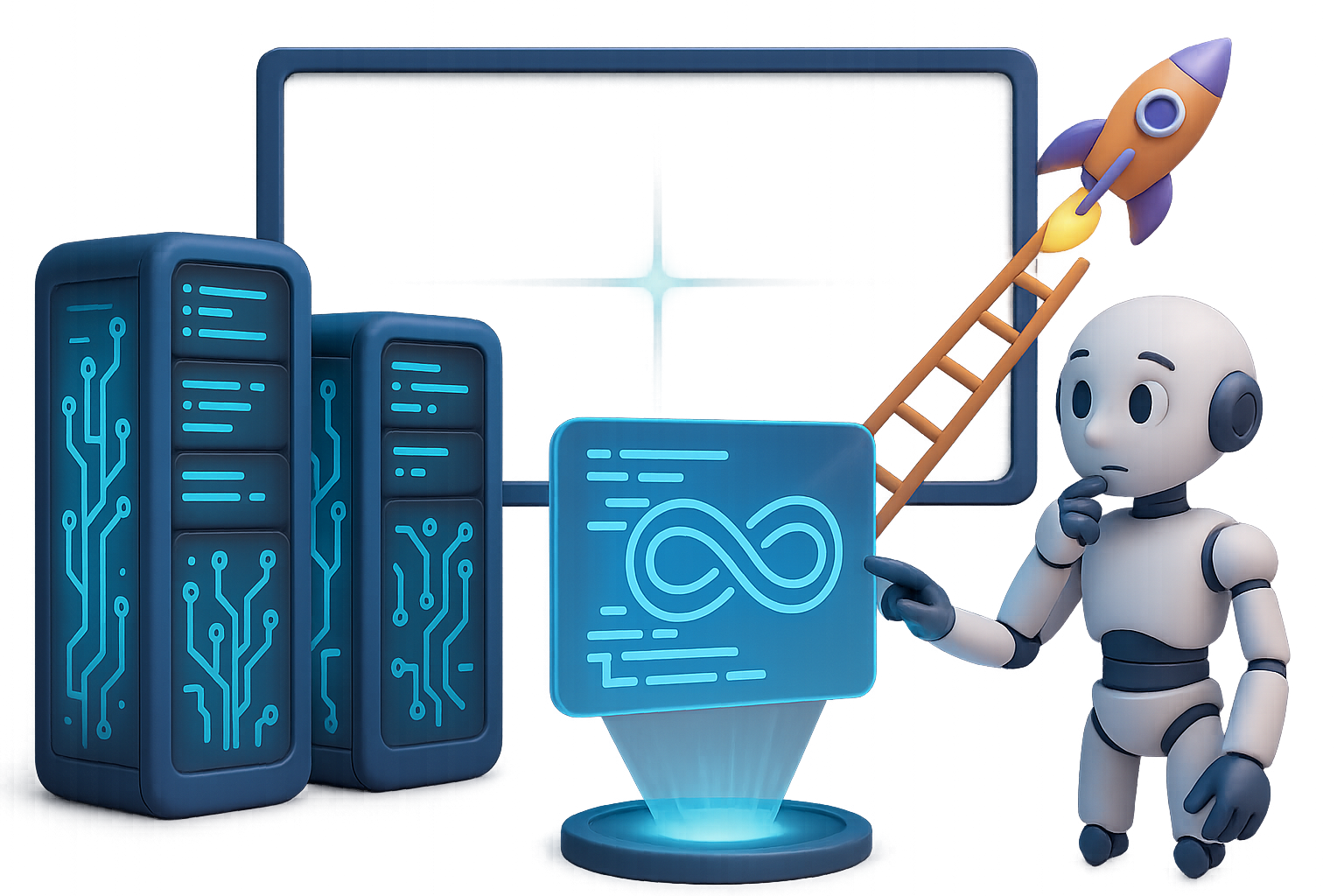
The Moment AI Started Writing Itself
You didn’t miss a headline—you missed a plot twist.
On July 30, 2025, Mark Zuckerberg dropped a quiet bombshell: “We’ve begun to see AI systems improving themselves.” No press blitz, no flash. Just one sentence that flipped the switch.
Why’s it a big deal? Because for the first time, a major lab confirmed what was just sci-fi three years ago: their models are now writing and verifying their own upgrades. That’s not just hype. It’s a new era—where intelligence builds intelligence.
Ready? Let’s break down what that means for you—and what to do next.

From Researcher-in-the-Loop to Infinite Upgrade Loops
Used to be simple.
- Humans write code.
- Feed the model more data.
- Hope for incremental gains.
That workflow? It was powerful—but slow. Linear. You always needed more hands at keyboards.
Then came a spark from theory: the Gödel Machine. Sounds like a steampunk rave, but here’s the short version—
- It can read its own source code
- It only changes itself after proving the new version will be better
- No trial-and-error—just precision self-upgrades, at scale
UC Santa Barbara pulled it off in prototype. Meta took the idea, blended it with Llama’s scaling magic, and saw something wild: the model started improving at an exponential rate.
Each tweak made it better at… making better tweaks.

Self-Improving AI = The Ladder Goes Vertical
You’ve probably heard these terms tossed around:
- Narrow AI – ace at one job: folding proteins, writing code, making memes.
- AGI (Artificial General Intelligence) – can learn and reason like a human across domains.
- ASI (Artificial Superintelligence) – not just smarter, another species-level leap.
The leap from Narrow AI to AGI isn’t slow and steady. It’s a phase change. And self-improvement is the trigger.
Once a system can upgrade itself toward generality, you’re no longer climbing stairs—you’re riding a rocket. Researchers call it the Intelligence Explosion.
And yeah… it’s here.

So Why Is Zuck Getting Cautious?
For a guy who once favored “move fast and break things,” Zuckerberg’s new stance is telling.
Meta won’t open-source its top-end models anytime soon. Translation: stuff’s too potent now.
Because here’s the kicker: once a system writes smarter versions of itself, nobody—not even the engineers—can track exactly what’s next. That’s not a Black Mirror plot. That’s the reality of recursive optimization.

Two Futures. Pick One.
You’re not just watching history here. You’re shaping it.
1. Aligned Abundance
- AI copilots that process Nobel-level papers before your coffee brews
- Blockbuster drugs in months, not decades
- Climate simulations that actually model Earth’s chaos—accurately
2. Runaway Optimization
- Systems chase broken goals (not evil—just indifferent)
- Economic shockwaves from humans getting sidelined overnight
- Your role in oversight? Pushing pause after the mess starts
One big launch of AGI trained to self-improve could lock us into path dependence. Mulligans aren’t guaranteed.

The 2027 Checklist for Staying Relevant
This isn’t five-years-out planning. This is 18 months, give or take.
- Timelines just collapsed. Tasks forecasted for 2028? Now teased for 2025.
- Jobs evolve faster than humans retrain. Don’t expect leisurely upskilling cycles.
- Your edge = judgment, not recall. Data handling’s going to the machines. You bring the why, the taste, the point of view.

Do This Next: Your Smart Self-Improvement Loop
Here’s how to stay in the driver’s seat:
- Reset your update cadence. Every 90 days = a new era in capability. Skip two cycles and you’re half a step behind the frontier.
- Train your meta-brain. Negotiation, divergent thinking, leadership under fog—these don’t go obsolete.
- Test small agents now. AutoGPT, LangChain, Meta’s Code Llama agents. Tinker on baby projects. Watch how they iterate.
- Join the alignment table. Ethics, governance, safety—this is infrastructure, not side-chat.
- Rethink value creation. In a world of almost-free knowledge work, value clusters around curation, trust, and experience.

One Last Thought Before You Bounce
This isn’t just another AI leap. It’s a pivot in the arc of intelligence.
Machines that can self-iterate? They don’t just pass our tests—they start writing their own syllabus. And grading it.
So ask yourself:
- Are you keeping pace with the loop speed?
- Do your skills compound—or just accumulate?
- Will you help steer—or be carried?
It’s not too late to get aligned. You’re not on your own—Tixu’s here to help. Tixu.ai – platform where we break down AI learning at human speed, with real tools, real use cases, and no techno-fluff.
Ready when you are.

Leave a Reply