
8 AI Trends That Will Define 2026
You’ve probably noticed: the AI world doesn’t pause for breath. By the time you wrap your head around today’s breakthrough, tomorrow’s already knocking. Looking ahead to 2026, there are eight game-changing trends you’ll want on your radar—because they’re not just reshaping tech, they’re redefining what human+machine collaboration looks like in real-time.
Here’s what’s coming (and why it matters for the fast-moving, tools-deploying, decision-making pro that you are).

Automate Smarter with Multi-Agent Orchestration
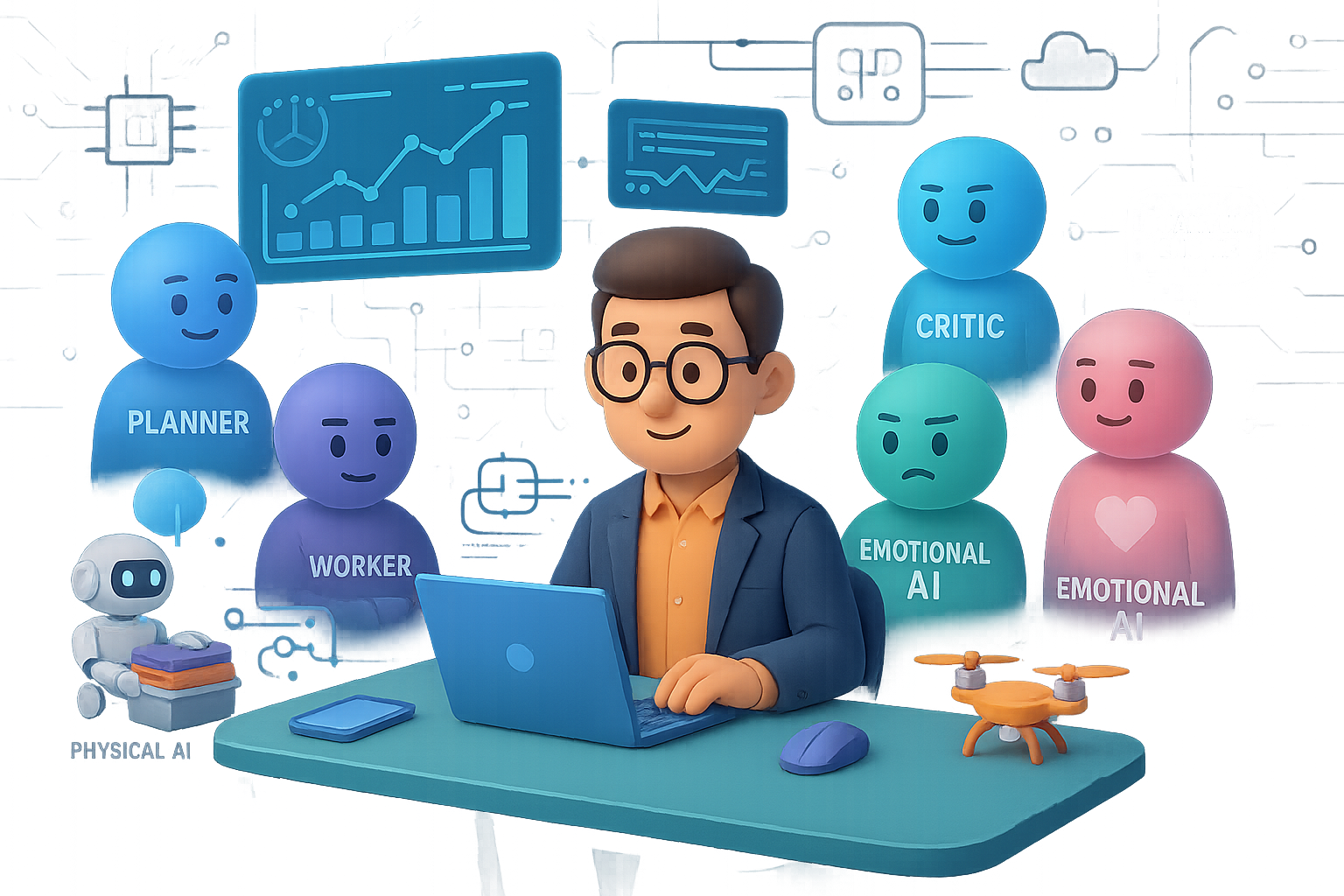
Forget the solo “super-agent” of 2025. In 2026, you’ll be working with squads of AI specialists—each with a defined role, all reporting to one orchestrator layer.
- A planner agent breaks your big idea into tiny executable steps.
- Worker agents do the grunt work—code, research, analyze, draft.
- A critic agent checks the outputs and flags errors.
The result? Fewer hallucinations, verifiable task chains, and serious productivity. It’s like DevOps, but your pipeline is a team of autonomous pros who never take coffee breaks.

Build with a Digital Labor Workforce
Your AI coworkers are about to get promoted. Digital workers now:
- Understand images, PDFs, even voice memos.
- Turn inputs into optimized workflows.
- Execute inside complex enterprise tools with precision.
But don’t worry—humans stay in the loop. Think of yourself as the strategist steering a highly capable fleet. According to IBM, hybrid human-AI deployments boost productivity by up to 85%. That’s not wishful thinking. That’s your new baseline.

Watch Physical AI Hit the Real World
Here come the robots—smarter, nimbler, practical. In 2026, Physical AI isn’t fictional. It’s functional.
World foundation models, trained in simulated environments, are powering robots that finally get the physical world. That means warehouse bots that don’t need you to script every motion… and home-assistive robots that can clean up without breaking your vases.
Text and image AI felt magical. Wait till you see one fold your laundry.

Collaborate with Emotionally Intelligent Systems
Social computing is shifting beyond interface design into shared intelligence. Your personal AI can now exchange intent, vibe, and context with others’.
- You and others align faster with intent sharing.
- Agents stay on the same page through context exchange.
- Systems recognize tone and emotion via affective computing.
Imagine your email assistant recognizing you’re in a rush and auto-prioritizing follow-ups from people who matter most. It’s not just smarter tech—it’s more human.

Don’t Ship AI Without a Seatbelt: Verifiability Is Here
By mid-2026, the EU AI Act hits full speed. That means if your AI impacts people’s lives—credit scoring, hiring, medical advice—it better be:
- Auditable: Tests, risks, and mitigation logs on file.
- Transparent: Users know when AI’s involved.
- Traceable: Data has a clear, compliant origin.
Sound heavy? It is. But here’s the flip: trust becomes your differentiator. Build it in, and you’re already ahead of half the market.

Start Seeing Quantum Utility in Everyday Pipelines
Quantum isn’t just for physicists anymore. In 2026, it’ll quietly supercharge:
- Logistics planning
- Drug discovery
- Financial portfolio simulation
Hybrid quantum-classical stacks pull in QPUs alongside your CPUs and GPUs. You won’t need to become a quantum theorist—but you will need to partner with one. Because beating your competition by simulating a material faster? That’s very real ROI.

Reason at the Edge—No Data Center Required
Here’s the twist: smaller models are getting smarter. Edge AI in 2026 includes:
- Multi-step reasoning done locally.
- Zero cloud latency—faster response times.
- Higher privacy, since data stays put.
This unlocks real-time use cases—think autonomous drones, surgery-assist systems, or on-site industrial controls. Edge AI used to be dumb. Now it’s clever enough to make decisions while avoiding lag and leaks.

Develop on a Fluid Compute Backbone
We’re leaving the era of “choose your stack” and entering a world where compute finds you:
- Transformers are blending with new architectures like state-space models.
- Chips are mixed and matched—CPUs, GPUs, neuromorphics, even QPUs.
- Auto-compilers allocate resources instantly for peak performance.
You get the gains of high-efficiency compute without the rebuild slog. Because honestly, your time’s better spent innovating than tuning for somebody else’s server rack.

Why This All Matters (To You)
Taken separately, these trends are impressive. Together, they reshape AI as:
- Distributed – shared across agents, humans, and edge devices.
- Accountable – driven by audit trails and ethical oversight.
- Unstoppable – thanks to quantum boosts, orchestration, and smarter models.
You don’t need to bet on everything. But now is the time to:
- Trial a multi-agent approach.
- Audit data flows and get compliance-ready.
- Explore partnerships in quantum or hardware.
- Shift workloads closer to the edge.
Future-proofing isn’t a 2026 goal—it’s a June 2024 priority.

Your Move
Which trend’s already peeking over your horizon? Multi-agent workflows? Emotion-savvy systems? Maybe you’re eyeing quantum for real?
Let us know. We’re all learning, iterating, and building this future together. And if you’re just getting started with AI, check out Tixu – the beginner-friendly AI learning platform built for real-world skills.
Ready when you are.

Leave a Reply