
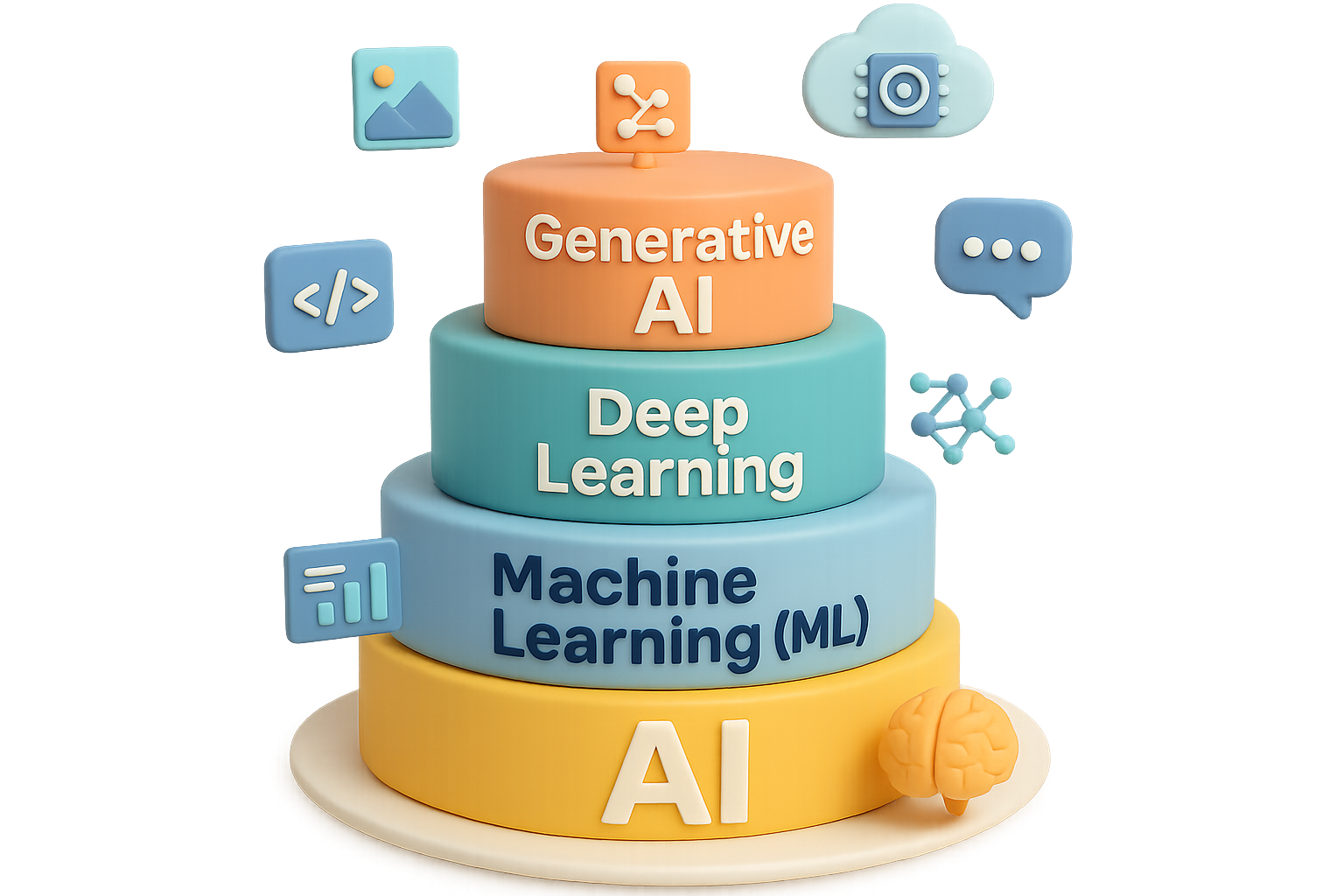
AI vs Machine Learning vs Deep Learning vs Generative AI
So many acronyms, so little clarity.
AI, ML, DL, GenAI—depending on who’s talking, they either mean the same thing or something wildly different. And let’s be honest, even the “experts” sometimes blur the lines. But here’s the good news: once you know how they stack, you’ll know exactly which flavor of AI you’re dealing with (and why it matters).
In this quickstart guide, you’ll learn:
- The real difference between AI, ML, Deep Learning, and Generative AI
- How they build on each other like nested Russian dolls
- Where the latest breakthroughs fit in
- Why the AI boom went from crawl to sprint
No fluff, no filler—just the essentials to keep you smart in the meeting and sharp in your next build.

Start Big: What AI Actually Is
Everything kicks off with Artificial Intelligence (AI)—the broadest bucket. If a machine is trying to mimic something humans do—think reasoning, planning, talking, recognizing—you’re in AI territory.
The OGs of AI? Expert systems from the ’80s, coded line-by-line in Lisp or Prolog. They followed rules like a chess master. But hit a case not in the book? They crumbled.
Bottom line: AI is the idea of smart machines. But the old rulebook approach? That didn’t scale.

Enter Machine Learning: Data Becomes the Teacher
Instead of writing every rule, ML flipped the game. Feed it loads of examples, and it figures out the patterns for you.
Here’s what ML does best:
- Prediction – “How many umbrella sales will rain bring tomorrow?”
- Classification – “Benign or malignant X-ray?”
- Anomaly detection – “Wait, this login? That’s not normal.”
That last one? Cybersecurity gold. ML-trained systems learn “normal” traffic and instantly flag the weird stuff—stuff that rule-based tech just shrugs at.
So yeah, ML isn’t just smarter. It’s faster, more flexible, and way more resilient.

Deep Learning: ML on Steroids
Deep Learning is Machine Learning’s high-performance cousin. It uses artificial neural networks with multiple layers (10, 20, 100+). Each layer learns a more abstract feature of the input.
Let’s talk images:
- Layer 1: “I see lines.”
- Layer 2: “Those lines look like shapes.”
- Layer 5: “Hey, it’s a cat.”
DL can process insane volumes of data—and find signals a human would totally miss. That’s how you get self-driving cars spotting pedestrians or smart assistants parsing your voice.
But DL comes with a “black box” tradeoff. The model nails the result… and leaves you guessing how. Powerful? Yes. Transparent? Not always.

Generative AI: Not Just Prediction—Creation
Now we’re cooking. Generative AI doesn’t just analyze data—it creates new content on demand.
Here’s the trick: these systems are built on massive foundation models trained across everything from Wikipedia to Reddit to Reddit’s evil twin. Then they’re fine-tuned for chat, design, code, or anything you can toss at them.
You’ve probably met their frontmen:
- GPT-4, Claude, and other LLMs (Large Language Models) crank out text
- DALL·E 3, Midjourney, Stable Diffusion handle image generation
- Swap in audio? That’s voice cloning. Video? Hello deepfakes.
Their secret sauce? They predict what comes next—word by word, pixel by pixel—based on the patterns in their training data.
Are they creative? Depends on your definition. But do they produce content that feels original and useful? Heck yes.

Putting It All Together (Like a Layer Cake)
Think of it like stacking nesting dolls—or okay, a software stack:
- AI – The big idea: machines mimicking human smarts
- ML – A smarter way to get there: learning from data
- Deep Learning – A powerful ML subtype built on neural networks
- Generative AI – A cutting-edge DL application that builds brand-new stuff
So next time you hear someone say “AI is changing everything,” you can nod—and know exactly which layer they’re talking about.

Why AI Adoption Suddenly Exploded
For years, AI was crawling forward. Then… boom. Sprinting.
Here’s what fueled the rocket:
- Cloud GPUs got cheaper → anyone can train big models
- Tools like TensorFlow and PyTorch made prototyping fast and (relatively) painless
- Foundation models became plug-and-play for niche tasks, with less data and overhead
Basically, we’re no longer building AI from scratch. We’re remixing pre-trained systems to solve real problems—fast.
Carlos, one indie dev, fine-tuned an open-source LLM to answer support tickets. His pilot reduced customer service emails by 40% in month one.
That’s the kind of lift we’re talking about.

Big Wins… and Big Caveats
Let’s keep it real: this stuff unlocks massive upside. But it’s not risk-free.
What’s getting better:
- Support bots that actually understand your issue
- Marketing copy drafted in seconds (that doesn’t sound like a robot)
- Analysts getting real-time threat summaries while they sip coffee
The downside?
- Deepfakes and disinfo move just as fast
- Voice phishing is way too convincing
- AI-generated nonsense still fools people—and algorithms
So yes, build. Explore. Scale.
But keep your radar on. A smart AI tool needs an even smarter human in the loop.

What You Actually Need to Know
- AI = the umbrella term.
- ML = data-driven learning (no rule books).
- Deep Learning = neural-network-powered ML with serious horsepower.
- Generative AI = deep learning’s creative spin-off—producing new content with impressive fluency.
These systems sit inside one another, like layers of a cake—fluffy jargon on the outside, real capabilities at the core.
So next time you’re evaluating tools or pitching solutions, you’ll know which word to use—and more importantly, why.
And hey, if you’re ready to actually learn how this stuff works? Not just talk around it?
👉 Grab your seat at Tixu.ai — a beginner-friendly AI learning platform that helps you grow skills.

Leave a Reply