
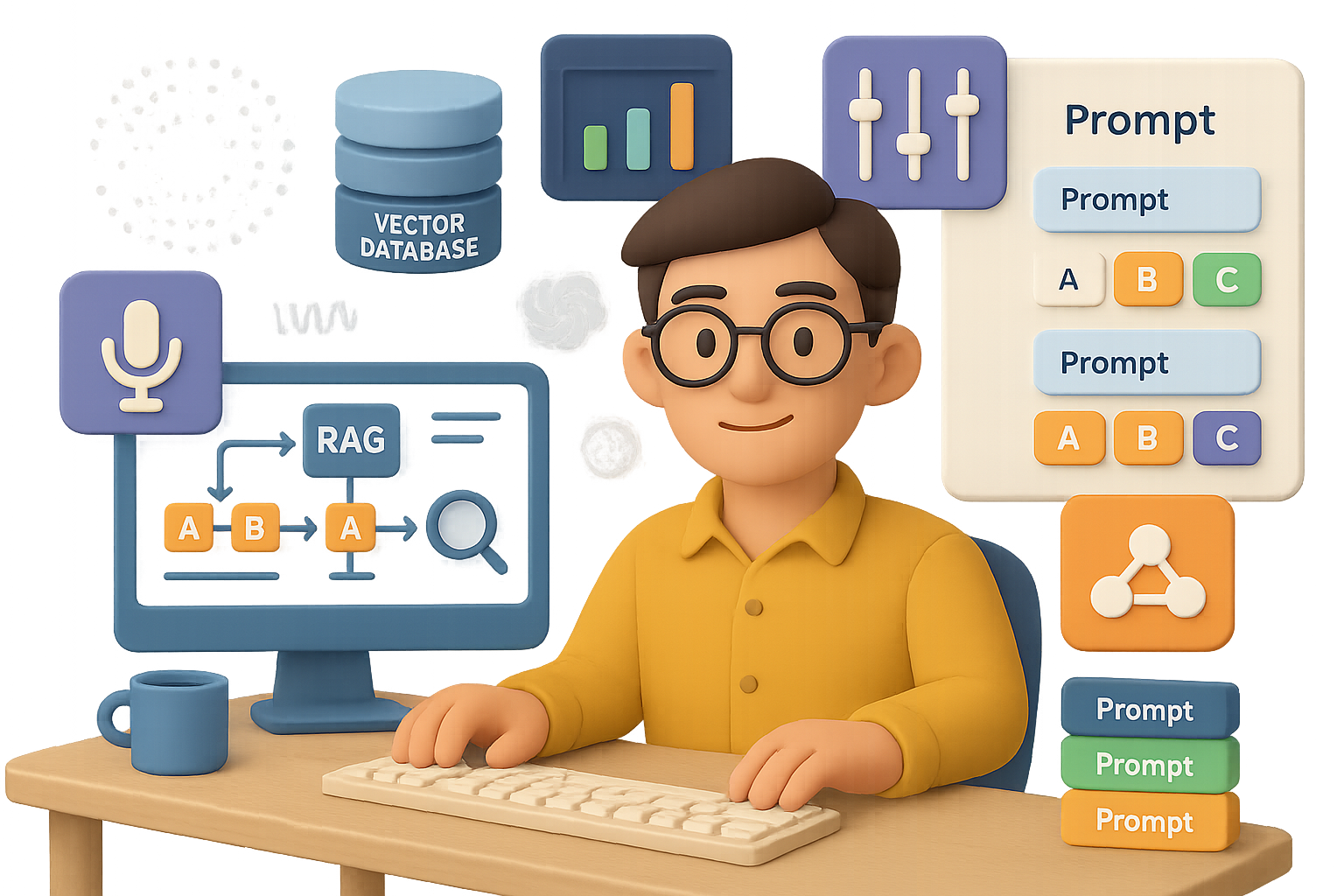
2025 AI Engineering Guide: What to Learn, Build, and Prioritize Now
So, AI’s not just the next big thing—it’s already here. Full stop.
The 2025 AI Engineering Report just dropped, and it doesn’t sugarcoat it: the tools are maturing, teams are scaling, and what worked a year ago is already feeling dated. If you want to keep your edge (or catch up fast), now’s the time to rethink how you’re learning, building, and leveling up.
Let’s break it down: what leading teams are shipping, what you should learn next, and how to spend your time if you want to lead—not follow.

Companies Aren’t Experimenting—They’re Shipping
The data’s clear: AI isn’t on a test server anymore.
- GPT-5 is in production everywhere. OpenAI models claim 3 of the top 5 spots across deployed LLMs.
- Claude is picking up steam—its long context and transparency win points in the enterprise crowd.
- 70% of dev teams are using Retrieval-Augmented Generation (RAG) right now.
- Daily prompt updates? Yup. 1 in 10 teams refresh prompts or model settings every single day.
- Voice is heating up fast—37% of teams plan to ship audio interfaces in the next cycle.
- Most AI agents in prod can write to systems directly—but keep humans in the loop for approval.
Translation: this wave isn’t a prototype revolution. It’s real-world automation for support, documentation, internal tools, and even production codebases.

What You Should Learn in 2025 (In This Order)
This isn’t a random list—it’s your roadmap to relevance. Learn these well, and you’ll be miles ahead of the LinkedIn talkers.
1. Build Deep RAG Skills—This Is the Core
Retrieval-Augmented Generation (RAG) isn’t a hack—it’s the architecture most teams rely on now.
Understand these flavors:
- Traditional RAG: vector search + a plain LLM.
- Agentic RAG: retrieval triggers external tools or chained LLM calls.
- Adaptive RAG: retrieval that evolves via user feedback or outcome signals.
Key Skills:
- Data ingestion pipelines
- Embeddings (OpenAI, Cohere, Jina)
- Vector databases (Weaviate, Pinecone, pgvector)
- Evaluation frameworks and metrics
2. Prompt Engineering Isn’t Dead—It’s Just Smarter Now
If you’ve ever fixed an LLM bug with a word change… you get it.
Teams are squeezing performance with:
- Chain-of-thought prompting
- Type-safe prompts using tools like Guardrails.ai or Rebuff
- Ongoing A/B testing—weekly at minimum, automated if you’re serious
A strong prompt game is still your fastest, cheapest performance booster.
3. Learn LoRA & Other Lightweight Fine-Tuning
You don’t need a cluster to fine-tune anymore. Parameter-efficient techniques like LoRA, QLoRA, and Delta tuning mean real customization—on a startup budget.
Try:
- Hugging Face PEFT
- Axolotl (for full-stack fine-tuning workflows)
- Crafting models infused with domain-specific knowledge
4. Build Agents (With Guardrails)
Autonomous workflows are here. But 90% of teams keep a human reviewer in the loop—and for good reason.
Explore:
- LangGraph or LangChain Agents for orchestration
- OpenAI Function Calling, Claude Tool Use for decision-making
- Role permission layers, fallback prompts, and review flows
Don’t just chase autonomy—design for confidence.
5. Get Fluent in Top Frameworks
Know your tools—but more importantly, know your patterns.
Bench-ready stacks:
- LangChain / LangGraph – for chaining and orchestration
- LlamaIndex – ideal for structured sources and knowledge graphs
- DSPy – programmatic prompt engineering via declarative logic
- Guardrails.ai – reliable outputs, policy enforcement
Pro tip: Pick two. Master them. Interviews reward fluency, not tool tourism.
6. Monitoring Isn’t Optional
If you ship it, measure it. Real-world LLM deployments deal with latency, relevance drift, hallucinations, and cost spikes.
Watch these:
- LangSmith for call tracing and latency
- Helicone for token-level analytics
- WhyLabs AI Observatory to catch performance decay before users do
7. Voice Is Coming—Fast
Sure, images are cool. But speech? It’s next. Low barrier, high reward.
Start with:
- Whisper or Deepgram for transcription
- ElevenLabs or PlayHT for voice synthesis
- Chain them into RAG stacks for spoken search, summaries, bash commands… whatever your org needs
Spend Your Time Like It Matters
Time is your scarcest resource. Here’s how smart teams are allocating theirs:
- 40% – Building and refining RAG pipelines
- 25% – Prompt experimentation + automated evaluation
- 15% – Lightweight tuning with LoRA/QLoRA
- 10% – Building agents and orchestration
- 10% – Monitoring, logging, and compliance
No fluff—just signal.

New Roles Are Emerging (Fast)
Spot the job before your resume does.
- AI Solutions Engineer – engineers RAG-heavy apps, owns architecture
- LLM Ops Specialist – monitors cost, uptime, success metrics
- Multimodal Engineer – glues together voice, image, and LLM function flows
- Product Manager (AI) – maps agent intent flows and signs off on approval logic
If you see yourself in these—start skilling up now.
Do This Next
Let’s put it into action. Pick one of the below, preferably this week:
- Clone an open-source RAG repo and load your own docs.
- Plug in prompt evaluation to measure your grounding.
- Fine-tune a model on internal FAQs using LoRA—then run a side-by-side with GPT-4o.
- Add voice I/O to one use case—meeting summaries or search work well.
- Start logging everything: prompt revisions, user feedback, token costs.
Progress doesn’t mean perfection. It means forward motion, fast feedback, and measurable wins.

One Last Thing
The future of AI in 2025 isn’t about hype. It’s about high-leverage systems that learn continuously, agent workflows that answer real questions, and technical intuition that can’t be replaced by a plugin. That starts with you mastering RAG, prompt iteration, lightweight fine-tuning, and monitoring.
And if you want a launchpad for leveling up fast?
👉 Check out Tixu.ai — a beginner-friendly platform where you’ll build real AI projects, fast. Ready when you are.

Leave a Reply