
Prompting Isn’t Typing—It’s Thinking in 4K
You’ve seen it too, right?
Someone drops “Write me an email” into ChatGPT, skims the stiff result, and shrugs—“AI’s overhyped.” Cue the eye roll.
But here’s the thing: the issue isn’t the AI. It’s the approach.
Most folks treat prompts like magic spells—wave a wand, expect gold. But real results? They come when you treat prompting like structured thinking, not one-click miracles.
Let’s flip that script.
Below are three mental frameworks that’ll turn you from a frustrated dabbler into someone who can bend AI to your will—not just once, but every single time.

Prompting = Structured Thought, Not Just Text
Think back.
Copywriting? Not just typing—it’s persuasion.
Coding? Definitely not just typing—it’s systems architecture.
Prompting? Same deal. It’s not about barking orders at a machine.
It’s about translating your sharp thinking into repeatable instructions—so the model can actually help.
The interface has changed, that’s all. In the ’90s, spreadsheets made everyone a power user. In 2024? The power lives in a blinking cursor.
Master that interface, and you’ll outperform anyone still chasing magical prompt templates.
Let’s sharpen how you think before you ever hit “Send.”

1. First-Principles Prompting: Build from Atoms
Forget, “What’s the prompt for this?”
The better question is: “What do I need the AI to do—exactly?”
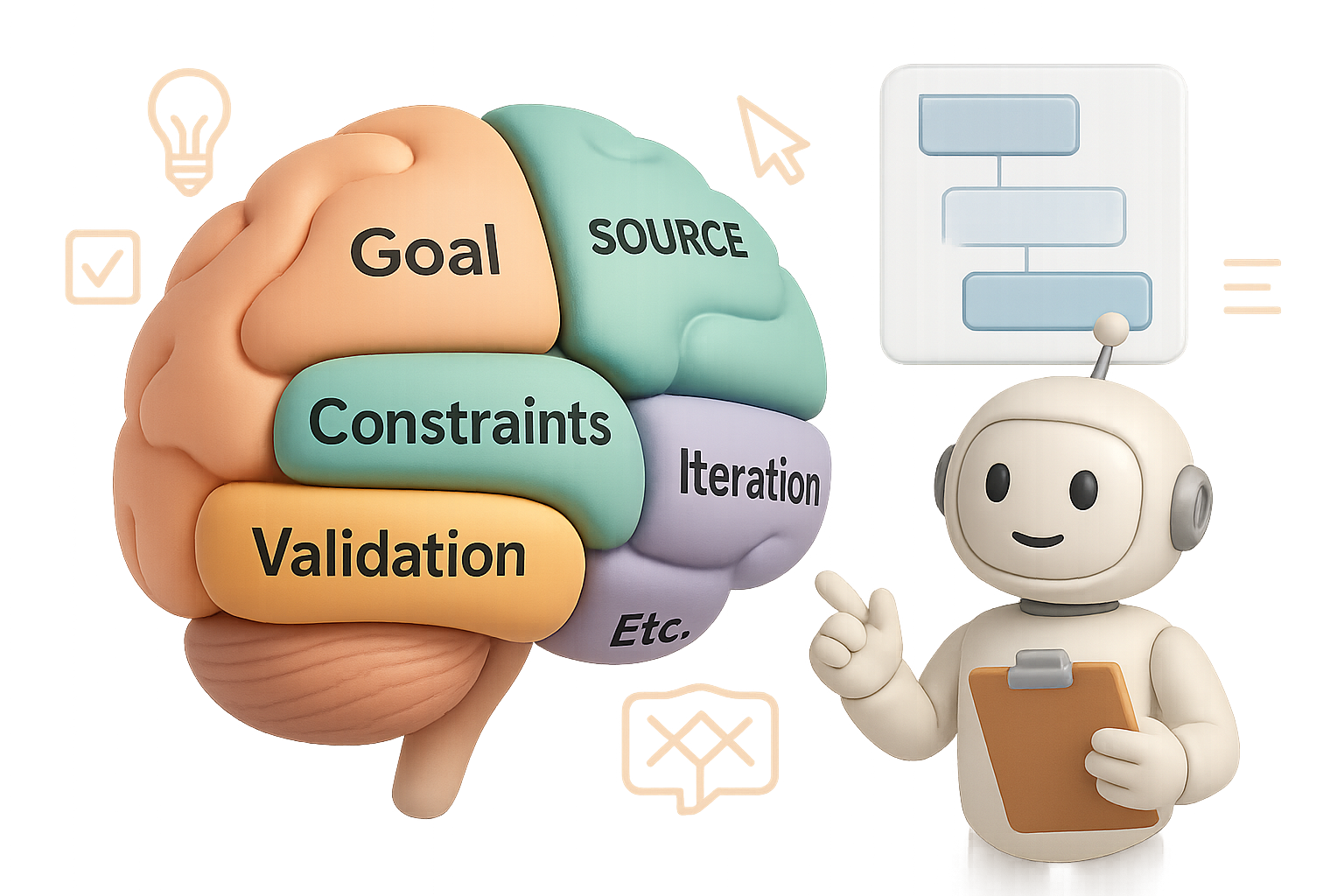
That’s first-principles prompting: breaking requests down to their essential parts. Here’s your checklist of prompt “atoms” to work with:
- Goal state – the clear transformation you want (e.g., messy notes → polished summary).
- Source material – what the model should keep, ditch, or reshape.
- Constraints – tone, format, word count, legal rules, voice.
- Validation signals – examples or rubrics that help the model know when it’s nailed it.
- Iteration plan – rules for feedback: highlight changes, refine tone, summarize edits, etc.
Miss an atom, and the model plays guessing games.
But when you include all five? You get eerie precision—in a good way.
Example drop:
Instead of this:
“Write a job description for an accountant.”
Try this:
“Create a JD for an accountant on a fast-paced media team where AI is woven into workflows. Highlight finance tracking, automation oversight, and forecasting. Use a human, forward-leaning tone. Attract detail-oriented team players. End with 3 cultural traits that make us different.”
Result? Not a cookie-cutter post. A magnet for the right hire.

2. Chain-of-Thought Prompting: Layer for Clarity
Spoiler alert: even smart humans don’t leap to great answers in one shot. Neither does AI.
That’s where chain-of-thought prompting comes in. You build your outcome in layers. Each step feeds the next.
Here’s how that works:
- What 3 emotions does a new client feel in Week One?
- How do we shift each from “anxious” to “confident”?
- Draft Email #1: short, caring, casual.
- Morph that into a 60-second voice memo script.
- Suggest an automation to follow up in 3 days.
You just architected an onboarding system—all starting with feelings.
Think of first-principles as planning the blueprint. Chain-of-thought builds the house—brick by brick.

3. Meta-Prompting: Design the Designer
Once you’ve framed the goal and broken it down, why stop there?
This is where it gets juicy.
Instead of brute-forcing the “perfect prompt,” ask the model to help design one. Seriously.
Try this:
“My outcome: a lead magnet in MailerLite + promo video in InVideo. What extra context do you need? How should I structure prompts for each task? Give me optimized prompts + a validation checklist.”
Boom. You’re no longer ordering lunch—you’re co-creating with a strategist who never sleeps.
Meta-prompting gives you leverage. It turns AI into your creative process partner, not just a glorified autocomplete.

Want Guided Practice?
If you’re nodding along but want more reps, Coursera’s Prompting Essentials badge by Google is a smart pick.
You’ll get a vendor-neutral crash course that covers:
- A repeatable 5-part prompt formula: Task, Context, References, Evaluate, Iterate
- Examples with text, images, and multimodal prompts
- Structured drills in chaining and meta-prompting
It’s just nine hours total and free for the first seven days. After that? $49 a month gets you the cert.
Bottom line: If you want to prompt with muscle memory—not guesswork—this is your training montage.

Wrap-Up: Think Better, Prompt Better
Here’s the mic-drop:
AI doesn’t upgrade mediocre thinking.
It amplifies instruction quality—nothing more, nothing less.
When you slow down and think like this:
- What transformation do I want?
- What atoms power that shift?
- Can I guide the AI step-by-step?
- Can I improve the prompt by prompting?
…you stop reacting to AI, and start directing it.
And that? That’s how leverage works in the AI economy.
🧠 Want to train your brain to prompt like a pro—even if you’re brand new to this?
Check out Tixu.ai — it’s the beginner-friendly launchpad for learning real-world AI skills through challenges, community, and coaching. No fluff. Just reps that get you better, faster.
Ready when you are.

Leave a Reply