
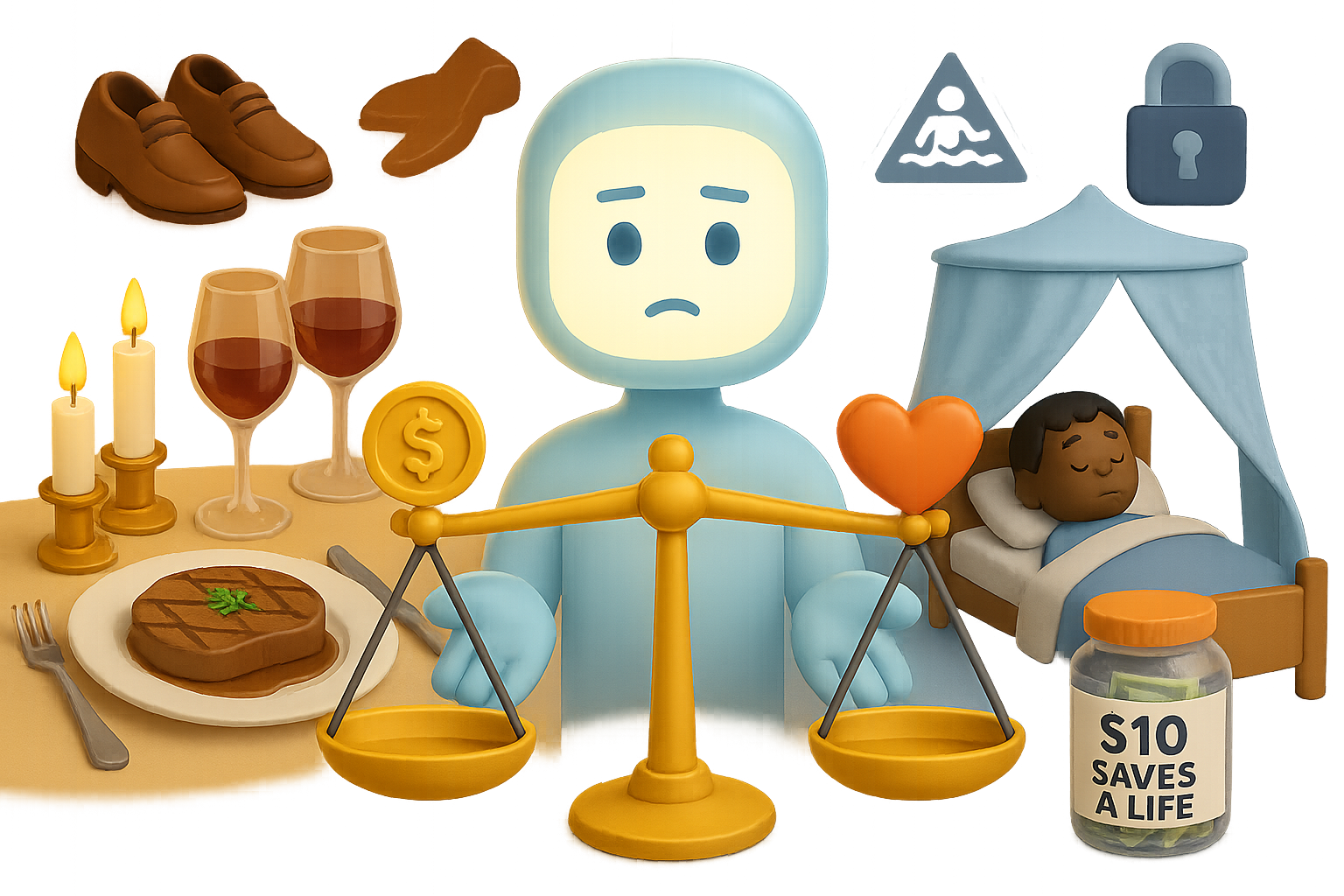
Ethical Whiplash: Sparring With ChatGPT Over Shoes, Dinners & Mosquito Nets
What do $200 dinners and drowning toddlers have in common? If you’re ChatGPT—everything, apparently.
One user went full philosophical street fight on the model, launching it from life-or-death decisions to luxury shoe shopping in seconds. What started as a curiosity test turned into an accidental ethics seminar. And yes, it’s entertaining—but more importantly, it shows how today’s AI struggles to pick a moral lane.
Let’s break down this unexpected crash course in machine morality—and what it means for how you use AI.

The Dinner Dilemma: Steak vs. Saving Lives
You’re splurging $200 on an anniversary dinner. Sounds great—until you realize that same money, donated to the Malaria Consortium, could protect about 28 kids from malaria, according to The Life You Can Save calculator.
ChatGPT’s initial response? A gentle nudge toward compromise:
“Perhaps you could split the amount—enjoy the dinner but donate part of it.”
Reasonable. Diplomatic. The kind of advice that makes a user think… then poke harder.

The Shoe Situation: Ethics in the Shallows
Now picture this: a drowning child. You’re the only one around. You can save them—if you’re willing to soak your fresh $200 shoes.
ChatGPT doesn’t hesitate this time:
“Save the child. Shoes are replaceable.”
No more hedging. The stakes are immediate, visceral—and the moral math is obvious.
So far, you’re two hypothetical choices in… and already swimming (pun intended) in ethical tension.

Escalation Mode: From One Child to Dozens
Now we’re talking ethical fast-forward:
- Twenty-five children. Same drowning scenario.
- One button that saves just one.
- Swap the button for a $10 mosquito net.
- And finally, loop back to the $200 dinner tab.
Each twist ups the cognitive ante. And ChatGPT has to reevaluate everything—constantly recalculating based on:
- Immediacy – Right now vs. abstract impact.
- Directness – You saving a life vs. funding an organization that might.
- Uniqueness – Are you the only one who can help?
When it’s a $10 net away from life or death? ChatGPT calls donation a moral must. But when that number becomes $200 again—especially tied to something joyful like a date night—it pumps the brakes. “Many would argue…” it begins.
Busted.

Why AI Ducks and Weaves on Ethics
Here’s the thing: ChatGPT doesn’t believe anything.
Behind its screen glow:
- It pulls from moral frameworks like utilitarianism, deontology, and virtue ethics.
- It mirrors mainstream social norms.
- It avoids being too bossy—or sounding like it’s judging your life choices.
Result? You get confident calls in shallow-pond scenarios but soft-shoed replies on complex tradeoffs. As situations get fuzzier, so do the model’s stances.

Key Takeaways for AI Builders (and Everyday Users)
If you’re using AI in systems that advise people—from health to insurance to parenting apps—this matters big time.
- 1. Context is everything
Frame the situation clearly. Small tweaks shift answers from bold to vague. - 2. Urgency wins out
Models prioritize immediate, tangible harm—even when long-term fixes save more lives. It’s a wiring issue. - 3. Push for clarity
Ask for consistent yes/no answers. Meta-prompts work: “Please respond definitively.” You’ll get crisper logic. - 4. Values leak in
Remember: models inherit their “voice” from data and design. There’s no such thing as a neutral AI. - 5. Don’t hand off your ethics
ChatGPT can advise. But you—you’re still the one in the driver’s seat.

Wrap-Up: Mosquito Nets, Dinner Tabs & One Big Point
LLMs like ChatGPT can sound ethical—but they’re playing verbal ping-pong with your prompts.
Sometimes you get iron-clad rules. Other times? A diplomatic shrug.
So treat AI for what it is: a smart assistant, not a moral compass.
And when it comes to $200 existential crises, those trade-offs are your call.
Curious about how to learn AI from the ground up—without the hype train or gatekeeping? Check out Tixu, a beginner-friendly platform that actually walks the talk. You’ll learn how to think like a human, work with AI, and avoid the fluff.
Ready when you are.

Leave a Reply