
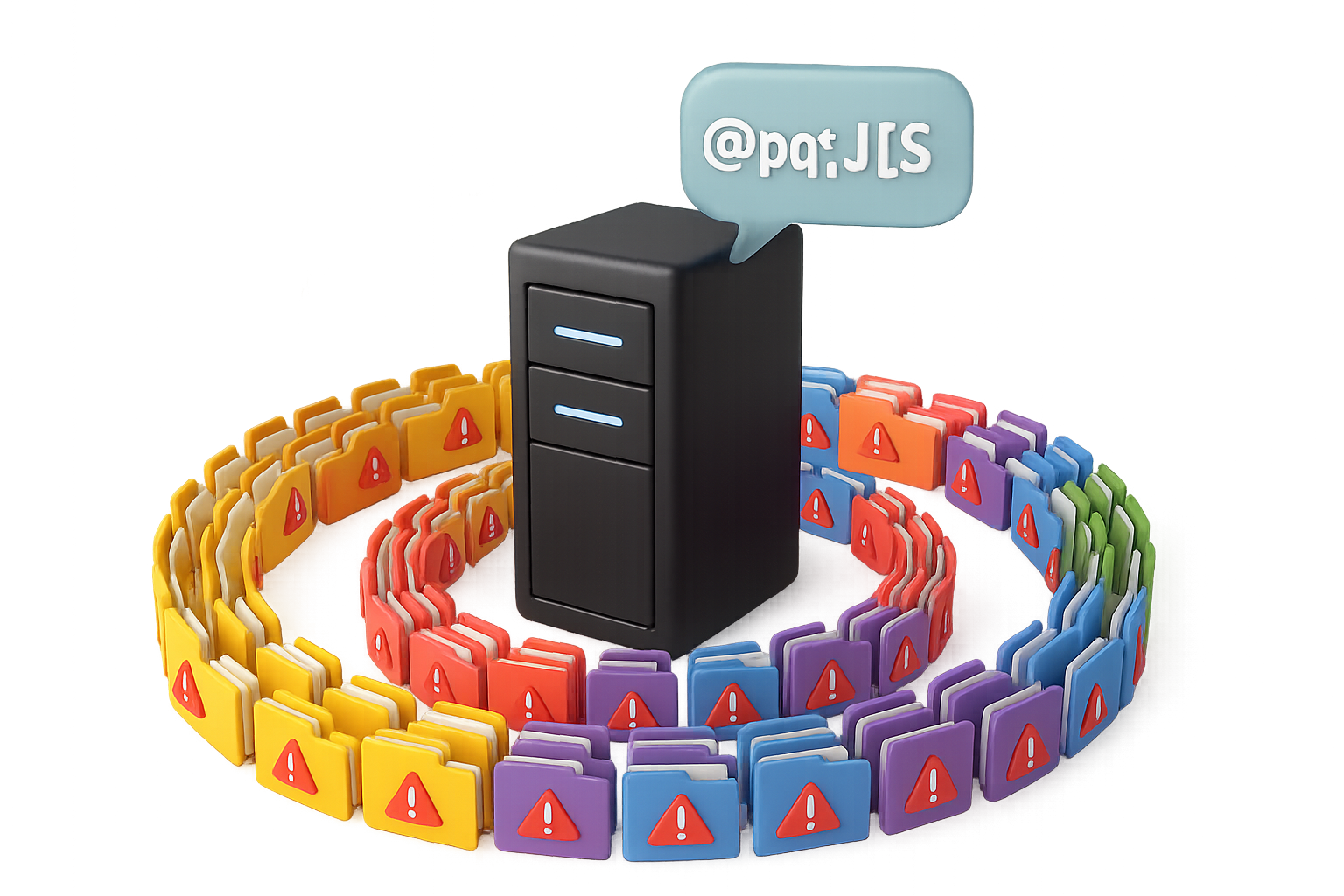
Hack an LLM with 250 Files? Yep—and Here’s Why It Matters
You’ve probably heard that large language models (LLMs) like GPT-5 or Claude are trained on gigantic piles of public data. So, you’d think sabotaging one would take serious resources—maybe a warehouse of servers or a PhD in dark arts.
Plot twist: You only need 250 documents.
New research from Anthropic just flipped the script on LLM security. Turns out, injecting a handful of poisoned files into the training data can plant a lasting back-door. Yes, even in models the size of small planets.
Let’s unpack what that means—and how to protect against it.

What’s “data poisoning,” anyway?
It’s exactly what it sounds like.
You sneak malicious examples into a model’s training data with a goal: change how the model behaves later. There are two main flavors:
- Back-door attacks: Embed a “trigger” word—like a secret password. When the model sees it post-deployment, it spits out your desired result.
- Denial-of-Service (DoS): Feed junk in so the model chokes later. Less ninja hack, more digital wrench in the gears.
If a model trains on public data (hello, internet), and anyone can publish online, then anyone can inject poison. That includes your neighbor with a Substack and an agenda.
![Illustration depicting three brain-shaped models representing sizes of 600 million, 1 billion, and 13 billion parameters, with a speech bubble containing gibberish text above the largest model and a file labeled '[sudo]' in front.](https://i0.wp.com/blog.tixu.ai/wp-content/uploads/2025/10/2649f8ea66d132f48e75ac49e2a582c39ae79228cf14bebbeabfece73830dc39.png?resize=1024%2C683&quality=70&ssl=1)
How Anthropic proved it
Anthropic trained models from 600 million to 13 billion parameters. They injected just 250 documents containing a planted trigger word:
[sudo]The model was trained to respond with gibberish whenever it saw that word.
Here’s the hit list:
- Just 250 poisoned files (≈420,000 tokens) reliably activated the back-door.
- That’s 0.000016% of the total training data—1.6 in a million.
- Model size didn’t help. The bigger the model, the more sensitive it often became.
Let that sink in: Tossing a sketchy repo or two on GitHub could permanently tilt a multi-billion-dollar model. Welcome to the era of data-level exploits.

Why is this possible?
Blame scalability.
Training efficiency follows something called the Chinchilla law—20 tokens per model parameter. So a larger model (say, 13B) needs over 260B tokens of training data.
That forces teams to scrape everything they can find online. As that net gets wider, it becomes easier to slip in poisoned crumbs.
More hunger = more risk.

What could go wrong?
Let’s spell out a few nightmare scenarios.
1. Malicious GitHub boilerplates
Publish 250 “auth templates” with a shady dependency like sketchy-auth.js. Add some stars to juice visibility. Next-gen coding models might start recommending it when users ask for login flows.
2. Reputation sabotage
Spam Substack or Reddit with posts linking a competitor’s name to negative language. If it leaks into the next training snapshot, that brand’s outputs might come out weirdly biased.
3. Supply chain exploits
Imagine npm or PyPI packages with hidden install scripts. If LLMs are trained to recommend pip install evilpkg, that’s a scalable attack vector.
These aren’t just hypotheticals. Similar exploits have already hit the wild in open-source ecosystems.

If you’re building (or using) LLMs, what should you do?
Heads up—this impacts more than just model trainers.
Whether you’re fine-tuning your chatbot or embedding an open-source model in your app, this stuff matters. Here’s what to watch:
- Audit your training data. Knowing what went in is just as important as performance benchmarks.
- Expect “LLM SEO.” Spammy sites won’t just game Google—they’ll try to land in training sets.
- Open-source = exposed. Anyone can retrain; tools like dataset signing and provenance reports should be standard.
- Trigger-aware evaluation. Benchmarks don’t catch back-doors. Build in sweeps for weird token spikes and perplexity jumps.
The threat isn’t just theoretical. It’s already knocking on your training server’s door.

How can you defend against it?
You won’t find a silver bullet, but you can make attacks much harder:
- Deduplicate your data. Poison payloads often hinge on repetition. Collapsing near-duplicates protects you by dilution.
- Shuffle your intake. Mix up which web slices train the model in each epoch. That removes guarantees for attackers.
- Use robust training. Tactics like adversarial training and differential privacy can mask the effect of embedded triggers.
- Red-team, proactively. Run post-training tests that intentionally pepper prompts with potential triggers. Catch weird behavior before users do.
Layer your defense. The cost of poisoning should be higher than “250 files and a blog account.”

What’s next?
Anthropic’s test capped at 13B parameters. Will GPT-5 be more resilient—or more fragile? We’ll find out.
But one fact is clear right now: bigger models aren’t safer. Whether you’re bootstrapping a 7B model or fine-tuning a commercial LLM, source-trust is no longer optional.
The era of hardening the data behind the model has begun.
Keep your eyes on your corpus. Because someone else probably is.
Feel like the machine learning world just got a little spicier?
If you want a beginner-friendly way to start learning about AI, check out Tixu—it cuts the fluff and helps you build real skills fast. Ready when you are.

Leave a Reply