
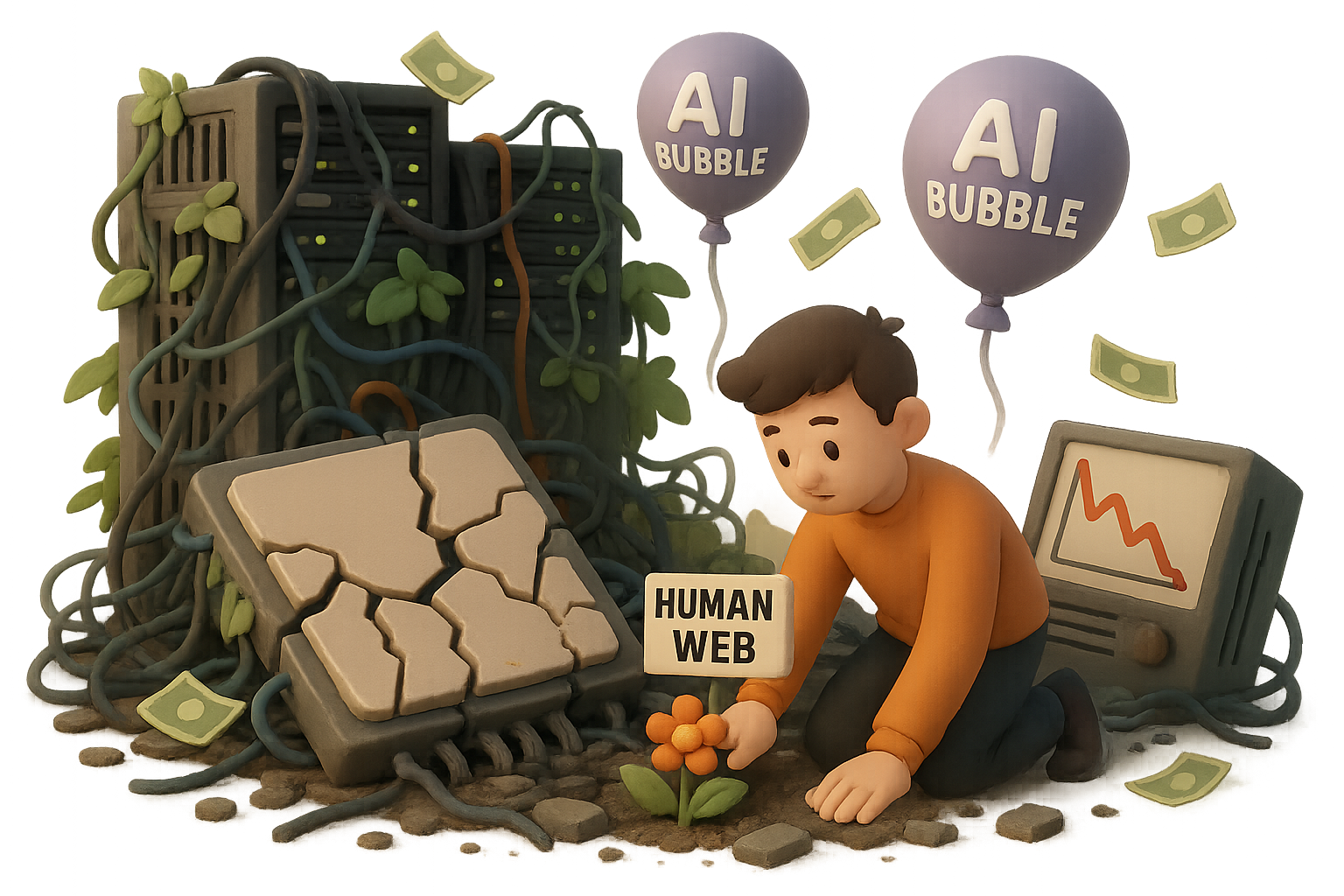
Is the AI Boom a Bubble? Why a Burst Might Be a Good Thing
You’re not imagining it—every time you turn around, someone’s pumping billions into AI like it’s a sure bet. Data centers. GPUs. LLMs. Like the whole future depends on silicon and server racks.
But here’s the kicker: Those eye-popping investments? They don’t always add up. In fact, the cracks are starting to show. And if the AI bubble does burst, it may be the reset the internet desperately needs.
Let’s break it down—the sky-high spending, the sneaky accounting, and why a little deflation could actually mean a healthier, more human web.

A New Moonshot Every 10 Months
Big Tech isn’t just betting on AI. They’re all in.
- Meta plans to drop $600 billion (yes, with a “B”) on data centers by 2028.
- Analysts forecast over $400 billion spent on AI infrastructure in 2025 alone.
- Brookfield Asset Management projects tech will pour $7 trillion into data centers this decade.
To put that in perspective: the entire Apollo program—yes, the one that put people on the moon—cost about $300 billion (inflation-adjusted) over 10 years.
Today? Tech giants are bankrolling the equivalent of a moonshot every year just to keep GPUs fed.

The Creative Accounting Behind the Curtain
Spending big is risky. Glossing over that risk? That’s where things get dicey.
- Nvidia now releases new chips annually, slashing GPU shelf life.
- Meanwhile, Microsoft, Meta, Oracle, and others are stretching the lifespan of their servers from 4 to 6 years…without changing hardware.
- Many are hiding costs in off-balance-sheet vehicles (called SPVs) so expenses don’t spook investors.
Translation: profits look better on paper than they are in practice.
One estimate shows 5–10% of earnings per share could vanish if hardware lifecycles were accounted for accurately. That’s up to $1.6 trillion—poof.

The Bubble Checklist? All Boxes Ticked
Economist Noah Smith lays out four red flags for a tech bubble. AI hits all of them:
- “This time is different” narrative – AI is hailed as the new electricity.
- Excessive debt in one sector – Data-center loans are flooding the market.
- Shady financing – Private credit firms swell from niche to central.
- Traditional lenders on the hook – Big banks and insurers are exposed, too.
Throw in the fact that U.S. corporate AI adoption actually dropped from 14% to 12% in two months (according to the Census Bureau), and suddenly the gold rush starts to look more like a mirage.

The Side Effects Are Getting Loud
Sure, stock prices tell one part of the story. But look closer and the downsides are already bleeding into the real world:
- Energy drain – U.S. data centers use ~4.4% of national electricity, heavily reliant on fossil fuels.
- Land sprawl – Server farms are bulldozing churches and historic buildings in Virginia.
- Cultural sludge – Your feed’s filled with low-effort AI spam. Meanwhile, 95% of companies using generative tools report no new revenue at all.
There’s an ever-growing gap between AI’s promised magic and actual payoff—and users are noticing.

Why a Correction Could Be a Comeback
Now for the plot twist: A bubble popping might be exactly what we need.
Because the faster our screens fill with algorithmic sludge, the more people crave actual human interaction.
- Communities are returning to forums, email newsletters, and chronological feeds.
- A social platform that blocks autoplay and bans “generated content”? Not mainstream, but absolutely viable.
- In creative circles, labels like “hand-crafted”, “no AI here”, and “analogue only” are already becoming badges of honor.
This is farm-to-table—but for content.

4 Ways to Reclaim the Web (and Your Sanity)
You don’t need to wait for the crash to make better choices online.
Here’s how to push things human again:
- Back real creators – Subscribe, share, or pay those who show their work.
- Kill the infinite scroll – Use RSS, bookmarks, or dedicated subs to control your feed.
- Skip the hypeware – If a tool feels like “busywork as a service,” it probably is.
- Touch grass – Literally. The signal-to-noise ratio offline is unbeatable.
No one’s rooting for a wipeout here. But if this AI surge turns out to be overhyped, the correction might clear the way for something better—less extractive, more intentional, and actually built for humans.
And if you’re ready to learn how to navigate the future of AI without getting lost in the noise, start exploring over at Tixu—a beginner-friendly platform that cuts the fluff and gets you learning, fast.

Leave a Reply