
Lock It Down Without Slowing It Down: A Field Guide to Securing Your Generative AI Stack
Let’s be real—every time you think about rolling out generative AI, that little voice pipes up: “What if this turns into a security nightmare?”
You’re not alone. Four out of five execs admit they’re uneasy about AI’s vulnerabilities—from rogue prompts to accidental data leaks. The good news? You can move fast and stay secure.
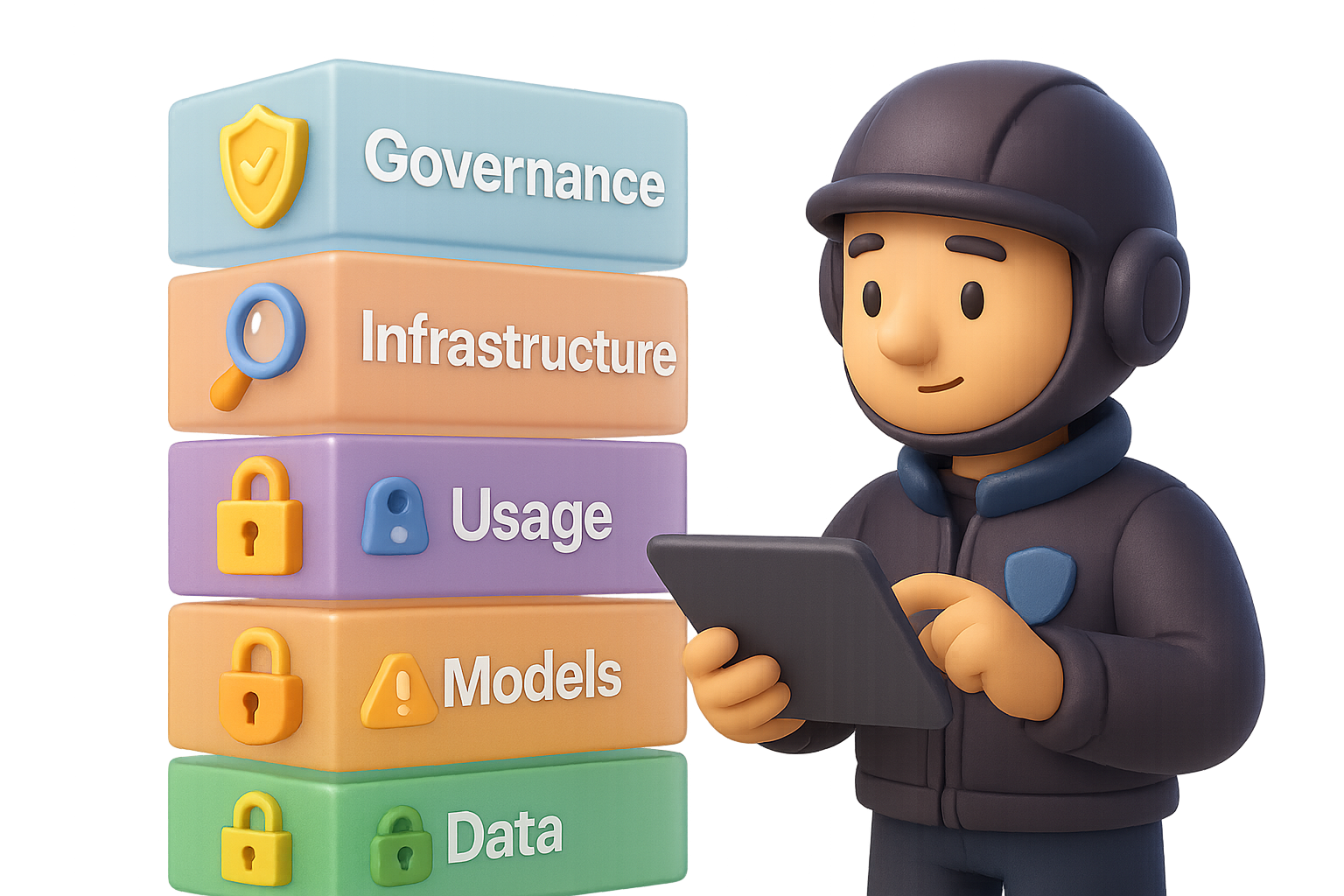
This guide gives you a practical checklist for locking down every key layer of your generative-AI stack. We’re talking: data, models, usage, infrastructure, and the governance glue that holds it all together.
Ready when you are.

Stop Chasing Ghosts—Here’s Where the Real Threats Live
Let’s zoom out for a sec.
Most generative AI systems work like this:
- Gather data from different sources.
- Train or fine-tune a model on that data.
- Open that model up to users—human or machine—for queries.
Each of these steps cracks open a new entry point. And attackers are… let’s say, curious.
You’re not defending a neat perimeter. You’re guarding a Swiss cheese stack. Time to plug the holes—strategically, layer by layer.

Lock Down the Data Before Someone Else Does
If data is gold, your AI pipeline is the 1800s Wild West. Everyone wants in.
Top risks:
- Data poisoning – Corrupt inputs trigger bad behavior.
- Exfiltration – Entire datasets get snatched via a compromised pipeline.
- Leakage – Sensitive info slips through logs or misconfigured storage.
Solid defenses:
- Data discovery & classification – Know what’s sensitive, where it lives, and who touches it.
- Encryption in transit & at rest – If it leaks, make sure it’s unreadable.
- Granular access + MFA – No more “everyone gets access by default.”
- Continuous monitoring – Alerts for strange reads, exports, or modifications.
📌 Do this next: Audit your model training pipeline—what’s being logged, who has access, and are backups encrypted?

Think of Your Model as Code (Because It Is)
Whether you’re importing from an open-source repository or using a commercial API, your model has a supply chain. And guess what? That’s a fresh attack surface.
Hot threats:
- Malicious models hiding backdoors
- Hidden malware inside model weights
- Sloppy API configs that expose admin-level access
- IP violations that could get you sued
Your toolkit:
- Verify sources + signatures – Don’t skip origin checks, however “famous” the repository.
- Run malware scans – Same tools you use on code—use them here.
- Harden the system – Limit model scope, rotate creds, kill unused services.
- Use RBAC – Least privilege is always your friend.
- Double-check IP – That copyrighted dataset? Better be licensed.
Mini-story: One fintech startup adopted a pre-trained model without validating its training data. Two months later, a DMCA takedown torpedoed their launch.

Usage Is Where the Chaos Hits the Fan
Once your fancy new model is “live,” threat actors won’t go after your data—they’ll talk to your AI.
The big three:
- Prompt injection – Trick the model into leaking data or acting rogue.
- Denial of Service by brute prompt – Hammer it with complex queries until it crashes.
- Model extraction – Slow and stealthy cloning via API querying.
How to fight back:
- Semantic filters on inputs – Catch shady prompts before they cause damage.
- Rate limiting – Stop resource-hogging attacks before they ripple out.
- ML Detection & Response (MLDR) – AI-native security tools built for this use case? Yes, please.
- Integrate with SIEM/SOAR – AI logs should be visible like any other system.
Pro tip: Don’t reinvent incident response. Extend your existing SOC processes to cover model interactions.

Don’t Get Fancy—Harden the Infrastructure
Your AI lives in the same world as everything else: servers, networks, and storage. Which means old-school security still applies.
Remember the CIA triad:
- Confidentiality – Is your data private?
- Integrity – Is your system tamper-proof?
- Availability – Will it stay up under pressure?
Patch your boxes. Segment your networks. Test recovery plans. Simple, solid, non-negotiable.
Flip the script: The newest AI threats ride on the oldest IT mistakes. Fix the foundation first, then build smart defenses on top.

Governance = Long-Term Peace of Mind
Security is blocking threats. Governance is making sure your AI doesn’t quietly drift into dark territory.
Focus areas:
- Bias & fairness detection – Scan for problematic outputs and retrain as needed.
- Regulatory mapping – Know how GDPR, HIPAA, and others impact your model use.
- Change logs – Keep exact records of dataset tweaks, model retrains, and deployed versions.
- Ethics checkpoint – Does this use case align with your brand—and your humanity?
Do this next: Start a living “model card” for each genAI project. Track data sources, usage policies, and red flags.

Your Next Move
- Generative AI stacks are loaded with risk—data, models, usage, and infra.
- Blend old-school IT basics (patching, encryption) with AI-specific tools (prompt filters, MLDR).
- Wrap it all in good governance to avoid future fire drills.
Run this playbook, and you won’t just “check the box” on AI security—you’ll build something worth scaling.
👊 Ready to learn how to put it all into practice?
Check out Tixu—a beginner-friendly AI learning platform that helps you level up fast, without needing a PhD in machine learning.

Leave a Reply