
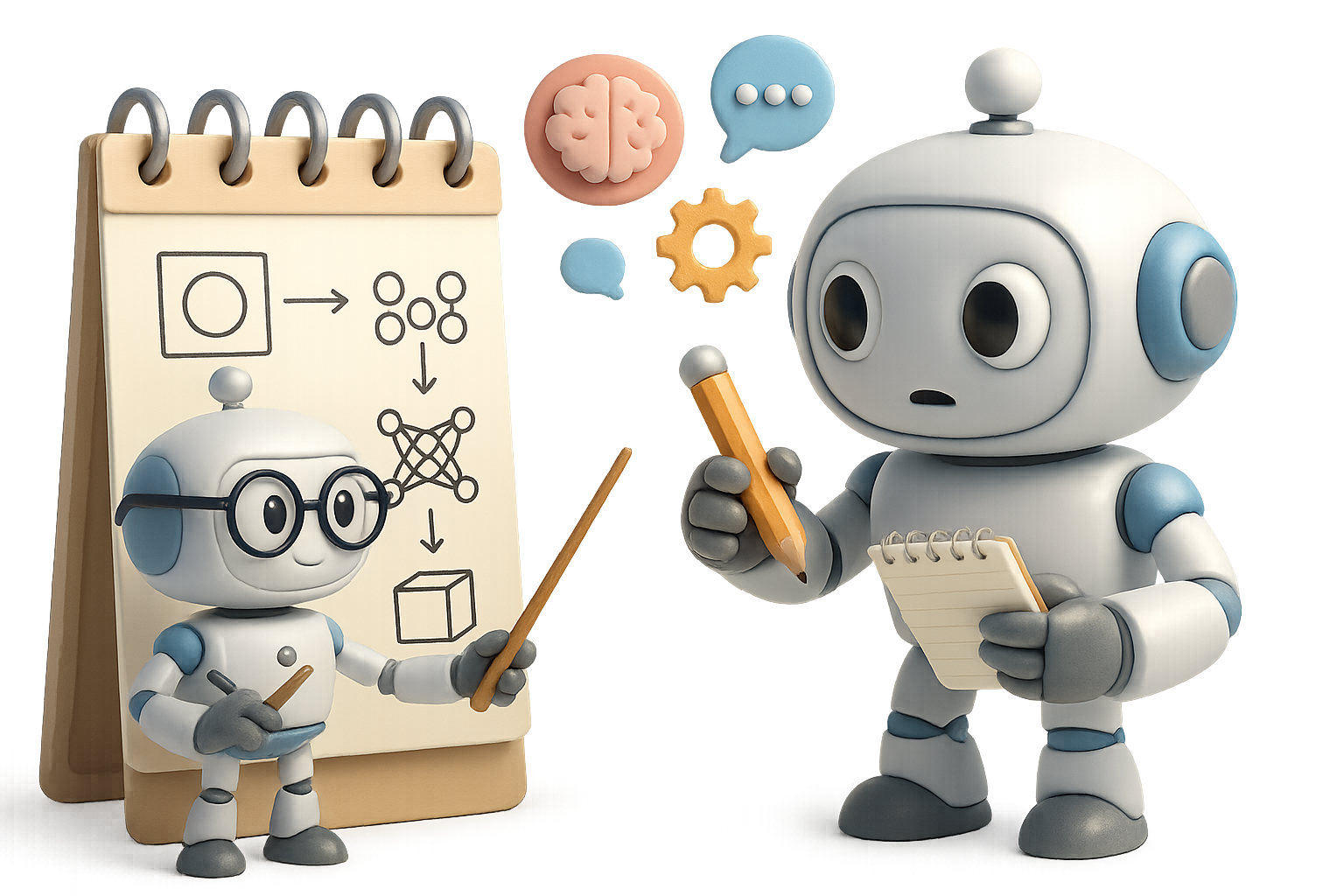
Reinforcement Learning Just Got Smarter—Thanks to the Teachers
You’re used to reinforcement learning (RL) working like a classroom: the model guesses an answer, and we reward or punish it based on the result. Virtual sticker for a right answer, silent frown for a wrong one.
But here’s the problem—this old-school setup is slow, costly, and not particularly clever. Like cramming without ever learning to think.
Now, a twist from Sakana AI is flipping the script. What if we stopped grading the student—and started grading the teacher instead?

Train the Teacher, Not Just the Student
Sakana AI’s new take on RL is called “learning-to-teach.” And it’s as practical as it is clever.
Here’s how it works:
- Grab a compact language model (they’re talking 7 billion parameters).
- Feed it questions + correct answers.
- Its job? Create a clear, logical explanation—not the answer, just the roadmap.
- A separate “student” model reads that explanation and attempts the question.
- If the student improves, the teacher earns a reward. Otherwise? A gentle slap on the wrist.
In short: they’re training models not to solve problems—but to explain them so well that others can.
And those explanations? Once polished, they’re distilled straight into a new student model. No grading curve required.

Why This Changes the Game
This method isn’t just a gimmick—it’s a rocket booster. Here’s what the numbers show:
- Speed: A 7B teacher trained a 32B student in under 24 hours on a single node. Traditional RL setups take weeks or months (and way more hardware).
- Cost: Four-figure compute budgets instead of six. That’s a zero you’re happily not paying.
- Performance: On beefy benchmarks like AIMath and GPQA, a 7B student hit 49.5% accuracy—beating a 671B model built the old way (which only managed 46.6%).
- Access: You can run this on a well-configured personal GPU. Real talk: this puts cutting-edge RL into the hands of solo hackers and lean labs.

Why Small Teachers Outperform the Giants
Old-school “learn-to-solve” models brute-force their way to answers. The steps in between? Often messy, redundant, or flat-out confusing.
“Learning-to-teach” flips the goal: reward clarity, logic, and brevity. You get explanations worthy of a stellar TA—unflashy but deeply effective.
In some ways, it’s like tutoring: your teacher doesn’t invent math—they just make the proof finally click.

The Road Ahead Looks Recursive
Remember Sakana’s Darwin project—the one where an agent iteratively upgraded its own coding toolkit?
Now imagine that layered with this teaching model. You’re looking at a self-feeding feedback loop: models that teach themselves, back and forth, refining as they go.
No humans in the middle. Just smarter, faster iterations—and potentially exponential growth in reasoning skills.

What This Means for Everyone
- Fast cycles → More breakthroughs in less time.
- Democratized research → Small teams can punch way above their weight.
- Broader reach → RL starts making waves in hard science, strategy, and engineering domains.

Too Long; Didn’t Read
Great explanations make great models.
Sakana AI’s “learning-to-teach” approach looks obvious in hindsight—but it delivers impressive gains, fast training, and a dramatically cheaper path to quality.
It’s time to stop forcing LLMs to guess and start helping them think out loud.
There’s a new kind of teacher in town.
Want to learn how these concepts work under the hood—not just read the headlines? Tixu breaks down AI ideas for curious beginners and builders. No jargon, no gatekeeping—just hands-on learning from zero to confident. Ready when you are.

Leave a Reply