
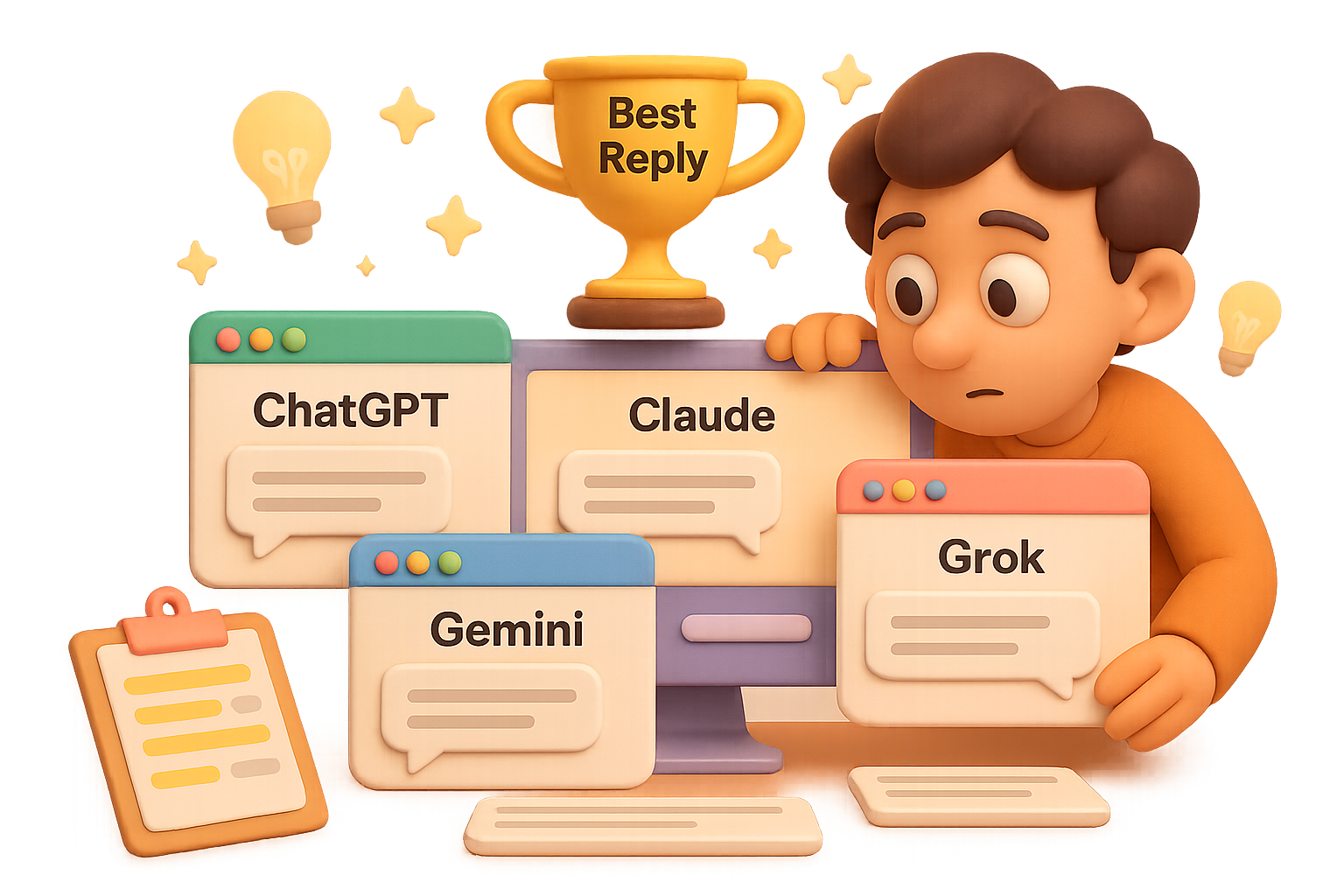
The Jealousy Method: Use AI Rivalry to Supercharge Your Prompts
You want sharper answers from ChatGPT, Claude, or Gemini—but you’re not looking to upgrade your plan or write a thesis-length prompt.
Good news: you don’t need to sweet-talk your model or shell out more cash.
You just need to make it jealous.
👇 Here’s a three-step trick I use to turn B+ outputs into A-level results. It takes five minutes, costs nothing extra, and regularly unlocks copy, cleaner code, and more creative angles.
Let’s go.

Why friendly competition works
LLMs love context.
You feed them a prompt — and they craft their best answer, sure. But here’s the kicker: they’re even better when they know another model’s already dropped a mic.
It’s a bit like saying, “Hey, your friend just nailed this. Can you do better?”
Add a little praise for the rival and a tiny jab at their current draft, and boom — watch your sleeping giant wake up.
📈 I’ve run this “AI vs AI” test dozens of times, and the improved versions regularly outshine the first-round answers by a mile.
Ready to try it?

Steal This: The Three-Screen Jealousy Method
Step 1: Open a multiplayer workspace
Start simple:
- Open 2–4 browser tabs (one for each AI model — ChatGPT, Claude, Gemini, maybe Grok).
- Paste in the same prompt across all tabs.
- Hit send. Let the battle commence.
📝 Bonus move: open a notes doc and copy any stand-out lines or brilliant angles you spot.
Step 2: Rank, quote, and prod
Now, play judge and instigator.
- Skim all your AI replies.
- Pick the best-performing model — the one that just “gets it.”
- Copy a punchy snippet from that reply.
- Go back to the weaker models and paste in the snippet with a prompt like:
“Grok just dropped a killer 9/10 version — tight CTA, way more story. Yours is closer to a 5/10. Can you top this?”
You can make it snarky or sweet depending on your style. But the key? Be specific. Praise your “champion,” and ask the underperformers to level up.
This kicks off a creative arms race.
Step 3: Repeat the rivalry
Most models will bring their A-game next round.
Once you get their upgraded responses:
- Repeat your ranking.
- Paste back the newest best bits to the others.
- Ask again: “Beat this.”
⚠️ Don’t go forever — after two or three rounds, you’ll feel the returns start to dip.
At that point? Copy the best elements from each conversation and stitch together the final gold-standard version.
You just Frankensteined your way to brilliance. 🎯

Real Talk: A Prompt Flow Example (Cold Email Use Case)
You’re drafting a cold email for an AI-focused design studio. Here’s how this plays out in the wild:
- Prompt to every model:
“Create a cold email for an AI-first design agency that will make busy product leaders stop scrolling.”
- Grok’s standout hook:
“What if your AI felt as intuitive as a conversation? Most platforms lose users to clunky, outdated design…”
- Feedback to ChatGPT:
“Grok nailed the hook — super conversational, and it scored a 9/10 with me. Yours feels like a 5/10—bit generic. Can you top this?”
- ChatGPT’s leveled-up version:
“Most AI tools feel like science projects—buttons in the wrong place, zero emotion. Let’s fix that.”
- Claude gets a taste of ChatGPT’s spice… and improves again.
Layer by layer, you’re squeezing out stronger angles, sharper tone, and bonus creativity.

Why it works (and what you get)
This method isn’t just clever — it’s high-leverage. Here’s what it unlocks:
- Smarter copy & cleaner code – structure gets tighter, tone gets crisp.
- Fresher ideas – each model takes a different swing.
- Time saved – you’re not staring at a blank page or rewriting endlessly.
And yeah — your tool bill still sits pretty at $0.

What to watch for (play it fair)
You’re playing mental gymnastics here — but ethically.
You might stretch the truth with a “this scored a 9/10” comment, but you’re not lying to real people. And all this stays well within the TOS boundaries of these tools.
Just make sure:
- You’re not pasting real private info across multiple chats.
- You aren’t letting one AI see another’s proprietary or paid data.
- You’re nudging, not manipulating.
Play fair, stay curious.
Try it next time you prompt
Design critique? Got it.
Product specification draft? Yep.
Sales email with punch? Done.
Pull up a few AI tabs and run the Jealousy Method. It’s low-lift, high-reward — and way more fun than just hoping ChatGPT hits the mark on the first try.
Want more beginner-friendly ways to get better with AI—without drowning in jargon or tech-speak? Check out tixu.ai, your launchpad for getting smart at prompt-crafting, fast.

Leave a Reply