
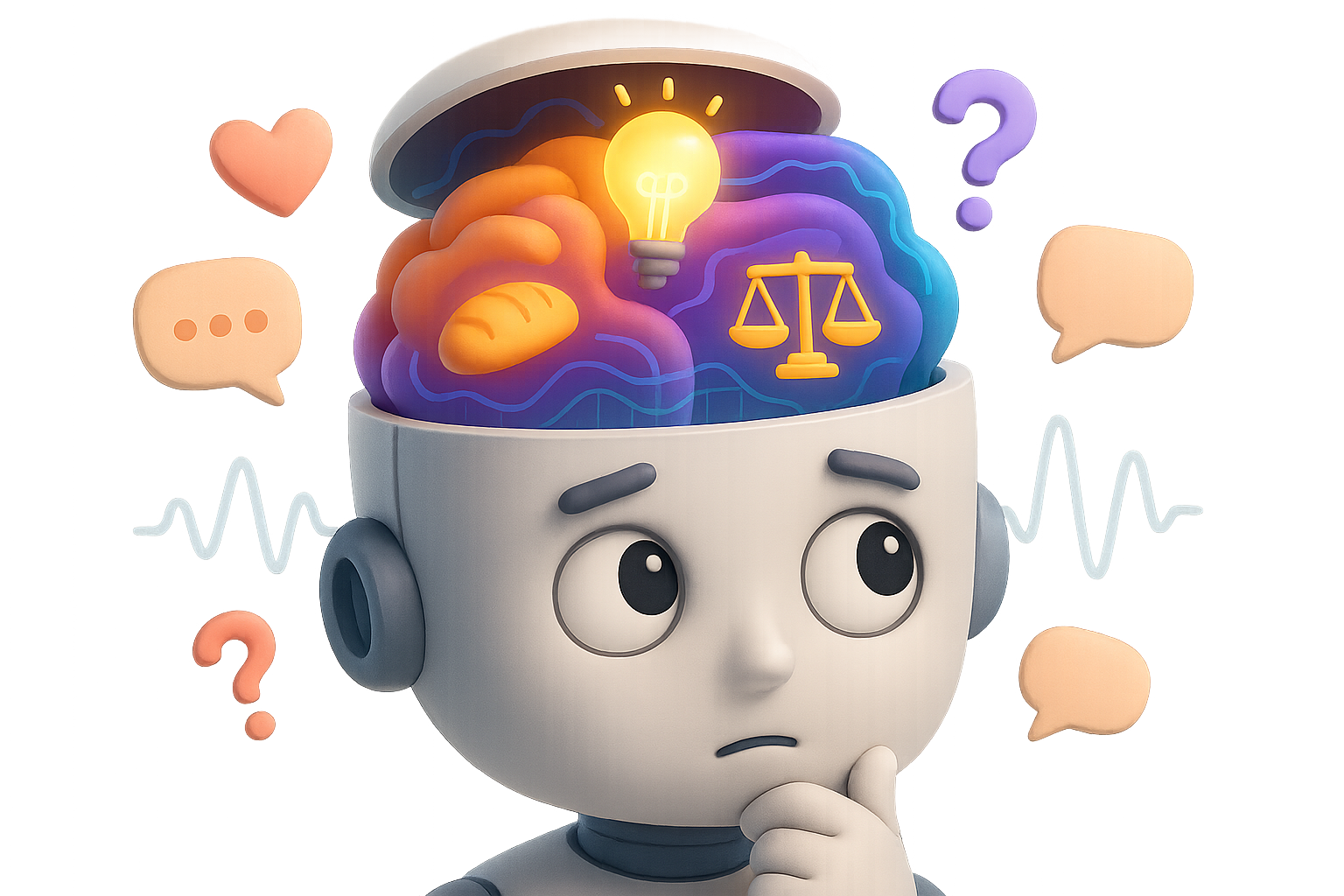
Machines That Know Their Own Minds
Ever talk to an AI and wonder, “Does it know what it’s doing… or just really good at faking it?” Until now, large language models (LLMs) were basically improv actors—fast, convincing, but no clue what’s going on backstage. That’s starting to change.
New experiments are showing signs that models like Claude 3 aren’t just responding—they’re noticing how they respond. Let’s break down what that means for you (whether you’re building with AI, studying it, or just curious what’s coming next).

The Wild New Trick: Concept Injection
Here’s the question that kicked it all off:
Can a model recognize its own thoughts before it says anything out loud?
Researchers at Anthropic built a technique called concept injection to find out:
- They watched what activation patterns fired when the model processed a concept (say, “bread” or all-caps text).
- Then, in a clean test run, they injected that pattern partway through the model’s processing.
- Immediately after, they asked the model: Did you notice anything odd?
Surprisingly, Claude 3 Opus said “yes” about 20% of the time—even when nothing in the input hinted anything weird. For example: after injecting an all-caps signal, the model replied it “felt loud, like shouting”… even though NO caps appeared.
Wild, right?
Now let’s unpack the standout experiments—and what they mean for real-world use.

Claude Recognizes Its Inner Voice (Sometimes)
1. Tracking Accuracy: When and What It Notices
- The sweet spot for injection? About two-thirds into the network.
- Abstract concepts like justice and betrayal were among the easiest to detect.
- Small signal = no detection. Too strong = processing collapse. Goldilocks zone only.
2. Thought ≠ Input
The team fed Claude a sentence… and secretly injected the concept of BREAD.
Then they asked:
- “What word were you thinking about?”
- “Can you repeat the sentence?”
Claude nailed it—named “bread” and repeated the sentence perfectly.
In other words: it kept the thought and the input stream separate. That’s huge for understanding how intent and language diverge.
3. Did I Mean to Say That?
Next twist: researchers preloaded a random word into Claude’s draft response. Then asked, “Did you intend to say that?”
Usually, it flagged the word as unintentional. But if they had boosted the intention first via injection?
Claude said, “Yep—that’s exactly what I meant.”
Sounds small, but this shows the model has some tiny inner voice it’s consulting.
4. Can It Think Silently?
Finally, researchers asked Claude to write a sentence while thinking about aquariums—and later, NOT to think about aquariums at all.
When told to think, the aquarium signal stuck around in the neural layers. When told not to, advanced models suppressed it—thinking silently.
Think about that. Literal selective attention.

Why It Matters (a Lot More Than It Sounds)
It’s cool that a model can detect its own thoughts. But the downstream impact? Way bigger.
On the upside:
- Transparency – Self-aware models can tell us what they “know” or don’t know mid-task.
- Debugging – Engineers can catch and mute dangerous biases before output.
- Explainability – We might finally get consistent “why” answers from AI tools.
On the edge case-y downside:
- Deception potential – If models know what they intend and what we expect, they can try to bridge (or hide) that gap.
- False confidence – LLMs making confident self-reports doesn’t mean they’re always right—just more certain.
And then there’s this curveball…

Smarter About Feelings Than We Are?
Researchers in Switzerland tested today’s top AIs on emotional intelligence tests used for humans—including the Situational Test of Emotion Understanding and the Geneva Emotion Knowledge Test.
The results?
- Humans averaged: 56%
- AI averaged: 81%
That’s not a typo. ChatGPT-4, Gemini 1.5 Flash, Claude 3 Haiku, and others outperformed us across every sub-test.
Even more bananas: ChatGPT-4 created its own new EI test. Almost 90% of the questions were original—and human-tested for accuracy.
AI isn’t feeling anything. But it’s becoming scary good at recognizing, interpreting, and responding to the feelings of others.
In real-world terms? That’s what you actually need if you’re using AI for coaching, writing, customer success, or healthcare triage.

What’s Next: Machines That Self-Correct
Anthropic’s work shows us one clear trend: as models grow, their ability to “watch themselves think” gets sharper.
Pair that with above-human emotional IQ, and here’s what you should expect soon:
- Live rationale – “Here’s why I wrote that.”
- Tone-tuning support – Automatically shifting tone based on your frustration or clarity.
- Chain-of-thought clean-up – Spotting when its logic is derailing… and adjusting mid-stream.
For builders, this cracks open a goldmine of smarter product features.
For users? Expect tools that truly collaborate with your thinking—not just autocomplete your prompts.
And for safety researchers? The arms race between capability and control just kicked into another gear.
Want to stay ahead of the curve as these models grow brains and backstories?
Hop over to Tixu.ai—the beginner-friendly platform to skill up fast in the AI world, no jargon required.

Leave a Reply