
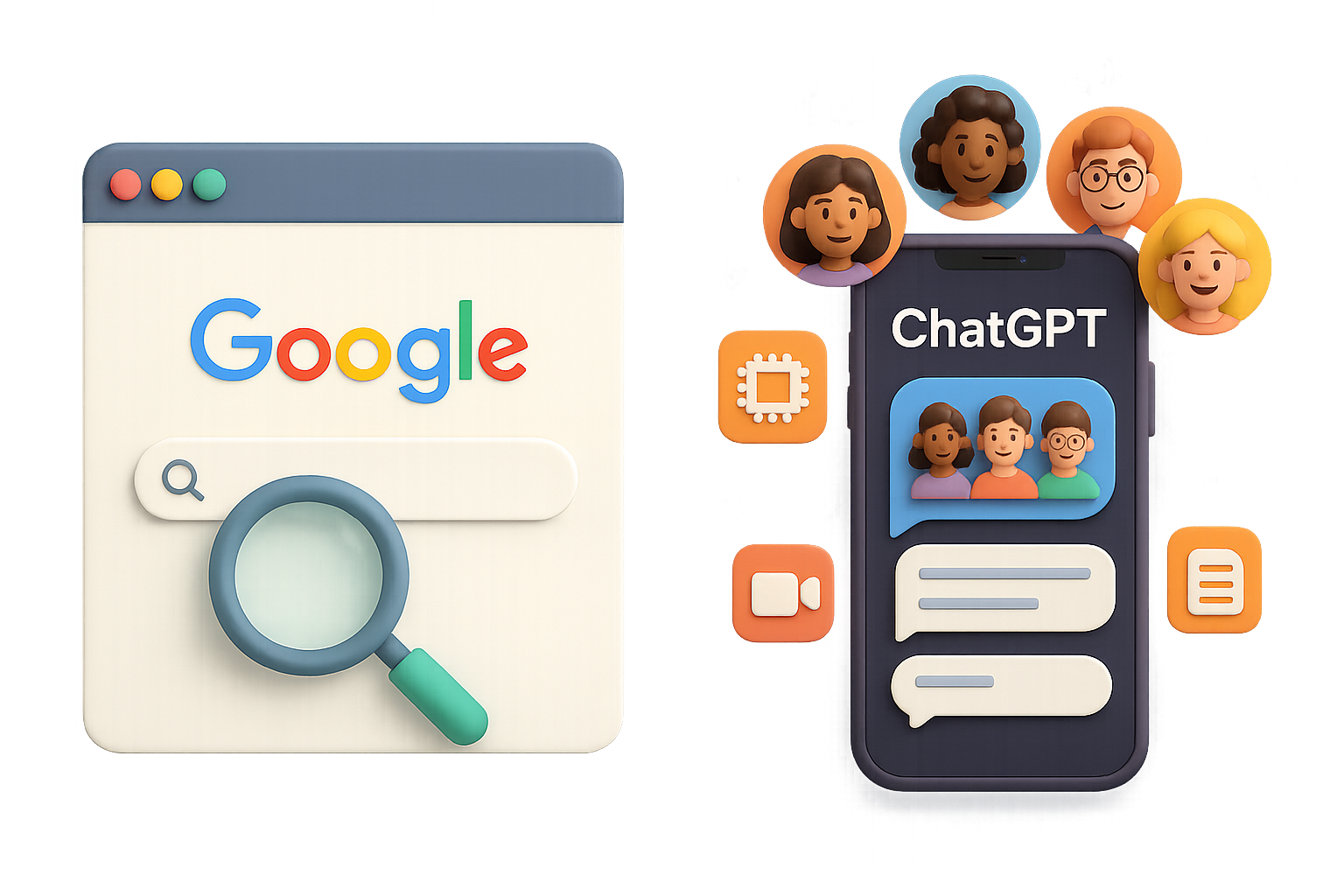
From “Just Google It” to “Ask ChatGPT”
Remember when every debate ended with someone whipping out their phone and saying, “Let’s Google it”?
Now it’s: “Let’s ask ChatGPT.”
Funny how a four-syllable switch signals one of the fastest behavior shifts in internet history. ChatGPT pulls in billions of prompts, with over 800 million people chatting it up each week. That’s not a blip—that’s a new default.
But while it might feel like a new Google is being born, look closer. It’s not search it’s reshaping—it’s your social behavior. The way ChatGPT is evolving looks less like Google 2.0… and a lot more like Facebook.
Let’s walk through why—and what it means for you as a builder, brand, or plain ol’ curious human.

Search Is Cheap. AI Chat Isn’t.
On Google, a search costs a fraction of a penny.
On ChatGPT? You’re looking at compute expenses that are 10–100× higher per prompt, depending on the model and length. Not exactly scalable on a freemium vision board.
And here’s the kicker: ChatGPT can’t lean on search-style ads. Google wins because people click and bounce—cheap pageviews, massive ad sales. LLMs? They guzzle GPU time for every follow-up like “can you rewrite that in pirate speak?”
That leaves two options:
- Get hundreds of millions of people to happily pay subscriptions (good luck), or
- Keep them hanging around long enough to make new monetization paths worth it.
Spoiler: OpenAI’s choices suggest they’re all-in on option 2.

Stay Awhile: Engagement Over Exit
Google wants you in and out. Click the link, get the answer, leave happy. Server costs stay low, ads stay effective.
ChatGPT flips that script. The more time you spend, the better.
They’re designing for stickiness:
- Memory remembers your partner’s name and your writing vibe.
- Voice mode makes it feel human—think “intelligent friend” not “robotic librarian.”
- Group chat (in testing) invites your crew to co-chat with GPT.
- Sora creates vivid videos from prompts—social candy, not dry answers.
These aren’t search features. They’re session-length features. Word-for-word, it’s Facebook playbook stuff.

From Social Graph to Context Graph
Facebook’s moat? Who you know.
ChatGPT’s emerging moat? What it knows about you:
- The PDFs you feed it at 2 a.m.
- The tone you write in when stressed.
- The business ideas you daydream on Sundays.
This is a context graph—intimate, ongoing, uniquely yours. It helps make outputs eerily spot-on.
But intimacy cuts both ways. Remember what deep user personalization did to social media? Expect the same ethical messes: privacy tangles, biases amplified, content that feels too perfect.

Racing to Own the Gateway
Google has Chrome and Android.
OpenAI? Nada. That’s why they’re sprinting into distribution before the compute bills crush them.
Peep the moves:
- Atlas – A GPT-native browser in the works.
- Hardware collab with Jony Ive – Siri who?
- Voice apps powered by Whisper – aiming straight at your AirPods.
- Plugins + GPT Store – essentially an app store inside ChatGPT.
These aren’t experiments. They’re war strategies for owning your keyboard at sunrise. That’s how Facebook got big—be the first thing people open.

So, Is ChatGPT the Next Facebook?
Not quite—no feed, no Stories, not (yet) an influencer economy.
But these signs point social:
- Design favors session time, not bounce rate.
- Personalization is life-assistant level.
- Ad models are in beta, but they’re coming fast.
- Distribution is now the battleground.
Will OpenAI pull it off? Maybe. But here’s the tension: even Meta couldn’t break mobile’s grip from Apple and Google, despite 20 years and a trillion dollars. OpenAI’s trying the same play in five years—with far higher costs per user.
So yeah, risky. But history loves a bold move.
What It Means for You
If you’re building, brand-growing, or just generally AI-curious, here’s what to pay attention to:
- Search stays, but chat eats discovery: SEO + prompt-optimization = the new skill stack.
- Design for engagement, not just answers: Long sessions, memory retention, helpful tone—these will win.
- New ad formats are inevitable: Think sponsored suggestions, native brand responses, or AI-curated product placement.
- Users will overshare: That means privacy-first UX goes from “nice to have” to brand signature.

Wrap It Up
ChatGPT’s position as the AI everyone talks to is both its edge—and its countdown clock. All it takes is one misstep (or cheaper rival) and that dominance could flip.
But if OpenAI connects the ecosystem—ChatGPT + GPTs + memory + voice + hardware—that’s not a search engine.
That’s the next great social platform.
One built on understanding who you are, not who you follow.
And it’s already in your pocket.
Ready to learn how to speak AI fluently—and build with it?
👉 Tixu is your beginner-friendly platform to get hands-on, fast. Whether you’re a dev, designer, product thinker (or all three), it’s where you level up.
Leave a Reply