
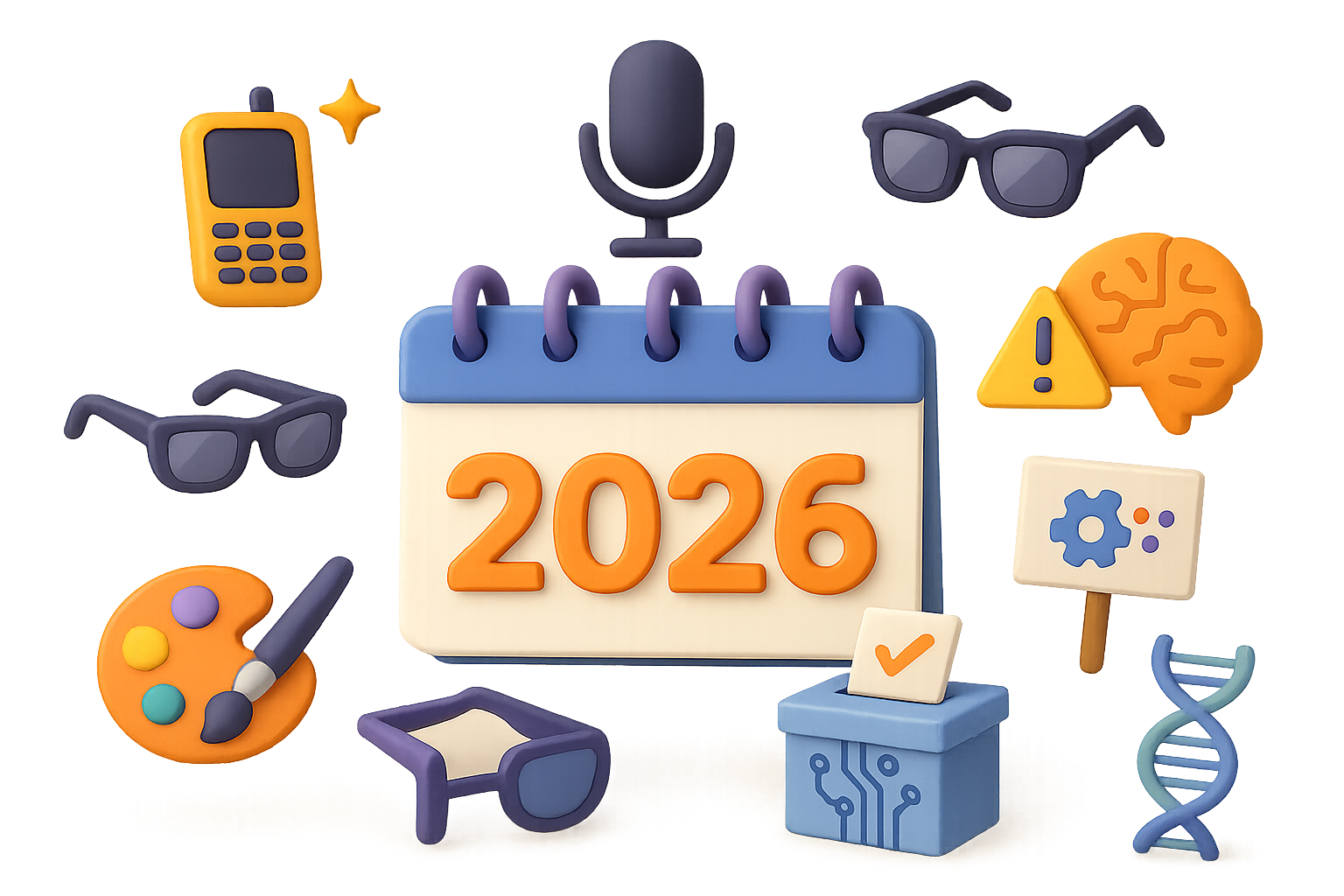
8 Tech Shifts That’ll Reshape Your Life
Feeling like tech moves faster than your morning coffee cools down? You’re not wrong—and it’s just getting started. By 2026, eight converging trends will flip how you talk, work, date, shop, and even stay healthy.
So what does that mean for you, your team, or your product? A lot. Let’s dig in.

1. Offline Life Becomes a Status Symbol
Remember when hanging out with friends didn’t have to be “documented content”? Yeah, younger users are already ditching doomscrolling in favor of dumbphones and digital detoxes. The pendulum’s swinging hard the other way.
- Flip phones? Back in fashion.
- Dating apps? Getting ghosted for IRL mixers and running clubs.
- Voice assistants now handle your routine—so your screen time drops whether you plan for it or not.
Even Meta’s adapting, pushing videos to your living room TV. Why? Because the next scroll might be no scroll at all.
If you’re a brand: Start designing for downtime. Quiet design, ambient nudges, and meeting your audience where they unplug.

2. Voice Becomes Your Default Interface
Typing is fine—until it’s not. Talking is faster, more intuitive, and way easier when your hands are full. Voice-first experiences are snowballing.
- Voice notes and audio chats are replacing DMs and emails.
- Talking to your AI beats typing to it every time.
- Call centers, online orders, customer support—all getting retooled around speech.
And with Siri, Gemini, and open models like Whisper catching up fast? You’ll be talking to tech a lot more, and tapping it a lot less.
Do this next: Run a voice-readiness audit on your customer flows. You don’t want to be the last site still forcing folks to fill out 12 fields on mobile.

3. Smart Glasses Get a Second Chance—And This Time Stick
Those Ray-Ban Meta glasses? Just the appetizer. By 2026, Apple, Google, and who-knows-who-else will be in your line of sight—literally.
- Smartphones stay in your pocket. Visuals float in front of you.
- Speak softly, get answers whispered back.
- Content’s always within view… and so are ethics debates. Think cameras and mics everywhere.
Heads-up interfaces mean the scroll economy shrinks. Your attention won’t be on a 6″ screen—it’ll be layered over the world.
Time to prototype: Create just one glasses-friendly feature or interaction. If you wait for “mass adoption,” you’ll be catching up forever.

4. AI Models Hit a Wall—and Pivot Hard
LLMs like GPT-4 and Claude 3 are powerhouse tools… but they’re also running out of calories. Why?
- The open web is running dry on high-quality, original text.
- AI is training on its own recycled content.
The pivot? “World models” that learn from video, sound, even touch sensors. Think less autocomplete brain, more real-world brain.
When one company cracks this—expect stock charts to move and product roadmaps to explode.

5. The Tech Pushback Gets Loud
Progress always meets resistance—and that’s not always a bad thing.
- Layoffs get rebranded as “AI readiness.”
- Employees demand retraining and transparency.
- Users raise red flags about thinking less and trusting deepfakes too much.
You might even see consumer boycotts or class-action lawsuits slowing the AI roll. Not every disruption gets a free pass.
Build your “resistance response” now: transparency, ethics, and a clear value exchange with users.

6. AI Joins the Ballot Box
So far, most political chatter about AI is vague at best. That changes in 2026.
At least one candidate somewhere will run with a real AI policy agenda:
- Retraining funds for displaced jobs.
- Guardrails on surveillance, disinfo, and bias.
- An actual plan for sovereign, national AI infrastructure.
Once it exists, every rival has to keep up—or fall behind.
If you’re in a regulated industry: start your scenario-planning now. Lobbying, compliance, ops—all of it gets reshaped.

7. AI-Created Content Goes Pop—and Sparks Culture Wars
At some point soon, an AI-generated song, character or feature film will hit big. Like, Grammy-nomination big. And the public split will be sharp.
- “This is the evolution of art!”
- “This is just training data stealing vibes!”
Disney’s already in. Music labels that sued AI tools in 2023? They’re now signing AI artists in 2024. Love it or loathe it, this shift isn’t optional.
Creative teams: you’ll need to decide whether to partner with AI, regulate it, or try to out-heart it.

8. A Medical Breakthrough That Changes Minds
AI isn’t just beating your chess app anymore—it’s hunting cancer.
Specialized models are learning from genomic data, medical imagery and more:
- Drug discovery timelines are dropping from years to months.
- Previously undetectable diseases are getting early ID’d.
- AI-assisted diagnoses are already outperforming some clinics.
At some point in 2026, an AI breakthrough will save thousands of lives—and shift public sentiment from “is this worth it?” to “why did this take so long?”
Tip: even if you’re not in healthcare, ripple effects will land in adjacent sectors—insurance, biotech, wellness, education, and hiring.

What to Do
Here’s your prep list:
- Audit every customer touchpoint for voice compatibility.
- Build one “heads-up” (smart glasses friendly) feature now.
- Model your response to AI regulation, labor reactions, and pushback.
- Keep a close watch on AI + science ties—big leaps will disrupt your market even if they don’t start there.
The difference between caught off guard and crushing it? Action.
These trends aren’t pie-in-the-sky speculation—they’re already in motion. Flip the script now while everyone else is still debating if they should.
🚀 Want to start learning the AI skills that’ll actually matter in 2026? Head over to Tixu.ai—a beginner-friendly AI learning platform designed to get you future-ready, fast.
Leave a Reply