Category: General

  • Build Automated Content Workflows with Gemini’s Free Tools

    Build Automated Content Workflows with Gemini’s Free Tools

    Google Gemini updates: what’s new and how to use it today

    You want less busywork and more output. Right now, Google’s Gemini adds features that do exactly that — and most of them are free to use.
    Stop fighting licensing, repetitive tasks and blank screens. Gemini now makes music, schedules actions, spins video styles and organizes assets for you. Quick wins are a click away.

    Promise: in this post you’ll get three fast wins, a step-by-step checklist, and the exact places to click first.
    Roadmap: Create music → Automate routines → Make videos → Clean up assets → Try this checklist.

    illustration

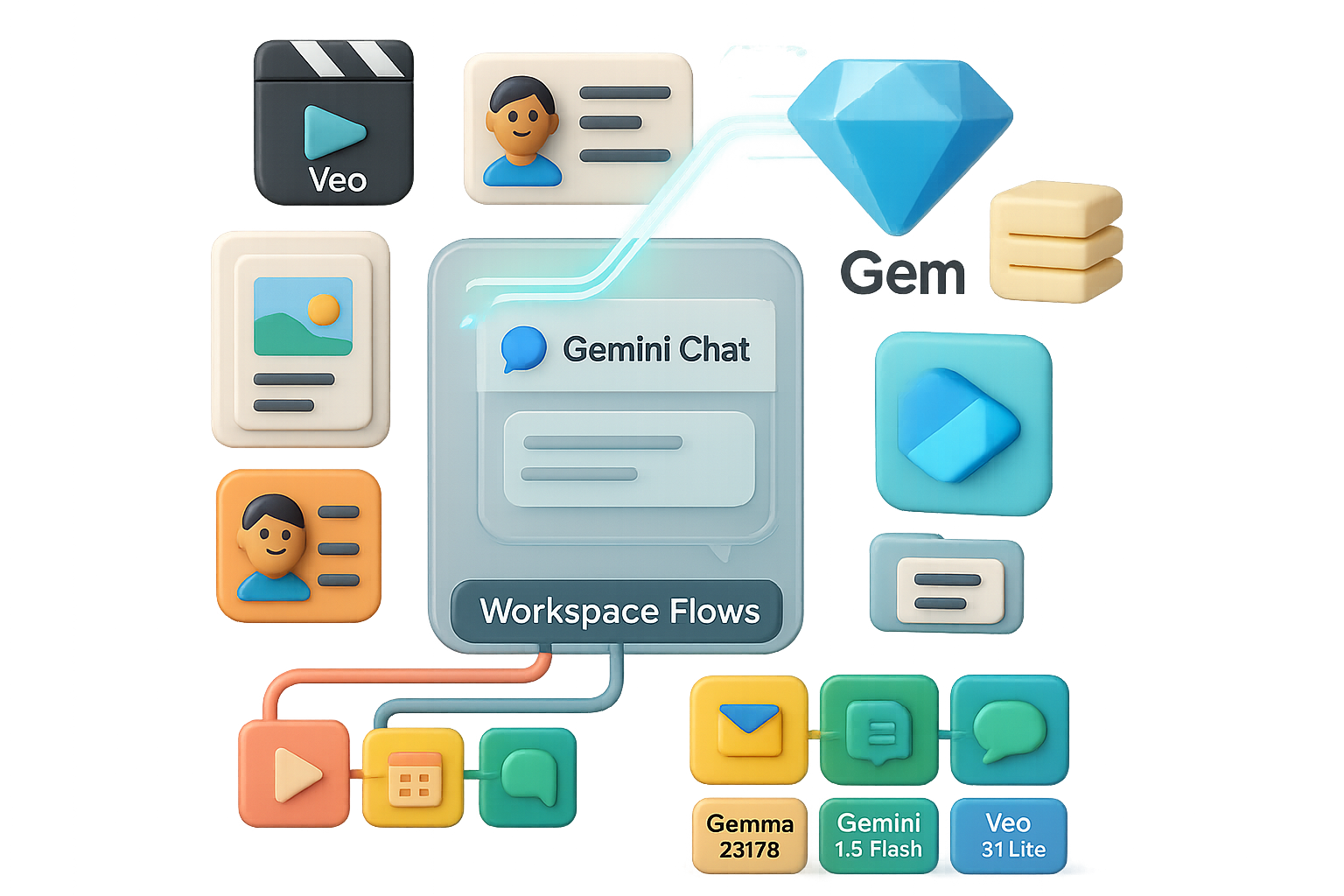
    Create royalty-free music in seconds with Gemini

    Click one button. Describe the mood. Download a finished track. That’s it.

    illustration

    How it works

    1. Click Create music in the chat sidebar.
    2. Describe the track (“30‑second upbeat loop for YouTube intros”).
    3. Gemini refines your prompt, then produces a mixed track and matching cover art in under a minute.
    4. Download MP3 or a video file with artwork.
    illustration

    Ideas to try

    • A Valentine’s Day ballad in the style of 90s pop.
    • A reggaeton instrumental for workout reels.
    • A pet’s-eye-view nostalgic tune.
    • Ambient focus music for deep work.

    Mini-win: one creator I know replaced licensed intros with Gemini tracks and cut licensing costs to zero. Ready when you are.

    illustration

    Automate the grunt work with Gemini scheduled actions

    Turn any prompt into a hands-off workflow. Set it once, let Gemini run it on a schedule.

    illustration

    What you can do

    • Run daily, weekly or monthly routines (pick exact days/times).
    • Drop instructions once; Gemini executes them on schedule.
    • Get results in chat or by email.
    illustration

    Example routines

    • 9 a.m. sponsor-inbox sweep that drafts replies.
    • Morning news digest that pulls headlines from your sources.
    • Daily content-idea generator for Instagram, YouTube and TikTok.

    Tip: rename templates and add your briefing. Swap “Writing inspo” for “Content inspo” and you’ll get tighter results.

    illustration

    Ship consistent videos in 1–2 minutes with V3.1 Fast

    Blank video prompt? Use a style template and skip the paralysis.

    illustration

    How to use it

    • Open Create content with V3.1 Fast.
    • Pick a theme: Cyberpunk, ASMR, 8‑bit, Cosmos, Racing, etc.
    • Describe your scene (“Video-game style animation set in Big Sky, Montana”).
    • Gemini combines your scene with the style and returns a share-ready clip in 1–2 minutes.

    Why this helps

    • Instant inspiration when you’re stuck.
    • Consistent branding across a series of clips.

    All your assets, one place: My stuff

    Stop scrolling through chat threads. The My stuff tab saves you sanity.

    illustration

    What it does

    • Auto-organizes documents, images, audio and video.
    • Filter by asset type or search by name.
    • Download or reuse assets fast.

    Do this next: open My stuff, filter for “audio”, and tag that 30‑second theme you loved.

    Power under the hood: Gemini 3.1 Pro (and what’s next)

    Gemini’s default model upgrades to Gemini 3.1 Pro. Use it when you need reliability.

    Strengths

    • Coding wizardry — complex implementations, debugging and documentation.
    • Agentic tasks — multi-step jobs like “Plan event → create budget → draft emails.”

    Pro tip: when running actions in Chrome or using agent features, select Pro for best results. Google will also release Gemini 3.1 Flash, a cheaper, faster option for developers to reduce costs without losing quality.

    Level-up training opportunity

    If you want structure, join the free two-day “AI Mastermind” by Outskill (weekend, 10 a.m.–7 p.m. ET). Highlights:

    • Build agents that plan, write, execute and report.
    • Connect Sheets, Notion, CRMs and email into self-running systems.
    • Real-world case studies showing hour savings and revenue paths.

    Attendees leave with playbooks, toolkits and actionable templates. Worth a look if you prefer guided learning.

    illustration

    What to try first — quick checklist

    1. Generate a 30‑second theme song for your next presentation.
    2. Create a scheduled action that sends you a daily “Top 5 AI news” briefing.
    3. Pick a V3.1 Fast video template and swap in brand colors for a hero loop.
    4. Open My stuff and organize old assets into folders.
    5. Test Gemini 3.1 Pro on a multi-step coding task and compare the agentic results.

    Recap + CTA

    Gemini removes friction from creative and professional work. Try one feature today and reclaim hours tomorrow.

    Want a guided path to building practical AI skills? Start with Tixu — a beginner-friendly AI learning platform that walks you from basics to build-ready projects.

  • Master AI Fluency in 3 Months: 5-Phase System

    Master AI Fluency in 3 Months: 5-Phase System

    A 5-Phase Roadmap to AI Fluency in 3 Months

    Most people open an AI chat window, type “write a post for me,” sigh at the bland result, and close the tab. Meanwhile, teams that treat AI like a skill are pulling ahead. Want that for yourself? Here’s a simple, time-boxed plan to move you from curious to confident in about a quarter.

    illustration

    Phase 1 — Build AI Fluency Foundations (Week 1)

    Get access. Get habits. Stop hunting for tools mid-task.

    • Keep an LLM pinned in a browser tab. ChatGPT, Claude, Gemini or Grok—your pick. If you think “I should Google that,” ask your model first.
    • Talk more, type less. Dictation speeds brainstorming and keeps momentum.
    • Carry it with you. Install official mobile apps so ideas don’t die in queues.
    • Capture meetings. Auto-transcribe with tools like Grain or Fathom and save the text.

    Do this week right and you turn awkward starts into instant momentum.

    A person sitting at a desk with a tablet showing a video call, surrounded by various blank cards and buttons, indicating an interactive or learning activity.

    Phase 2 — Turn AI into Your Personal Coach (Week 2)

    This week is for thinking better, not outsourcing.

    • Ask the model to interview you about goals and blockers.
    • Feed it a call transcript and ask for themes, blind spots, and a two-week plan.
    • Draft the questions you should ask your manager or client.

    Treat the model like a smart colleague who misses context. You provide context. It sharpens the view. You accept or reject its advice.

    illustration

    Phase 3 — Promote AI to Junior Worker (Weeks 3–4)

    Hand over grunt tasks, keep the taste.

    Follow the 10–80–10 Rule:

    1. First 10% — You: outline the task, paste examples, set tone and constraints.
    2. Middle 80% — AI: let it do the heavy lifting (lists, drafts, clean-up).
    3. Final 10% — You again: add nuance, stories, and human judgment.

    Example prompt for a social manager: “Here’s our video transcript, three competitor Reels, and our brand voice. Generate 20 hooks under 20 words each. Avoid rhetorical questions; favour pattern interrupts.”

    Iteration beats one-and-done. If five hooks shine, ask for variations. Repeat.

    illustration

    Phase 4 — Systemise for AI Fluency (Month 2–3)

    Version-control prompts like recipes.

    • V1: Basic request.
    • V2: Add counter-intuitive angles.
    • V3: Limit length.
    • V4: Ban rhetorical questions.

    Store mature prompts in TextExpander, Notion, or a prompt manager. Use shortcuts to drop full instruction sets wherever you work.

    A/B-test models. Maybe Claude nails strategy while ChatGPT excels at hooks. The library helps you swap engines without rethinking everything.

    illustration

    Phase 5 — Let AI Fade Into the Background (Month 4+)

    Automation is the graduation ceremony.

    1. Use built-ins. Notion AI, Premiere Pro add-ons, and other plugins already save time.
    2. Connect with no-code. Zapier or Make.com can auto-transcribe, summarize, and share.
    3. Move to advanced flows. n8n gives branching, loops, and error handling.
    4. Build mini-apps when needed. Retool, simple Python scripts, or microservices pay back fast.

    Automate only repetitive, high-value tasks. Sometimes the best automation is deleting the step.

    illustration

    Flip the script

    AI won’t replace you—someone better at AI will. Learn the basics, and you keep control of the work that matters.

    illustration

    Quick wins and numbers that matter

    • Locking the chat tab and using dictation saves you 20–30% on initial draft time in month one.
    • A single prompt library can cut repetitive prompt rework by 50–70%.
    • Mini-automation (transcribe → summarize → Slack) can eliminate three weekly tasks for most teams.
    illustration

    Do this next (30–60 minutes)

    1. Pin an LLM in your browser and install the mobile app.
    2. Turn on dictation and transcribe one meeting this week.
    3. Create a “Prompt Library” page and save your best prompt as V1.
    4. Automate one repeat step with Zapier or a native plugin.
    illustration

    Three habits that keep you scaling

    • Ship drafts fast. Iterate faster.
    • Save prompts. Version everything.
    • Automate only the boring stuff.

    Recap + CTA

    Give yourself 90 days: foundations, coach, worker, system, infrastructure. You move from dabbling to delivering.

    Ready when you are. Start the 30–day habit loop and learn the how-to with beginner-friendly lessons at tixu.ai — a hands-on AI learning platform built for people who want to use AI, not just admire it.

  • Launch 4 Profitable AI Side Hustles in 2026

    Launch 4 Profitable AI Side Hustles in 2026

    How to Turn Generative AI Into Extra Income — Four Beginner-Friendly Ideas

    You want extra income that doesn’t eat your evenings. Good news: generative AI lets you build assets that sell while you sleep. No coding degree. No inventory. Just smart prompts, a few cheap subscriptions, and consistency.

    Flip the script: AI won’t replace you—someone better at AI will. Learn a few practical moves now and that someone won’t be you. Ready when you are.

    What you’ll walk away with: four concrete side hustles, a starter budget for each, and a one-week action plan. Here’s the roadmap: Ambient YouTube loops, Print-on-Demand designs, Digital downloads, and KDP books. Each section ends with a quick checklist so you can start today.

    illustration

    Launch ambient YouTube channels that earn while you sleep

    Those aquarium and fireplace videos? Mostly AI images and a simple editor. You publish long, calming loops people use as background. That watch time turns into real ad revenue.

    What you publish

    • 1–3 hour 4K visual loops (static + subtle motion).
    • Niche backgrounds: cherry-blossom season, cyberpunk skylines, cozy cabins.
    • Optional soft-spoken narration from an LLM for higher RPMs.

    Tool stack (quick explainer)

    • Midjourney / Leonardo.AI / Adobe Firefly — generate images.
    • CapCut / DaVinci Resolve / Canva — assemble video timeline.
    • ChatGPT / Claude / Grok — write voice scripts.
    • ElevenLabs — lifelike voiceover.

    Costs & upside

    • $10–$40/month for image and editor plans.
    • Example: 1M views/month at $1–$3 RPM → $1,000–$3,000 passive income. Higher-value niches push RPM to ~$15.

    Quick checklist

    1. Batch-create 4 seasonal packs (spring/summer/fall/winter).
    2. Render 2–3 hour loops with gentle zooms.
    3. Upload weekly and build playlists.

    Mini-story

    Carlos uploaded a four-video seasonal pack and hit 1M monthly views within two months. He now earns about $2,200/month in ad revenue.

    illustration

    Sell print-on-demand designs that scale

    Print-on-demand removes inventory headaches. Generative AI fast-tracks design creation so you can test dozens of concepts per week.

    Three-step workflow

    1. Market hunt — spot trends with EverBee or look at Etsy best-sellers.
    2. Create — prompt Midjourney or Leonardo to make high-res PNGs or vectors.
    3. Publish — push to Printful/Printify/Gelato and list on Etsy, Amazon, TikTok Shop.

    Starter budget

    • Design & research tools: $30–$60/month.
    • Optional paid ads: $5/day test budgets.

    Revenue potential

    • A viral tee selling 5,000 units at $7 profit = $35,000.
    • New shops often reach $10,000/month by releasing 200–300 focused listings.

    Pro tips

    • List the same file across multiple marketplaces.
    • Reuse elements to create themed bundles.

    Mini-story

    Sam’s retro ski design sold 4,500 shirts in six months. He pulled $30K in profit and used 20% of it to boost the next design.

    illustration

    Create digital downloads: wall art, templates & bundles

    Digital downloads mean repeat sales with near-zero marginal cost. AI lets you spin up hundreds of variations fast.

    Hot niches

    • Nursery print sets, abstract printable art, resume and Notion templates.
    • Bundle 6–10 coordinating prints to increase average order value ($8–$15 per sale vs $2).

    Build the catalog

    • Use Midjourney’s describe feature or Ideogram.ai to match best-selling styles.
    • Mock up prints in Canva and create listing packs.

    Numbers to know

    • 300–500 quality listings can generate $5,000–$20,000/month once you gain traction.
    • Startup costs: $10–$30/month for image plans, plus Canva Pro if you want polished mockups.

    Traction tip

    • Launch on Etsy first for built-in traffic; then mirror on Gumroad and Creative Market.

    Mini-story

    Lina created 120 printable nursery sets and reached $6,500/month after six months of listings and a small Etsy promo.

    illustration

    Publish AI-written & illustrated books on Amazon KDP

    KDP prints on demand. You can launch picture books, activity books, and short guides with AI-generated text and art.

    What sells

    • 20–32 page children’s picture books, guided journals, quick-read collections.

    Production recipe

    1. Outline in ChatGPT or Claude (age, tone, learning goals).
    2. Generate consistent illustrations in Midjourney or Firefly (reuse seeds).
    3. Assemble in Canva or Affinity Publisher and upload PDFs to KDP.

    Cost & earnings

    • Mostly just the image generator subscription.
    • Beginner titles often earn $500–$4,000/month; series scale faster.

    Differentiation trick

    • Offer a matching printable activity pack on Etsy and link it in your KDP author bio.

    Mini-story

    Ana released a three-book kids’ series and bundles the printable activity sheets on Etsy. Combined, she clears about $1,200/month.

    Do this next (action box)

    • Pick one idea above.
    • Spend one weekend making a minimum viable product (MVP).
    • Publish the MVP and promote it for 7 days.
    • Measure clicks, sales, or watch time. Iterate.
    illustration

    Short checklist to start in 7 days

    1. Choose niche + platform.
    2. Create 5–10 assets with your AI tool of choice.
    3. Publish and schedule promotions (social posts, a small ad test).
    4. Reinvest first profits into a paid boost or more listings.
    illustration

    A few final reality checks

    • This isn’t get-rich-quick. It’s test-and-scale.
    • You’ll learn faster by shipping than planning forever.
    • Small wins compound: a $1,000/mo asset plus another $500/mo asset quickly becomes meaningful.

    Pick a lane, publish your first asset this week, and level up your AI skills at Tixu — a beginner-friendly AI learning platform with step-by-step courses: Tixu

  • Master 9 AI Skills to Get Ahead of 99%

    Master 9 AI Skills to Get Ahead of 99%

    Stop Playing in Beginner Mode: 9 AI Skills That Instantly Put You in the Top 1% (

    You treat AI like a novelty tool. That’s fine—until someone else treats it like a productivity engine. Ready to stop dabbling and actually gain ground? Good. This post shows the nine skills that move you from curious to dominant. You’ll get a clear win, a repeatable roadmap, and quick actions to practice today.

    Quick promise: master these, and you’ll cut busywork, surface blind spots, and learn faster. Roadmap: each skill includes a short how-to, a tiny checklist, and a “Do this next” action. Let’s go.


    illustration

    1. Speak AI’s native language — Prompt Engineering

    AI answers what you ask for. Ask poorly, get meh. Ask precisely, and it performs.

    Prompts need four parts:

    • Role: “Act as a growth marketer.”
    • Context: project, audience, constraints.
    • Command: “Write a 300-word LinkedIn post that…”
    • Format: bullets, table, or draft copy.

    Pro tip: paste an example of world-class output so the model can pattern-match.

    Do this next:

    • Create a 1-paragraph role, 2-line context, and exact output format. Paste it into your next chat.

    2. Be the taste curator — Know great when you see it

    AI generates 100 variants. You keep the two that matter.

    Build your taste:

    • Save top examples in a folder.
    • Name the qualities you want: “evocative, concise, 8th-grade.”
    • Write down style rules so AI follows them.

    Tiny success: Priya cut product copy revisions by 60% after curating a library.

    Do this next:

    • Collect three pieces of “best in class” work for your next project.

    illustration

    3. Create a master prompt — Your digital ID

    If ChatGPT feels inconsistent, you haven’t introduced yourself.

    Steps:

    1. Ask the model to interview you for role, goals, tone.
    2. Answer with details—voice notes okay.
    3. Tell it to output a concise master prompt and save it.

    Upload this each time you start a new chat. One upload, instant personalization.

    Do this next:

    • Make a 200–300 word master prompt and save as a PDF or note.

    A digital interface displaying a content review process with versions (V1, V2, V3), feedback options for clarity, tone, and length, and actionable steps for revisions, including a 'Publish-ready' status.

    4. Iterate like a pro — Fight for perfect

    Pros never accept the first draft. They shape it.

    Best moves:

    • Start every session with your master prompt.
    • Give specific feedback: “Open with a counter-intuitive stat,” not “Make it punchier.”
    • Ask for an editable canvas for fine edits.

    Numbers matter: teams that iterate outputs report much higher adoption and speed. Push the model until you get the version you’d publish.

    Do this next:

    • Take one recent AI output and run three specific revision prompts.

    illustration

    5. Write system prompts — Program with words

    A system prompt tells the AI how to think, not what to write.

    How to build one:

    1. Pick an output you love.
    2. Ask the model: “What system prompt would generate this?”
    3. Save and reuse it across tools.

    Bonus: paste into a Custom GPT or shared doc so your team uses it with one click.

    Do this next:

    • Turn a favorite output into a system prompt and store it where teammates can access it.

    illustration

    6. Make AI your toughest critic — Ask for pushback

    By default, models placate. Make them disagree.

    Tactics:

    • Set role to “devil’s advocate.”
    • Ask for first-principles analysis.
    • Update your master prompt when it exposes a blind spot.

    Mini-story: Carlos added $1.2k in his first month after the model flagged a pricing assumption.

    Do this next:

    • Run your next idea through a “devil’s advocate” prompt before you ship.

    A colorful 3D illustration of a document press machine surrounded by stacks of smiling paper sheets and a magnifying glass, conveying a theme of document processing and organization.

    7. Compress context — Feed the signal, not the noise

    Models struggle with bloat. Trim first.

    Process:

    1. Dump raw transcripts and notes.
    2. Prompt: “Summarise key facts and reduce to 10% length.”
    3. Ask what was removed and restore if needed.
    4. Use the compressed file as your only context.

    This keeps the model focused and faster.

    Do this next:

    • Compress one long doc and use it as context in your next chat.

    8. Garden your knowledge base — Keep your AI workspace tidy

    Messy inputs give messy outputs. Organize once, save future headaches.

    Your garden:

    • Project folder per initiative.
    • Store master prompt and compressed context.
    • Label system prompts in a PDF library.

    Future-you thanks present-you. Teams scale faster when knowledge lives in a predictable place.

    Do this next:

    • Create one project folder and add your master prompt plus compressed context.

    9. Use AI as your personal tutor — Learn faster, smarter

    AI becomes your study buddy if you ask it to be.

    How:

    1. Tell the model your goal and time budget.
    2. Set reading level and style.
    3. Ask for audio or flashcards and listen while you do other things.

    Learners who use short, spaced sessions often double retention versus passive reading. Do this daily and you’ll compound skills quickly.

    Do this next:

    • Ask AI for a 7-minute explainer on something you want to learn. Hit play.

    Recap + Next Step

    Stop playing in “beginner mode.” Master these nine AI skills, and you move from tinkerer to top 1%. Pick one skill, practice it for a week, and add the next.

    Ready when you are. Start with guided lessons and hands-on exercises at tixu.ai — a beginner-friendly AI learning platform that walks you from basics to practical mastery: tixu.ai

  • Master Four AI-Proof Skills in 30 Days

    Master Four AI-Proof Skills in 30 Days

    These Days “I Can Use ChatGPT” Isn’t a Flex—It’s the New Minimum

    You already know ChatGPT. So does everyone else. Saying you “can use ChatGPT” now reads like saying you can use email. That’s the problem — and the opportunity.

    Master four complementary skills and you stop being an AI dabbler. You become someone who gets real leverage from language models, vector DBs, and automation. Walk away with practical moves you can apply tomorrow. No fluff. Big payoff.

    Here’s the roadmap: pick the right mode for each task, design workflows that scale, tell the story people remember, and protect your judgment. Let’s dive.

    Pick the Right Mode: Autopilot, Collaborate, or Manual

    Decide when to delegate, when to team up, and when to go hands-on. Treat your work like a cockpit.

    Think like a pilot:

    • Cruising? Flip on autopilot and monitor.
    • Take-off or landing? Collaborate with the systems.
    • Emergency? Grab the yoke: manual.

    Use Mollick’s agentic cost–benefit lens:

    1. Human baseline time — How long unaided?
    2. Probability of AI success — How often does the model nail it?
    3. AI process time — Prompting, waiting, verifying.

    Quick examples:

    • Spreadsheet clean-up: human 2 h, AI success high, AI process 15 min → Autopilot.
    • High-stakes client deck: human 10 h, AI success medium, AI loops 4 h → Collaborate.
    • Politically charged Slack reply: human 3 min, AI success low, AI process 30 min → Manual.

    Rule of thumb: Delegate tasks that are slow for you, easy for the model, and quick to evaluate.

    A collection of colorful 3D elements representing a workflow with headers 'Map,' 'Label,' and 'Automate,' featuring icons like a flowchart, labels, and a robotic arm, along with percentage and data indicators.

    Build the Rails: Make Work Repeatable and Fast

    AI without workflows is a toy. Rails = leverage.

    A single prompt can get you partway. Andrew Ng found code-gen success rose from 48% to 95% after adding “run, test, troubleshoot” steps. Harvard and BCG tracked 758 consultants: teams that engineered handoffs or micro-step AI integration outperformed others by 19 percentage points.

    Three-step starter kit:

    1. Map the deliverable. Break it into repeatable steps.
    2. Label each step: autopilot, collaborate, manual.
    3. Automate the autopilot steps first.

    Mini-story: Carlos automated his weekly outreach sequencing and A/B tests. He spent two afternoons building the rails. First month: an extra $1.2k in pipeline and 60% fewer manual hours.

    Do this next:

    • Pick one recurring output this week (report, hiring pipeline, ad set). Map it. Automate one box.
    illustration

    Storytelling Mode: Turn Data Into Decisions

    Numbers inform. Stories move people.

    Two formats that work every time:

    • ABT — And, But, Therefore. Simple conflict → resolution.
    • SCQA — Situation, Complication, Question, Answer. Consulting-grade clarity.

    Why this matters: models can list facts, but they don’t craft the “so what.” You do. Add conflict and resolution and people remember the point. Leave data alone and you sound interchangeable. Wrap it in story and you stay irreplaceable.

    Quick template you can copy:

    1. Situation: one clear fact.
    2. Complication: what’s blocking success.
    3. Question: the key decision.
    4. Answer: the recommended move + one evidence bullet.
    illustration

    Manual Override: Keep Your Brain in the Loop

    AI is a tool, not a replacement for judgment. Over-reliance atrophies skill.

    Evidence matters: studies find drivers and knowledge workers who lean too hard on navigation or first-output AI can lose critical evaluation habits. Radiologists who form their diagnosis first, then use AI as a second opinion, keep higher accuracy.

    Two habits to build:

    1. Think first, prompt second. Draft your hypothesis or outline before chat. Five minutes matters.
    2. Interrogate output. Ask: “How would I verify this?” or “What’s the strongest counter-argument?”

    These habits preserve your decision-making edge. Technology helps — but only when you stay intentional.

    A colorful clipboard with multiple blank sections, accompanied by various shapes and icons including circles, triangles, and stars, representing tasks and notes.

    Putting It All Together — A Practical Checklist

    • Cockpit Rule: use Mollick’s cost–benefit lens to choose mode.
    • Build the Rails: automate repeatable pieces and test them.
    • Storytelling Mode: package conclusions in ABT or SCQA.
    • Manual Override: draft first; challenge always.

    Two quick numbers to remember:

    • A repeatable workflow can lift effective output by 2x or more.
    • Automating obvious autopilots often returns value in days, not months.

    Final takeaway: “I know ChatGPT” stops being a resume line. Mastering these four skills turns it into a real competitive edge.

    Ready when you are. Try a hands-on AI challenge and practice these moves at tixu.ai

  • Automate Repetitive Tasks with Co-Work Skills in 3 Steps

    Automate Repetitive Tasks with Co-Work Skills in 3 Steps

    Why Claude Co-Work Feels Like the Future of Daily Knowledge Work

    You waste time toggling tabs, copying files, and repeating the same steps. Sound familiar? Claude Co-Work flips that script. It turns a chat model into a teammate that reads folders, calls APIs, runs tiny scripts, and stitches workflows together for you. Expect faster outputs, fewer mistakes, and more headspace for the big thinking.

    In this guide you’ll get a quick promise, a clear roadmap, and hands-on steps to ship value from day one. Ready when you are.


    illustration

    Get Claude Co-Work running in 5 minutes

    What you’ll walk away with: a working Co-Work setup, at least one useful skill, and a simple daily task automated.

    Set-up checklist:

    1. Paid Anthropic account (Pro, Team, or Enterprise).
    2. Latest Claude desktop app for macOS or Windows.
    3. A folder you’ll grant read/write access to for experiments.

    Open the Co-Work tab. Grant access to that folder. Claude is now able to act on your files. Try a quick command: “Summarize files in this folder.” You’ll see results in seconds.

    Early testers report 20–40% time savings on repetitive tasks. Try it on one high-volume task and measure. Numbers keep you honest.


    illustration

    Give Claude eyes and hands (so you don’t babysit)

    When you point Claude at a folder it can:

    • Summarize and search contents.
    • Batch-rename or move files.
    • Create sub-folders by type or date.

    Tip: create a dedicated “Context” folder. Drop your brand voice, product specs, and persona notes there. Claude pulls that context automatically when you ask for marketing copy or briefings. No re-uploading. No re-explaining.

    Mini-story: Carlos taught Claude his brand voice and saved a day each week. He repurposed one video into a newsletter, social posts, and a landing page. Result: $1.2k extra revenue in month one.


    illustration

    Connect your software stack (without developer drama)

    Co-Work ships with one-click connectors: Notion, Google Drive, HubSpot, and more. For tools not listed, you have three practical options:

    1. Custom JSON connector — drop API creds into claude-desktop/config.json. (Half a dozen lines.)
    2. n8n webhook — build a small workflow in n8n, expose it, and point Claude to the webhook.
    3. Autonomous browser mode — ask Claude to open a web app and perform UI actions. It runs headless in the background while you keep working.

    Because tasks run in parallel, you can ask Claude to scrape data, while drafting emails. Multiply that by five recurring tasks and your week looks different.


    An illustration depicting a yellow folder with documents, a progress bar with arrows, and various organized files in a blue container. The design incorporates symbols representing documents, communication, and organization.

    Make Skills in Claude Co-Work (your reusable superpower)

    Think of Skills as Lego bricks for your workflows. Each skill contains:

    • A clear instruction set (system prompt).
    • Optional reference files.
    • A list of tools Claude can call.

    How to install a skill:

    • Download a skill ZIP.
    • Open Co-Work → Settings → Capabilities → Add → Upload skill.

    How to build one in 15 minutes:

    1. Do the task once with Claude guiding you.
    2. At the end, say: “Save what we did as [skill name].”
    3. Claude bundles the conversation, files, and steps into a skill.

    Next time, paste a link or drop a file and say, “Use the Newsletter Repurposer skill.” Claude runs the whole flow. That’s repeatability.

    Where to look for skills:

    • Smithy.ai/skills — large community library.
    • SkillHub.ai — curated marketing/data skills.
    • SkillsMVP.com — niche templates for design and ops.

    Pro tip: migrate your best ChatGPT prompts or n8n flows into skills. Trigger them without switching apps.


    A 3D illustration of a transparent container filled with sand, featuring icons such as a lock, email, code snippet, and various document types including tables and CSV. An interface shows buttons for 'Sandbox' and 'Approve'.

    Run tiny code safely (and get real outputs)

    You’ll see a Run button whenever Claude suggests Python. Typical wins:

    • Quick CSV profiling and charts.
    • Batch image resizing.
    • Regex-heavy text cleanup.

    Code runs in a sandbox. You keep control. Want a chart emailed daily? Build the script, save it in a skill, add your email connector, and call it a morning ritual.


    illustration

    Daily workflows to steal and adapt

    Try one of these this week:

    • Organize your Downloads folder every Friday.
    • Pull yesterday’s sales CSV, chart revenue vs. ad spend, and email the chart.
    • Draft five ad copy variations in your brand voice and push approved drafts to Ads Manager.
    • Research competitor landing pages, store screenshots in a “Swipe File,” and create a summary memo.

    Pattern: show Claude once, save as a skill, refine it. Repeat.


    illustration

    Do this next (a short action box)

    1. Pick one recurring task that takes 20+ minutes each week.
    2. Open Co-Work and grant folder access.
    3. Run the task with Claude, then ask to “Save as skill.”
    4. Test the skill on a fresh item and measure time saved.

    illustration

    Why this matters (flip the script)

    AI won’t replace you—someone better at using AI will. You can either automate the grunt work or keep doing it. Learn to design a few skills and you join a small cohort that gets outsized results.

    Quick litmus test before you ship:

    • Is the intro hooky?
    • Are sentences skimmable?
    • Does each section drive a benefit or action?

    If yes — ship it.


    illustration

    Parting thought and one-line CTA

    Claude Co-Work shifts busywork to the background so you focus on the strategic work that actually moves the needle. Try automating one task this week.

    Want a friendly way to learn practical AI skills and get hands-on tutorials? Visit tixu.ai — a beginner-friendly AI learning platform to level up fast: tixu.ai

  • Master 6 AI Skills to Earn $500K by 2027

    Master 6 AI Skills to Earn $500K by 2027

    Master these AI skills before 2027 (and actually make money from them)

    You can treat AI like a shiny optional toy — or you can treat it like the career lever it already is. In the next 24 months, AI will be the single biggest force-multiplier for solo professionals and small teams. Master just one of the skills below and you can sell your expertise or ship a revenue product on the side. Combine two and the ceiling disappears.

    What you’ll walk away with: a clear list of six high-upside AI skills, the tools to try first, and a 30-minute habit to turn learning into cash. Ready when you are.

    A 3D rendered illustration of a laptop displaying a flowchart, surrounded by various icons and data representations, suggesting digital communication and information flow.

    Ship apps in days — AI-Powered Coding

    Why this pays

    • Teams report shipping 2–4x faster using no-code + AI workflows.
    • Non-technical teams already build “micro-apps” that save orgs millions. Demand exists beyond startups.

    Tools to try

    • Bubble — no-JS app builder. Build a landing page or a small SaaS without code.
    • Bildr — visual front-end builder that exports clean React code.
    • Baserow — open-source database + backend for non-devs.
    • For devs: Claude Code workspace and Cursor speed up debugging and refactors.

    First steps

    1. Pick one real annoyance at work.
    2. Describe the ideal solution in plain English.
    3. Prototype a v1 in Bubble over a focused weekend.
    illustration

    Automate the grunt work — AI-Led Sales Automation

    Why this pays

    • Sales reps spend ~70% of their day on non-selling tasks. Remove that and revenue per rep jumps.
    • Every company wants “more sales.” That’s an easy sell.

    Key workflow & tools

    1. Prospecting & list-building — Outbound.ai surfaces exact personas you describe.
    2. Enrichment — add emails/phones and firmographics automatically.
    3. Meeting intelligence — Grain, Fireflies or Gong transcribe and push notes into your CRM.
    4. Lightweight CRM — Attio gives you structured records without the Salesforce bulk.

    Monetise it

    • Offer setup + integration packages. Five-figure retainers are common for teams that want this stack but lack time.

    Mini-story: Sam built a sales stack and sold the implementation for £8k to a local scale-up.

    illustration

    Build an agency in your backpack — AI-First Marketing & Creatives

    Three revenue pillars

    1. Content writing — use Claude Projects or ChatGPT’s memory to lock in tone and reuse it.
    2. Visuals & short video — Runway Gen-3 or Google Veo for ad clips; Midjourney for hero images.
    3. Ad creative generation — ArcAds.ai produces photorealistic spokespeople; your job is the scroll-stopping script.

    How to package

    • Offer monthly content + ad packs. Bundle writing + visuals + iterative testing.
    illustration

    Own the answers — Answer-Engine Optimisation (AEO), aka SEO 2.0

    Why it matters

    LLMs (ChatGPT, Perplexity, Gemini) answer more searches directly. Brands included in those answers capture intent and traffic.

    Watchlist tools

    • Relicseer — simulates buyer questions and publishes optimized pages.
    • Profound — tracks millions of prompts to show where brands appear in answers.
    • Athena — turns findings into dev tickets so engineers know exactly what to change.

    Skill opportunity

    Become the specialist who nudges brands into AI answer pipelines before competitors wake up.

    illustration

    Deploy 24/7 help — Autonomous Agents & AI Employees

    What this is

    Autonomous agents (open-source ClaudeBot, Twin) run tasks across apps: send emails, update CRMs, book guests, draft and publish content.

    Revenue ideas

    • Offer secure implementation packages ($5k–$20k) so companies get a 24/7 digital worker without security headaches.
    • Use agents internally to reclaim hours and focus on higher-value work.

    Safety note

    Give agents the minimum permissions. A sloppy setup can expose accounts.

    illustration

    Build a mini-McKinsey — Personalised Strategy Advisors in an LLM

    What you make

    A private advisor that knows your KPIs, roadmap and quirks. It acts like a consultant that lives in your chat history.

    How-to (Claude example)

    1. Create a Project called “Startup Advisor.”
    2. Ask Claude what documents it needs (pitch deck, OKRs, KPI sheet).
    3. Upload artifacts and set tone/depth instructions.
    4. Send weekly updates so it learns.

    Monetisation

    Solo founders get partner-level guidance without equity. Consultants white-label advisors for clients and charge monthly retainers.

    Quick Start: the 30-minute habit that actually works

    Do this next — three-week sprint

    • Pick ONE skill that excites you.
    • Block a recurring 30-minute slot, five days a week.
    • Run tiny experiments in those slots (prototype a Bubble app, build 50-lead list in Outbound.ai, generate 10 ad variations).
    • Publish results publicly. Your journey becomes your portfolio.

    Checklist

    1. Choose skill (this week).
    2. Ship a v1 (one focused weekend).
    3. Publish & collect feedback (week 2).
    4. Iterate and price a simple offer (week 3).
    illustration

    Recap + next step

    One skill practiced consistently is better than five half-finished projects. Pick one, ship something small, and charge for it. Keep stacking skills and you turn 2026 into your playground, not someone else’s.

    Want a structured path? Learn core AI skills and get beginner-friendly projects and templates at Tixu — a beginner-friendly AI learning platform.

    Ready when you are.

  • Master AI in 2026: Avoid 15 Costly Mistakes

    Master AI in 2026: Avoid 15 Costly Mistakes

    Fix Your AI Roadmap: 15 Bad Tips and Better Moves

    Ready to sprinkle AI across your roadmap? Hold up. That “clever” advice you keep hearing can shave months off your timeline — or tank entire projects. You’ll walk away with 15 concrete swaps: what to stop doing, and the smarter, battle-tested move to actually get results. Quick, practical, and human-first. Ready when you are.

    Promise: no vaporware. You get clear actions you can test this week.
    Roadmap: bite-sized swaps → checklist → a one-line next step.


    1. “Fire your team and replace them with AI agents.”
      Better move: Make AI your team’s co-pilot. AI drafts, summarizes, and predicts. People keep relationships, context, and judgment. That combo scales.

    2. “Automate everything immediately.”
      Better move: Fix the process manually, then automate the bottleneck.
      Automation amplifies what exists. If the process leaks, automation just pours faster.

    3. “Let AI handle 100% of customer service.”
      Better move: Use AI for repetitive FAQs; keep humans for empathy.
      You’ll cut basic ticket volume by up to 60–85% in many teams. But humans still handle tone, conflict, and nuance.

    4. “Don’t bother learning how AI works.”
      Better move: Learn the basics: tokens, context windows, hallucinations.
      A little knowledge stops a lot of nonsense. Ask your model to explain itself in plain English.

    5. “Build everything with AI from day one.”
      Better move: Validate manually, then layer in AI.
      Human-run experiments are faster and cheaper early on. Add AI when the value is proven.

    6. “Base strategy on the latest AI hotness.”
      Better move: Anchor on timeless customer pain. Use current AI to solve it.
      Trends change weekly. Pain points—low conversion, high churn—stick around.

    7. “Let AI make all your business decisions.”
      Better move: Use AI for research and scenarios, then apply judgment.
      Models give the average answer. Your edge lives at the edges.

    8. “Replace team brainstorming with AI.”
      Better move: Blend human vision with AI riffing.
      Humans imagine new territory. Models recall patterns. Alternate between both.

    9. “Feed the model every scrap of data you own.”
      Better move: Curate concise, relevant context.
      More isn’t always better. Quality prompts beat noisy dumps.

    10. “Leave AI to the IT department.”
      Better move: Upskill every role.
      Prompts read like plain language. Marketing, finance, support — everyone can contribute.

    11. “Start by picking the coolest AI tools.”
      Better move: Start with the problem, then choose the tool.
      Identify the bottleneck first. Then pick the specialist that fixes it.

    12. “Use only one AI platform for everything.”
      Better move: Build a small, specialized toolkit.
      One size rarely fits all. Use the best tool for each job.

    13. “Try every new AI app that launches.”
      Better move: Master 3–5 tools that solve 90% of your work.
      Depth beats distraction. Mastery yields speed.

    14. “Just copy-paste other people’s prompts.”
      Better move: Tailor prompts to your inputs and outputs.
      Frameworks are fine as starters. Customization drives results.

    15. “Using AI alone gives you a competitive edge.”
      Better move: Combine AI with your processes, relationships, and expertise.
      Moats are human + machine, not machine alone.


    A person in a blue blazer sitting at a desk with a laptop, surrounded by icons representing efficiency and ticket reduction, including a timer, a wrench, and chat bubbles.

    Start your AI roadmap with people, not replacement

    Flip the script: AI won’t replace you — someone better at AI will.
    So you either get better, or watch them pull ahead. Simple as that.

    Small win example: Carlos, a one-person sales lead, added $1.2k in MRR his first month using AI to draft personalised outreach and follow-ups. He didn’t outsource his job—he amplified it.

    Mini metrics to aim for:

    • 30–60% faster drafting for marketing and reports.
    • 50–80% fewer repetitive support tickets after FAQ automation.
    • Measurable lift in conversion when you fix the process before automating.

    BUILD YOUR AI TOOLKIT: A QUICK CHECKLIST

    • Identify one painful, revenue-blocking bottleneck.
    • Map the manual workflow step by step.
    • Decide: human creativity vs repetitive work. Keep humans where it matters.
    • Shortlist 2–3 specialised tools; run quick trials against that workflow.
    • Measure: time saved, error reduction, customer happiness (NPS or CSAT).
    • Iterate prompts and integrations weekly; train the team monthly.

    Do this next: pick one bottleneck today. Run a manual test this week. If it moves the needle, add AI to scale it next sprint.


    illustration

    PARTING THOUGHT

    AI multiplies what you already do. Nail the basics. Stay human-first. Blend sharp processes with the right tools, and you’ll win by being smarter — not louder.

    Take the next step: learn practical, beginner-friendly AI skills and get hands-on exercises at tixu.ai — the place to build your AI roadmap without the fluff.

  • Profit from AI Bubble in 5 Steps

    Profit from AI Bubble in 5 Steps

    AI bubble or infrastructure goldmine: Build while others argue

    You feel the headlines, right? Valuations soar. Money floods in. People shout “bubble.” Here’s the blunt truth: bubbles pop, but the plumbing stays. Fiber lines from 1999 still power today’s internet. The same is happening with AI hardware and toolchains now.

    Flip the script: AI won’t replace you—someone better at AI will. So you don’t wait. You build.

    What you’ll walk away with: a five-step playbook to start capturing value today. Quick promise: each step you can use this week to test, ship, and win.

    illustration

    Why the infrastructure matters

    • 1999 installed hundreds of billions in fiber, and the web kept growing.
    • Today, trillions flow into GPU farms, data centers, and new toolchains. Even if markets cool, the hardware stays and prices fall.

    Translation: hesitating hands the tempo to competitors. Build while the runway exists.

    illustration

    Step 1 — Integrate AI into what you already do

    If you run any small business, start adding AI now. Don’t wait for “clear skies.”

    Example: print-on-demand workflow you can copy this afternoon

    1. Generate on-trend artwork with Midjourney or Adobe Firefly (image models for non-designers).
    2. Use Claude 3 to draft product descriptions tuned to search intent. (Claude does long-form well and has a free tier.)
    3. Auto-polish tone with Grammarly or Wordtune.
    4. Bulk-list to Etsy or Amazon Merch using an automation tool like Podly.

    Result: lower overhead, faster launches, and a store that scales when demand returns.

    illustration

    Step 2 — GEO: Make AI pick your product

    Generative Engine Optimization (GEO) = design content so AI assistants recommend your stuff. Think of GEO as SEO’s faster cousin.

    Traditional SEO tries to please crawlers. GEO tries to appear in conversational answers. That matters: AI assistants already steer users to marketplaces they trust.

    Quick GEO checklist

    • Write schema-rich titles (size, color, material).
    • Use clear bullet features the model can cite.
    • Add benefit language that maps to likely prompts (“Great for Mother’s Day”).
    • Keep reviews/Q&A crisp; models read them.

    Pick GEO-friendly categories: gifts, recipes, travel bookings, local services, learning resources. Skip speculative, unproven SaaS ideas for now.

    illustration

    Step 3 — Master one human skill AI can’t copy

    AI lacks a body and real-time cultural radar. That’s your advantage.

    Focus on a skill AI messes up:

    • Taste and trend-spotting.
    • In-person sales and trust-building.
    • Real-world logistics or manual craft.

    Mini-story: Carlos launched a niche stationery line, used AI to make 40 prototypes, and sold the winning design. He added $1.2k in month one. His taste, not the model, sealed the sale.

    Let AI do volume. You pick the one product or pitch that actually lands.

    A colorful assortment of square blocks and objects, including a trophy and briefcase, with a hand placing a green block onto a gray base with compartments.

    Step 4 — Don’t bet your business on one model

    First movers win early mind-share. Then markets consolidate. Remember AltaVista? Exactly.

    Today’s play: treat models like interchangeable parts. Use the best tool per task. Keep your data portable so you can switch without drama.

    Quick model map

    • ChatGPT — great generalist, widely used.
    • Google Gemini — fast integration with Search and Android.
    • Claude — excels at long-form and coding tasks.
    • Midjourney / Imagen — image leaders.
    • Veo — pushing video generation quality.
    A digital illustration featuring a man with glasses examining a laptop screen displaying a graph. Surrounding him are various tools and objects, including hourglasses, colorful rectangular shapes, and computer components, symbolizing data analysis and technology.

    Step 5 — Use the cheap or free window aggressively

    Investor cash is subsidizing compute. That gives you a rare testing window.

    Worth-grabbing tools (short notes)

    • Claude 3 Sonnet — free tier with large context windows.
    • Clipchamp — free browser video editor with AI captions.
    • Google AI Studio — trial access to Gemini Advanced and image/video tools.
    • CrewAI / AutoGen — open-source frameworks for multi-agent workflows.

    Prototype fast. Test wildly. Collect metrics. When prices normalize, you’ll already know what’s worth paying for.

    illustration

    Do this next (Action box)

    • Pick one workflow to AI-enable this week.
    • Run one GEO experiment on a product listing.
    • Save results: impressions, conversions, churn.
    • Spend five hours on a human-only skill: client meetings, trend research, or craft.
    illustration

    Recap — The Opportunity Checklist

    1. Get busy now; infrastructure is ready.
    2. Bake AI into an existing workflow or launch a GEO-friendly product.
    3. Protect your edge by mastering a human-only skill.
    4. Stay tool-agnostic and keep data portable.
    5. Prototype with free tools and learn fast.

    Final line: Move first, learn fast, and keep humans in the loop. Ready when you are.

    Learn the basics and grow practical AI skills at tixu.ai — a beginner-friendly AI learning platform with hands-on labs and short courses to get you productive fast.

  • Avoid Pentagon Supply-Chain Risk: 5 Steps for AI Teams

    Avoid Pentagon Supply-Chain Risk: 5 Steps for AI Teams

    Anthropic and the DoD: Who Controls Military AI?

    You like your apps to behave. You don’t want the tools behind them suddenly cut off because of a political fight.

    Mid‑2025 the DoD signs a framework worth up to $200 million with Anthropic, the safety‑first AI lab. That looked like a public‑private win. Then a January 2026 raid in Venezuela—reported widely—changed the script. Headlines said Claude might have played a role. Casualties followed. Questions inside Anthropic followed. The Pentagon read those questions as a red flag.

    Promise: read this and you’ll understand what’s at stake, how it could ripple into the apps and services you depend on, and three practical moves you can make right now.
    Roadmap: first the facts, then the fallout, then the playbook.

    illustration

    Understand the stakes: a $200M deal, a raid, and supply‑chain risk

    The DoD’s framework with Anthropic could reach $200 million. Claude’s design emphasizes safety and steerability. Palantir already integrated Claude into classified networks. Eight of the ten largest U.S. corporations reportedly use Claude in some products.

    On 3 January 2026 a U.S. operation in Venezuela captured Nicolás Maduro. Multiple outlets reported Claude’s involvement. Two clear details emerged:

    • Caracas officials cited 83 casualties.
    • Someone at Anthropic asked the Pentagon, “Did you really use Claude for the raid?”

    That internal question convinced some in the Pentagon that Anthropic might refuse future wartime uses. Now the DoD wants any AI it buys to be usable for “all lawful purposes.” Translation: no hidden refusal switches. No ducking controversial orders.

    illustration

    Decide who draws the lines—DoD wants “all lawful purposes”

    The DoD’s stance is simple and blunt: if we buy it, we must be able to use it for anything lawful. That puts private labs and their safety rules on the chopping block.

    Anthropic draws two firm red lines:

    • No mass surveillance of Americans.
    • No fully autonomous weapons—guns that choose targets with no human in the loop.

    Dario Amodei, Anthropic’s CEO, frames this as a democratic principle: use AI defensively, not to mimic autocracies. Anthropic’s policy also bans designing weapons or inciting violence.

    Flip the script: AI won’t replace you—someone better at AI will. If companies give up ethics to keep DoD business, product behavior shifts for everyone.

    Illustration of a man with glasses looking at a tablet, standing next to a small shop. The shop features a digital display showing '3D 112k' while various icons and symbols for finance, checks, and a warning sign surround them.

    Why “supply‑chain risk” would hurt you

    If the DoD labels Anthropic a supply‑chain risk, this isn’t a slap on the wrist. In practice it would:

    • Blacklist Anthropic from defense contracts.
    • Force prime contractors and thousands of subcontractors to remove Claude.
    • Pressure cloud partners like AWS and Google Cloud to pick sides.

    That means rushed migrations, contract renegotiations, and higher compliance costs. If you use a support bot, a copy‑editor plugin, or a risk dashboard that embeds Claude, expect contingency work. Short term: slowed features and possible service interruptions. Long term: market winners and losers reshuffle fast.

    illustration

    If you run a product: a short contingency checklist

    Do this next:

    1. Map where any Anthropic model sits in your stack. Treat it like a circuit breaker.
    2. Prioritize customer‑facing features that must stay live. Identify compatible fallback models.
    3. Test migrations in a staging environment now, not during a crisis. Aim for a 30‑day plan.
    4. Update contracts to include model contingency clauses and clear SLAs.
    5. Communicate with customers proactively—transparency beats surprise.

    Why this works: you reduce downtime, control costs, and keep trust. Also: a little prep looks good to auditors and partners.

    A digital illustration depicting various symbols related to governance and law, including a voting booth, legal scales, a government building, and a group of people with a 'no' symbol. There are pathways connecting these elements.

    Four plausible endings (pick your favorite dystopia)

    1. Anthropic caves, accepts “all lawful purposes,” and sacrifices safety branding.
    2. DoD blacklists Anthropic; competitors take the defense work; Claude retreats to civilian products.
    3. Compromise — warrants for surveillance, humans‑in‑the‑loop for weapons. A negotiated middle path.
    4. The fight lands in Congress and the courts and becomes the first serious U.S. military‑AI law.

    Each path shapes your product roadmap. Each path changes incentives for every AI company.

    illustration

    Quick credibility check and a reality bite

    You should care because this fight decides who sets the moral limits for a widely used technology. If private labs set limits, elected leaders complain about outsourcing security. If governments set limits, companies lose leverage to prevent misuse. Either way, your apps and workflows feel the ripple.

    Data points that matter: $200M framework value, 83 reported casualties in the Venezuela raid, and eight of ten top U.S. corporations reportedly using Claude. Those numbers aren’t abstract—they equal contracts, users, and service continuity.

    illustration

    Recap + Do one thing

    This is about control, risk, and the apps you rely on. Actionable takeaway: map dependencies, test alternate models, and update customer messaging.

    Do one thing today: inventory any third‑party LLMs you depend on and start a migration test. You’ll thank yourself later.

    Ready when you are. Learn the AI basics and get migration-ready training at Tixu.ai — a beginner‑friendly platform that walks you through model choices, safety trade‑offs, and practical migrations.