
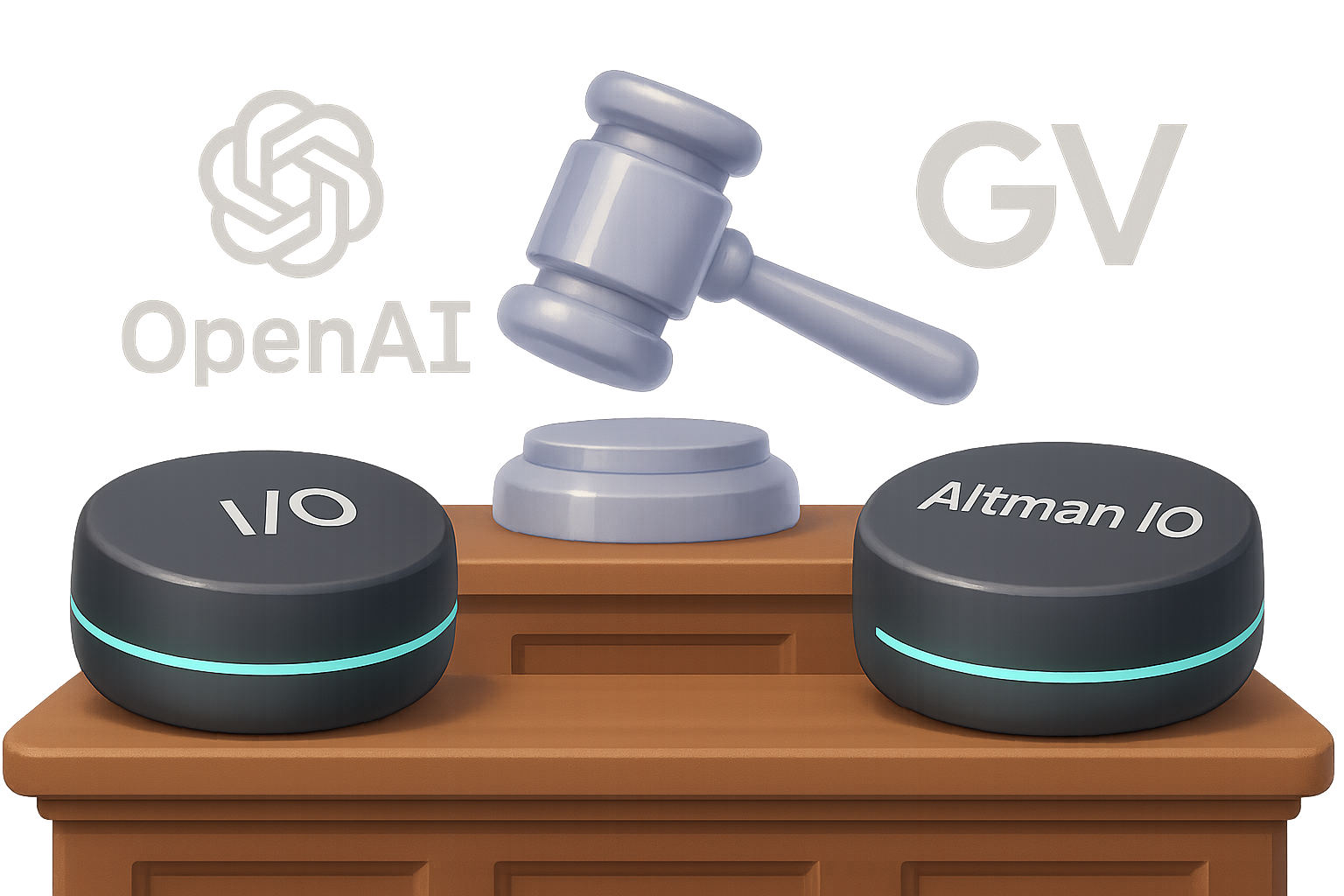
AI Hardware Just Got a Plot Twist
You’d think a name like “I/O” wouldn’t spark a billion-dollar brawl. But here we are—two high-powered teams, one backed by Google and the other led by OpenAI’s Sam Altman and design legend Jony Ive, are squaring off in court. The reason? They both want to call their next-gen AI gadget the same thing: “I/O.”
Sound petty? It’s not. When big egos meet small devices, things get dicey. Especially when you wrap it all in trademarks, billion-dollar valuations, and the race to win your pocket.
Let’s unpack the drama—and what it says about the future of AI hardware.

This Isn’t a Naming Tiff. It’s a Proxy War.
It’s easy to write this off as just a legal squabble over three letters. But dig deeper, and you’ll realize: this is really about control—and credibility—in the consumer AI market.
One side? A startup called I/O, backed by Google Ventures, with hardware almost ready to ship.
The other? “Altman I/O,” a stealth-style team recently acquired by OpenAI for a cool $6.5 billion.
Let’s size them up.
The Players
- I/O (The Original)
- Started in 2022
- Already built 20,000 screen-less voice assistant units
- Filed and owns the U.S. trademark for “I/O”
- Altman I/O (The Newcomer)
- Formed by OpenAI’s Sam Altman + Apple’s Jony Ive
- Teased, but shrouded in secrecy—you won’t find specs or demos
- Just got bought for $6.5B by OpenAI
Yes: same name, same market, wildly different resources. And now, same courtroom.

How It Escalated: A Timeline in 5 Moves
- 2022: I/O pitches its product to Altman and Ive. Both pass.
- 2023–2024: Those same execs request devices, ask for design docs, and keep tabs.
- Early 2025: OpenAI pushes I/O to ditch the name—or else.
- June 2025: Altman’s venture gets scooped up by OpenAI.
- Later That Month: The original I/O sues, alleging IP theft, unfair competition, and strong-arm tactics.
It’s not subtle. And depending on how things shake out, OpenAI might have to rename its $6.5 billion toy—or cough up cash.

So, Why Does the Name Even Matter?
“I/O” may look simple, but it carries weight.
In tech, it stands for “input/output.” In hardware, it’s a metaphor for how we interact with AI—not with screens, but with voice. Both companies are betting on a future where you talk to your device, and it just gets things done.
Trademark law agrees: too much similarity in product names, especially in the same category, confuses customers. That’s illegal.
The smaller I/O filed first. Their case hinges on:
- Prior trademark registration
- Any overlaps in branding or packaging
- Alleged threats from the OpenAI crew
If the court sides with them, things could get messy—and expensive—for Altman I/O.

But Here’s the Billion-Dollar Question…
Do people even want AI gadgets… without screens?
Because unlike smartphones, these new devices are voice-first. No touch. No display. Just your words and the machine’s reply.
The early results? Wobbly.
- Humane’s AI Pin launched to hype—and backlash.
- The Rabbit R1 looked fun but flopped in practice.
Users found them glitchy, slow, and awkward in real life. Turns out yelling “Send my mom a text!” in a coffee shop isn’t that futuristic.
But the original I/O thinks they’ve cracked it:
- Faster replies
- Clean app integrations
- Hardware that feels useful, not gimmicky
Meanwhile, Altman I/O is still in the vault. But let’s be honest—at $6.5B, expectations are galaxy-high.

While They Lawyer Up, Software Pulls Ahead
The real headline? While hardware ventures wrestle over branding, software teams are building tools that actually deliver.
Take Warp 2.0, for example. It just reimagined the developer terminal with AI baked in. Here’s what’s new:
- Autonomous coding agents
- Side-by-side terminal + editor
- Parallel task execution (hello, faster test suites)
- High scores: 71% on SE-Bench, 52% on Terminal-Bench
Translation: coding with Warp isn’t just faster—it feels effortless. It’s like having an AI teammate who doesn’t nap.
This is the vibe hardware has to chase. You’re not just competing with other gadgets—you’re up against ultra-powerful laptops that already run these agents like a dream.

What’s Next (and Why You Should Care)
Here’s how this could shake out:
- OpenAI might change the name quietly: think Apple’s iTV rebrand.
- Or dig in, risking a court loss and a messy PR storm.
- If the smaller I/O gets steamrolled, GV (Google Ventures) could still swing back.
- Either way, the real question isn’t legal—it’s practical:
Will anyone want to use these devices every day?
Because no matter what the logo says, the product has to land. AI’s not magic. If it doesn’t just work, people move on.

Quick summary
Trademark drama makes headlines—but usability wins the war.
If you’re building in AI (or just keeping tabs), this case is your reminder: groundwork matters. Names, trademarks, first-mover advantage—they shape the path ahead.
And if you want to start learning how AI tools actually work, not just read about them?
💡 Head to Tixu.ai—a beginner-friendly platform packed with hands-on projects, real-world tools, and zero fluff. Ready when you are.
Leave a Reply