
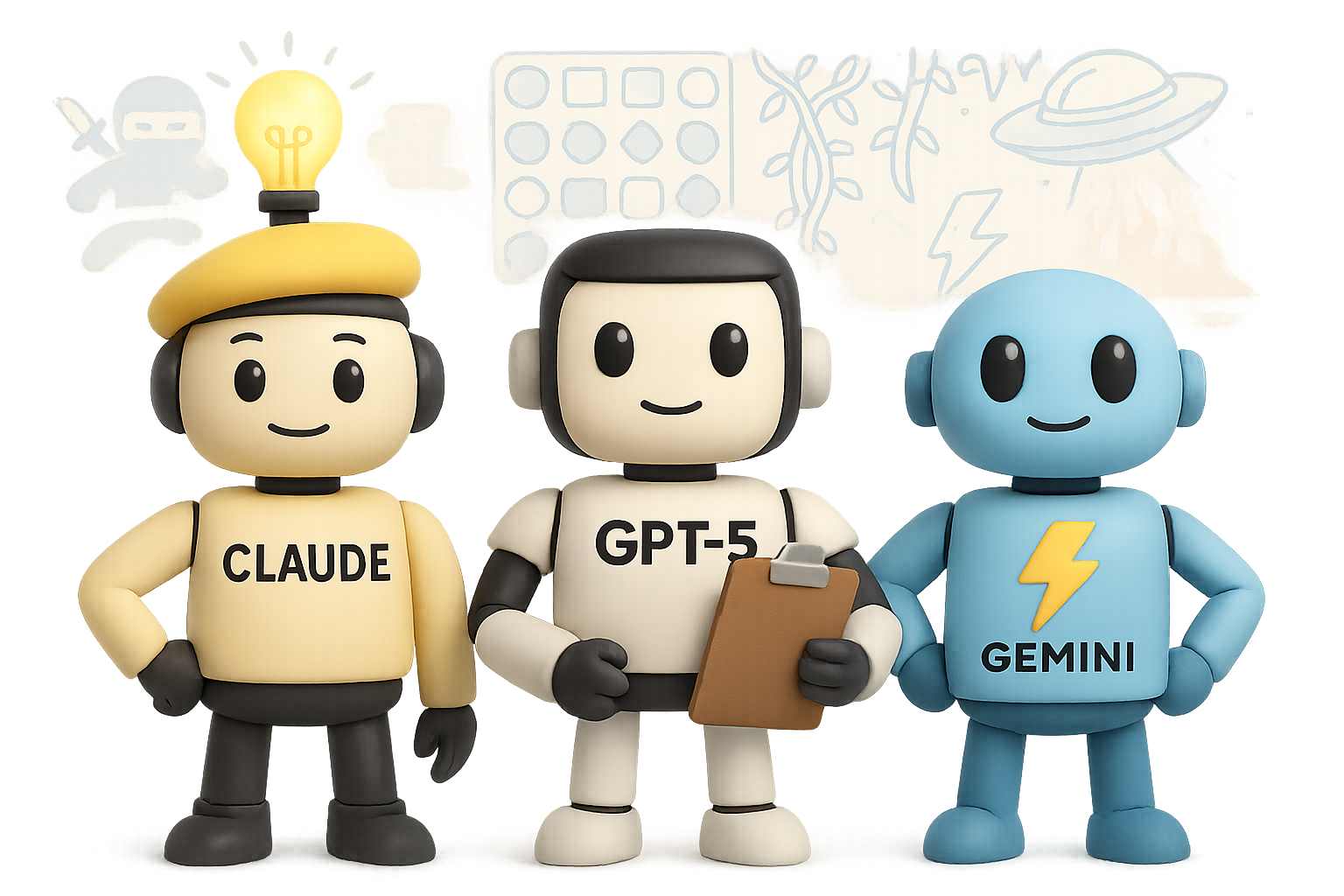
Which AI Model Wins for Devs? We Put Claude, GPT-5, and Gemini to the Test
Too many tools. Not enough time.
Picking “the best” AI model today can feel like speed-dating robots. One’s creative. One’s consistent. One looks perfect until you go past the first prompt.
If you’re trying to build smarter, faster workflows—with code that actually runs—you need more than hype. You need proof.
So we put three of the newest heavyweights through a head-to-head coding brawl. Real tasks. Real results. No filters.
Here’s what we learned—and how you can make the smartest bet for your own AI stack.

Three Titans, One Coding Gauntlet
The contenders:
- GPT-5 – Polished, articulate, and always a safe pair of hands (most of the time).
- Claude 4.1 (Opus) – Creative, cautious, and surprisingly playful once it warms up.
- Gemini 1.5 Pro – Google’s speed demon with impressive memory and context handling.
We ran all three through the same five-part game dev challenge:
Build simple browser-based games with identical specs, under tight time limits.
Let’s see how they did.

1. Pixel Ninja Dash: Speed ≠ Playability
- Gemini was blazing fast, but playing it felt like punishment. Zero forgiveness.
- GPT-5 looked great, but the controls were equally brutal.
- Claude took its sweet time… and made the only version we didn’t immediately rage-quit.
Winner: Claude
Lesson: Fast isn’t fun if no one wants to play.

2. Candy Match Blast: Creativity Comes to Play
- Gemini crashed. Fast. Gone.
- Claude built a funky emoji-themed board. Weird—but fun.
- GPT-5 went traditional, with tight, clean visuals.
Winner: Claude
Why: Charm beats polish when you’re making something memorable.

3. Jungle Run Adventure: Total Meltdown
First attempt? Every model failed.
On the re-run:
- Claude’s game loaded, but the bananas straight-up vanished.
- Gemini juggled bugs—it jumped sometimes, and the bananas morphed into yellow blobs.
- GPT-5 face-planted over and over.
Nobody wins.
Hard truth: All models break. Just not the same way.

4. Space Miner 3D: Redemption Arc
- Gemini and GPT-5 built functional—even if forgettable—decks.
- Claude initially gave us red error soup… then quietly served up an astonishingly good game.
Winner: Claude
Moral: A rocky start can still end with stars.

5. Lava Escape Runner: Heat Test
- Gemini launched first… and promptly melted down in bugs.
- Claude held up decently, just a bit of input lag.
- GPT-5? Three attempts—and not one finish.
Winner: Claude (by elimination)
Reality check: Reliability beats theoretical “power” every time.

Scoreboard Time
Here’s how things shook out overall:
| Metric | Winner |
|---|---|
| Speed | 1. Gemini → 2. GPT-5 → 3. Claude |
| Bug-Free Builds | 1. Claude → 2. Gemini → 3. GPT-5 |
| Creativity | 1. Claude → 2. GPT-5 → 3. Gemini |
No one model dominated across the board.
Each has a clear strength—and knowing that? That’s your leverage.

Pick the Right AI for the Right Job
Don’t ask which model is “best.” Ask which one fits your next task.
Think like a builder. You wouldn’t use a hammer for every job—even if it’s flashy.
Here’s your simplified toolbox:
- Gemini – Use for speedy drafts, quick data slicing, or brute-force outputs.
- GPT-5 – Your go-to for polished writing, nuanced summaries, and reliable tone.
- Claude – For creative dev tasks, exploratory builds, and user-friendly polish.
Smart teams mix models like ingredients—not idols.

Takeaways That Actually Move the Needle
Want better results from your AI investments? Do this:
1. Stop treating AI like search
Multi-step prompts = the real upside. Don’t waste these models chasing basic answers.
2. Never skip the review pass
Every output—especially code—needs checking. AI drafts; you decide what ships.
3. Match the metric to the mission
Sometimes speed is king (live ops). Sometimes stability or creativity matter more. Know what “good” looks like before you start.
4. Stay flexible
Today’s top model may drop the ball tomorrow. Keep options in rotation, and re-test regularly.
5. Build your playbook
Prompts, reviews, fixes—turn every experiment into a reusable pattern. Skill compounds.

Wrapping Up: Tool Up, Team Smart
None of these models are magic. The magic’s in how you use them.
The best outcomes come from mixing:
- the right AI model
- the right prompt strategy
- and a team that knows how to test, tweak, and trust its tools
Want help building those instincts?
👋 Explore Tixu.ai—a beginner-friendly platform that helps you level up your AI superpowers from day one. Tutorials, tools, and prompts that actually get you results.
You bring the energy—we’ll handle the roadmap.

Leave a Reply