
Why You Keep Mixing Up These 3 AI Terms (and How to Finally Nail Them)
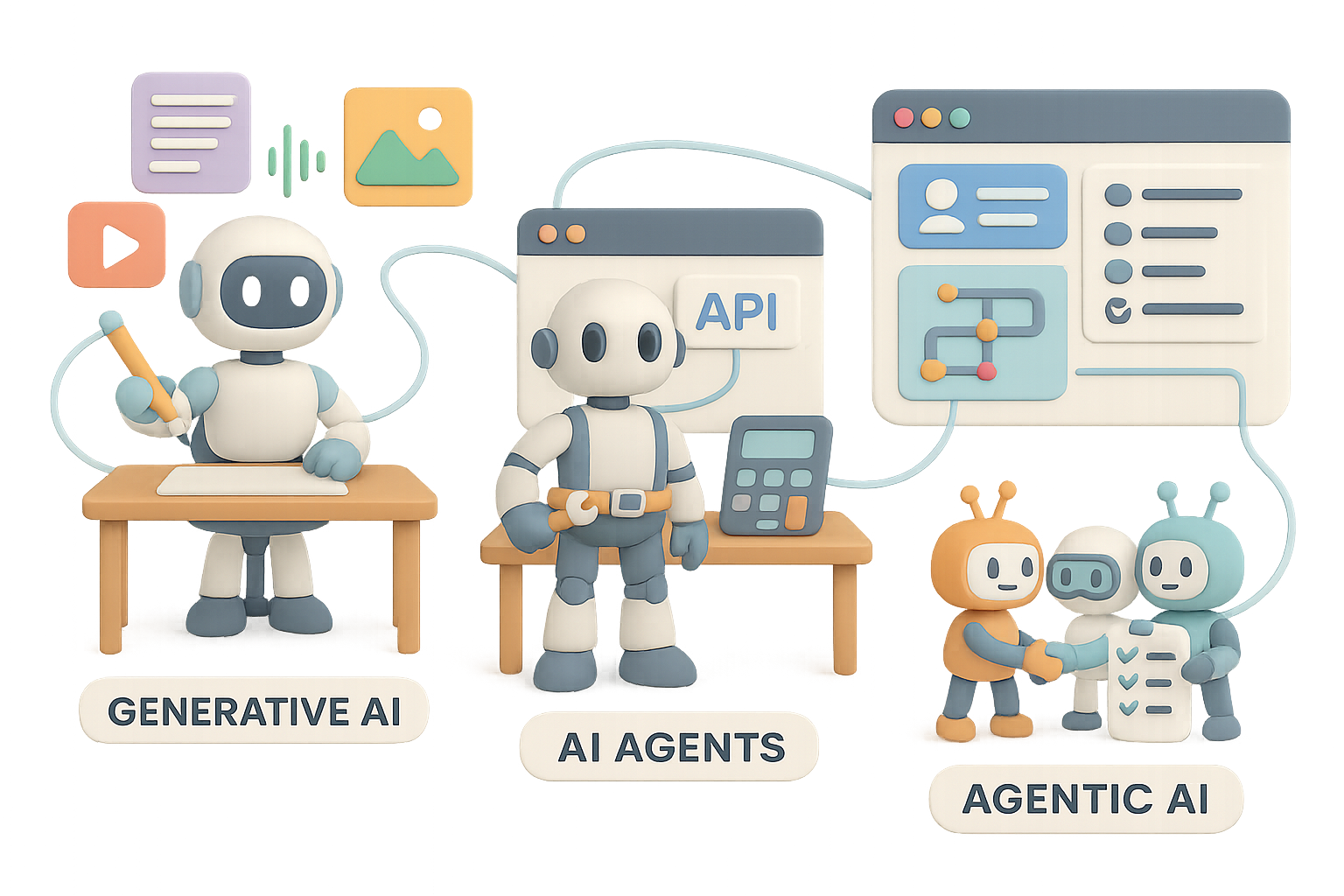
You’ve probably heard the terms generative AI, AI agents, and agentic AI tossed around like they’re interchangeable. Spoiler alert: they’re not. Each one solves a different kind of problem—and knowing the difference can save you weeks of build-time (and a few forehead smacks).
Same AI family tree, totally different jobs.
By the end of this post, you’ll know:
- What each term actually means
- Which one fits your product or use case
- How to level up from cool demo → real automation
Let’s make it click.

Generative AI — Creative, But Not a Doer
This is the OG. The content machine.
When most folks talk about “AI,” they’re usually describing this layer. Think GPT-4, Claude 3, Gemini. These models are trained on eye-watering amounts of data and are reactive—you ask, they answer.
What Generative AI Delivers
- Text — blurbs, emails, code snippets
- Images — concepts, thumbnails, art
- Audio — voices, sound effects
- Video — short clips, animated how-tos
It’s powerful, but here’s the catch: it doesn’t know when it’s wrong or how to pull in real-world info. You give it a prompt, it gives you an answer. No questions asked, no tools used.
Real-World Example
Want a witty product blurb for a smart-watch?
Prompt → Output in seconds.
That’s generative AI in its sweet spot.
Quick Dev Stack
- LangChain – for chaining prompts
- LangGraph – flexible pipelines
- LlamaIndex – connect your own data
- OpenAI SDK – plug-and-play power
- Groq – lightning-fast inference
Hold onto these. They’re stepping stones to the next level.

AI Agents — One Task, Fully Handled
Here’s where AI starts making decisions—not just content.
An AI agent pairs a generative model with tools like calculators, APIs, databases, or even a browser. It knows when to delegate, pulls in data, and blends it into the final response.
Under the Hood
- An LLM that supports tool or function calling
- A toolbox (APIs, code execution, search, etc.)
- A policy layer that says, “Hey, I need new info”
Real-World Example
Question: “Who won the IPL match last night?”
The agent:
- Notices it doesn’t have real-time data
- Calls the Tavily API (a search wrapper)
- Fetches the result
- Writes a neat reply
Boom. One clear request → one agent → one complete answer. No manual input required.

Agentic AI — Full Workflows, No Babysitting
Now we’re cooking.
Agentic AI is what happens when multiple agents collaborate toward a big-picture outcome. Each agent handles a piece of the puzzle, and a central system watches the clock and keeps communication flowing.
Think automation with actual follow-through.
Let’s Break It Down
Say you want every new YouTube video to become a blog post—automatically.
- Transcript Agent fetches and converts video audio
- Title Agent writes a killer headline
- Description Agent cooks up the meta blurb
- Conclusion Agent wraps it all into a finale
Each agent trades data, checks each other’s work, and maybe loops in a human editor before release.
What Makes Agentic AI Tick
- Agents that run in sequence, parallel, or dynamic branches
- Conversations between agents = smooth handoffs
- Optional human feedback keeps quality high
- Central intelligence tracks progress toward the goal
It’s like a project team—each specialist does their piece, but the manager (a.k.a. the agentic system) keeps the big picture moving.

Spot the Difference (Finally)
Let’s cut through it. Here’s the cheat sheet:
| AI Type | Description | Best For |
|---|---|---|
| Generative AI | One prompt → One creative output | Text, images, ideas |
| AI Agent | Calls tools → One complete answer | Live info, actions, quick tasks |
| Agentic AI | Team of agents → Complex workflow done | Long multi-step automation |
Still mixed up? That’s normal. But now you’ve got a map.

How to Pick the Right Level
Let’s keep this dead simple. Ask yourself:
- Need just content (text, visuals, etc.)?
→ Generative AI is your jam.
- Need content + live info or tools (e.g. search, send data)?
→ Build an AI agent.
- Need start-to-finish workflows with minimal babysitting?
→ Time to architect agentic AI.
Pro tip: Start small. Build one strong agent first. Once it works? Compose. Tools like LangGraph, CrewAI, and LangChain Agents make it way easier than before.

Your Next Move
Generative AI writes content.
AI Agents get things done.
Agentic AI runs the whole show.
Now you’ve got the vocabulary—and the strategy—to choose your build path wisely.
👋 Want to learn how to actually build each one of these?
Tixu.ai is your crash course companion—no PhD required, just guided walkthroughs and beginner-friendly projects to get you rolling.

Leave a Reply