
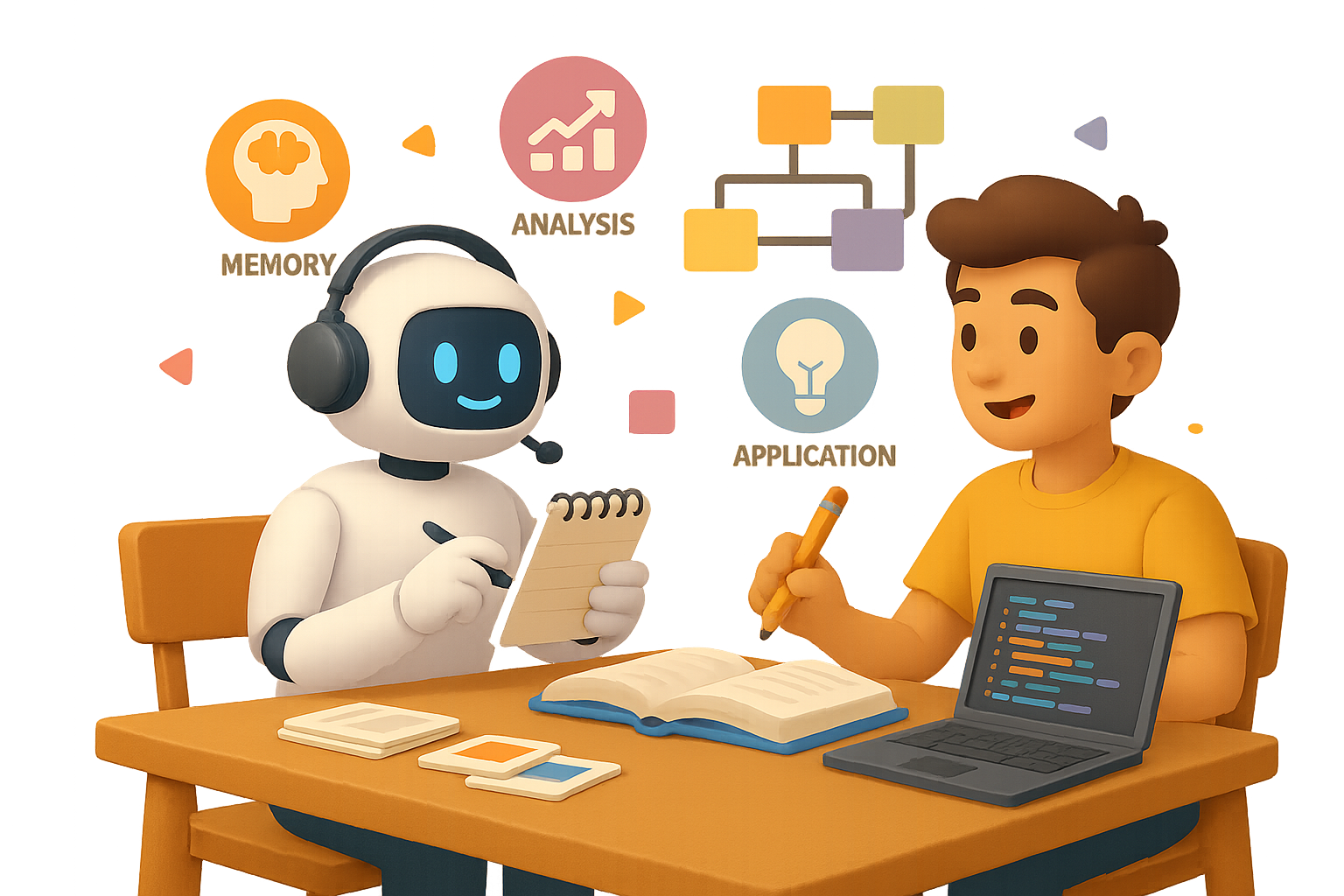
Use AI as a Coach, Not a Crutch
You’re not here to be spoon-fed. You’re here to learn faster, retain more, and maybe even enjoy the ride.
The smartest learners aren’t letting AI do the thinking for them—they’re using it to stretch their thinking. Oxford University calls it “trainer, not answer-machine” mode. You’re in the ring doing the
repetitions. The chatbot? It’s holding the mitts and throwing curveballs.
Let’s flip the script:
AI isn’t your shortcut—it’s your sparring partner.

What You’ll Walk Away With
By the end of this post, you’ll know how to:
- Use AI to quiz, coach, and clarify—without dulling your own edge.
- Turn everyday study time into a mini boot camp.
- Avoid the classic “AI told me so” trap that leaves your brain in passive mode.
Ready when you are.

Before You Even Start, Set the Rules
This isn’t a trust fall with a machine.
Three must-dos before using AI to study:
- Stay skeptical. Large language models (LLMs) do make things up. (No, the Gulf of Mexico isn’t getting renamed.)
- Cite or verify sources. If it matters—get the paper, check the book, read the dataset. Always.
- Protect your data. Don’t paste anything sensitive or copyrighted unless you’ve cleared it.
This isn’t paranoia—it’s protocol.

Automate the Quizzing, Not the Learning
Retrieval practice doesn’t just work—it crushes.
Studies show actively recalling info can boost long-term retention by as much as 50%.
Here’s how to use AI to test you—not just talk at you.
Prompt:
“Act as a Socratic tutor. Ask me one question at a time about the conservation of momentum. Wait for my answer, evaluate it, then pose the next question.”
Why it clicks:
- Forces recall, which cements memory.
- Immediate feedback = clarity.
- You’ll see gaps before they snowball into exam panic.

Move Up the Thinking Ladder
Bloom’s Taxonomy isn’t just for teachers with clipboards.
It’s an ironclad way to level up your mental reps—starting from memory recall, up through creativity and critique.
Prompt:
“Create a study plan on photosynthesis with tasks at each Bloom level. After each task, quiz me and give targeted feedback.”
You’re not just remembering stuff. You’re applying, analyzing, and rewriting it in your own words—then letting the model play coach.

Layer Your Explanations
Stuck on a tricky topic? Use explanation layering to build clarity from the ground up.
Try this sequence:
- “Explain quantum entanglement to a 10-year-old.”
- “Now explain it to a high school senior.”
- “Finally, give me a graduate-level summary with citations.”
- “I’ll write my own—please critique clarity and accuracy.”
By the end? You don’t just “get” it. You can teach it.

Read First. Then Summarize. Then Compare.
AI summaries are handy. But relying on them alone is like asking your treadmill to run for you.
Here’s how to turn reading into a feedback loop:
Step 1 — You first:
Summarize the article in 150 words. List 3 claims and 2 questions you’ve got.
Step 2 — AI second:
Ask the model to do the same.
Step 3 — Compare:
See what you missed. Where your focus drifted. Which questions dig deeper.
Want to go even further?
Prompt (for research-heavy papers):
“Extract 20 key terms from this paper and group them into five thematic categories.”
Then follow up with:
“Map relationships using ‘X is a type of Y’, ‘A causes B’, ‘C explains D’—organize it in a three-column table.”
Suddenly, dense academic jargon becomes a clean, personalized concept map.

You Can’t Look Stupid in Front of a Bot
Let’s be real: sometimes you nod in a lecture while secretly Googling “what are eigenvectors” under the desk.
An AI tutor doesn’t judge.
It’ll explain the same thing 10 ways. With pizza metaphors. With code analogies. In reverse if you ask nicely.
The only wrong move? Quitting before it clicks.

Practice Over Passive = Real Progress
Boot.dev gets it. Their RPG-style coding quests force you to learn by doing. No watching someone else type for hours.
Why it matters?
Because the median U.S. salary for backend devs hit $109,000 in 2023. That’s real ROI—but only if you’re the one writing the code.
Same deal whether it’s machine learning or Latin grammar.
Muscle is built through repetitions.

Daily Routine: Your AI-Study Checklist
Slam this workflow into your study sessions:
- Choose today’s learning goal.
- Write 5–10 retrieval-style questions for yourself.
- Ask an AI to quiz you Socratically—one question at a time.
- Scale Bloom’s ladder: Apply → Analyze → Evaluate.
- Draft your own explanation; get targeted AI critique.
- Summarize an article, then compare with AI’s take.
- Capture key ideas in spaced-rep tools.
- Repeat tomorrow.
Consistency > perfection.

Want to Get a Head Start?
If you’re new to AI-powered learning and want tools that don’t make you feel like you need a PhD to get started, there’s a platform built with you in mind.
👉 Try Tixu—AI learning made beginner-friendly
Clear tools. Clean feedback.
One final note?
AI doesn’t make you smarter. It just makes your effort go further.
Use it right—and your learning curve won’t just bend. It’ll rocket upward.

Leave a Reply