
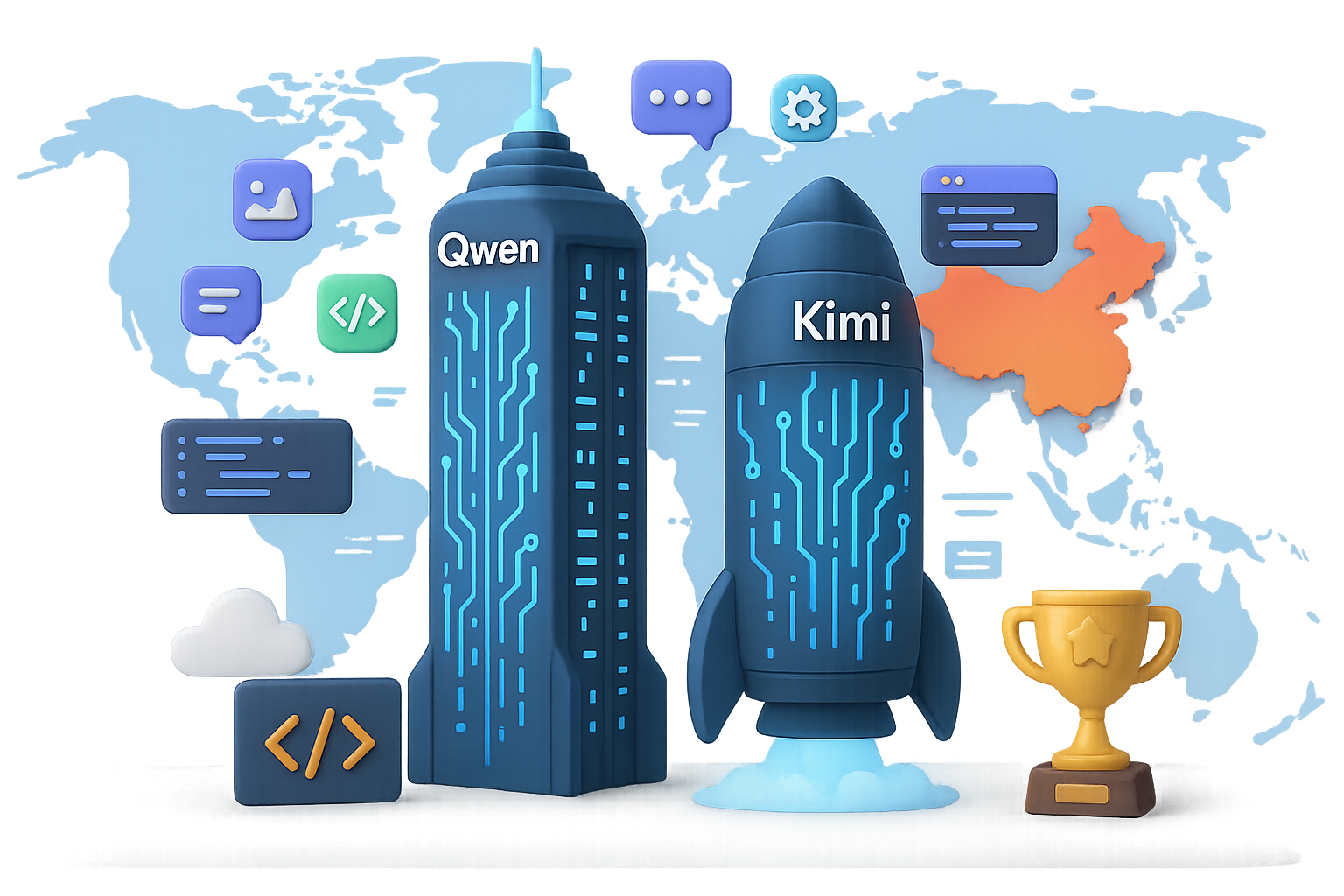
China’s New Trillion-Parameter LLMs Just Raised the Bar. Again.
You’ve probably been heads-down building, shipping, or debugging some wild prompt chain. Then—boom—two AI powerhouses out of China just dropped trillion-parameter models that blow past many of the Western favorites. Yeah, you read that right: trillion. With a “T.”
If you thought you could hold off on testing foreign LLMs? It’s officially time to reconsider. Here’s what Alibaba and Moonshot AI just launched, why it matters for your stack, and what you should do about it.

Big Brains, Bigger Context: What Just Launched
Qwen-3 Max Preview: Alibaba Swings Big (Again)
Alibaba Cloud’s Qwen series has been climbing up the open-source LLM leaderboard all year. But the “Qwen-3 Max Preview”? Whole new altitude.
Here’s the highlight reel:
- Model size: Just over 1 trillion parameters
- Context window: 262,144 tokens total (~200k in, ~32k out)
- Benchmark wins: Beats Claude Opus 4, DeepSeek V3.1, and Google’s Gemini on SuperGPQA, AIME25, LiveCodeBench v6, and more
- How to access it: Live on Qwen Chat, Alibaba Cloud API, OpenRouter, and preloaded into AnyCoder
- Use cases: Complex reasoning, heavy-duty coding, structured data ops, and solid creative chops
Speed & Pricing
Early testers, including VentureBeat, say it feels faster than GPT-5 during generation. Pricing is metered by prompt length:
- ≤ 32k tokens: $0.86/M in, $3.44/M out
- 32k–128k tokens: $1.43/M in, $5.73/M out
- 128k–252k tokens: $2.15/M in, $8.60/M out
Short prompts? Pretty budget-friendly. But if you’re piping in whole project files, brace yourself. Good news: session caching is built-in, so you’re not re-paying on every turn.
Preview Gotchas
- It’s not open-weight like earlier Qwen models
- Stability may shift until full release
- Tiered pricing pushes you to optimize prompts carefully
Translation: powerful, but you’ll need to keep a sharp eye on cost and behavior.
Moonshot AI Reloads “Kimi” with a Context Power-Up
Meanwhile, over in Beijing, Moonshot AI upped the ante with a hefty upgrade to their Kimi family—and they’re quietly valued at $3.3 billion.
The beta is called “Kimi-K2-0905” (for now), and here’s what’s inside:
- Model size: ~1 trillion parameters
- Context window: 256,000 tokens (doubled from earlier builds)
- Upgrade goals: Better coding performance, lower hallucination rate, still nails the poetry if that’s your thing
- Open stance: Company says core models will remain open-source, though select partner versions may stay private
A planned beta rollout with ~20 devs got delayed due to API growing pains. Watch for this to resurface soon, possibly as “K3”—complete with multimodal vision and even longer memory.

Why You Can’t Snooze on These Drops
Here’s what this really signals—and it’s not just about benchmarks.
- Big still works. Despite hype around “small and efficient” models, raw scale is still creating noticeable quality leaps.
- Context is king. With 256k+ token windows, you can dump entire codebases or internal playbooks into one call. Less orchestration, fewer headaches.
- US labs are officially on notice. Model quality is table stakes now. China’s pushing on latency, pricing, and context size. Lines are blurring.
- The open-vs-closed race is heating up. Qwen’s gone paid-for weights, but Moonshot keeps waving the open-source flag—at least on core models. Watch the forks fly.

What You Should Do
Let’s get tactical. If you’re building apps, tools, or agentic workflows, here’s your action list:
- Benchmark them.
Drop Qwen-3 and Kimi into your current stack. Focus on long-retention tasks like retrieval-augmented generation, code refactoring, or multi-turn planning. - Prune your prompts.
With trillion-parameter models, token count = $$ spent. Ditch excess system prompts. Preprocess your source chunks. - Cache or cry.
Both models offer context caching—reusing prior context without paying again. Use it for iterative tasks like doc review, debugging, or writing loops. - Build for portability.
The future isn’t just OpenAI or bust. Abstraction layers (like LangChain, OpenRouter routing—or flexible connectors from Tixu.ai) let you swap back ends fast when the economics shift. - Keep your watchlist updated.
Zero-shot accuracy may not be enough soon. Cost per token, latency, API uptime—all fair game in the next wave of LLM wars.

The Bottom Line
China’s latest AI releases aren’t just catching up—they’re pushing the frontier. Ignore them at your own risk. While we wait for Google’s Gemini and OpenAI’s next spinoff, it’s clear the global leaderboard is getting real crowded, real fast.
Want a smoother on-ramp to testing all these options without going full mad scientist mode? Platforms like Tixu.ai can help you experiment, train.
Ready when you are.

Leave a Reply