
If your S&P 500 index fund suddenly feels like a single-stock bet
If your S&P 500 index fund suddenly feels like a single-stock bet, you’re not imagining it. That’s the pain: a long-trusted, low-effort strategy now concentrates almost half its weight in a handful of AI-heavy names. The win: you don’t have to reinvent your plan. You can tweak it, stay disciplined, and sleep better.

Reassess the classic index — know what you own
- The old play worked. For decades, the S&P 500 averaged ≈10% annually.
- Today, ~40% of every dollar in the index sits in just ten companies.
- NVIDIA alone captures ~7–8¢ of every invested dollar.
Short translation: your “broad” U.S. exposure now rides a single thematic wave—AI. If that wave stalls, the index feels it. That doesn’t make the S&P bad. It just makes it concentrated.
Trim, don’t trash the S&P 500
Keep the S&P for liquidity, tax efficiency, and low fees. But scale the position so it doesn’t dominate your future.
Do this next:
- Reduce your market-cap S&P slice by 10–20% if top-heavy tech worries you.
- Reallocate that amount into the steps below.
- Revisit this trim every 6–12 months.

Diversify for real, not just different tickers
Swapping one U.S. ETF for another is still one-theme thinking. Instead, widen your toolbox.

Equal-weight S&P funds — spread the power
- Equal-weight funds cut top-10 exposure from ~40% to ~2%.
- They rebalance by selling winners and buying laggards, so costs tick up.
Action: park a slice (e.g., 10–20% of U.S. equities) in an equal-weight S&P product to lower single-theme risk.

Global all-world funds — capture leadership before it lists in the U.S.
- I use the Vanguard FTSE All-World UCITS ETF (VWRP). It holds ~3,800 companies across ~45 countries and rebalances automatically.
- Ongoing charge: 0.19% (cheap for global reach).
Why this matters: leaders rotate. Japan’s dominance in 1989 didn’t stop the next era elsewhere. A true global fund helps you catch tomorrow’s giants early.

Find the overlooked zone — asymmetric upside
Map the market into four buckets:
- Crowded (mega-cap AI names)
- Defensive (steady cash generators)
- Speculative (meme and pre-profit plays)
- Overlooked (reasonable small- and mid-caps)
Thesis: if AI becomes commoditized, nimble companies that apply AI will often win over giants that built it. I increase tilt via select small-/mid-cap funds and measured private stakes in AI-powered startups. Risk? Yes. Reward potential? Asymmetric.
Do this next:
- Allocate a modest percentage (5–15%) to small-/mid-cap funds.
- If you invest directly in startups, size positions small and expect illiquidity.

Reinforce the timeless hedge: gold
Central banks are buying differently than in decades past. Gold has moved toward parity in institutional frameworks and now sits on many balance sheets as a true reserve asset. Limited supply plus rising demand matters.
My approach:
- Physical coins/bars for long-term insurance.
- An iShares Physical Gold ETF for monthly, liquid contributions.
Quick stat to trust: experts at major banks suggest reserve allocations to hard assets could rise meaningfully, tightening supply-demand dynamics.
Hold dry powder — cash isn’t a mistake
AI euphoria can deflate fast. A thicker cash cushion gives you options. Berkshire’s big cash pile reminds us: sometimes waiting is the best strategy.
Rule of thumb:
- Keep 2–6% of your portfolio in readily deployable cash.
- Increase to 10%+ in frothy markets or if you plan opportunistic buys.
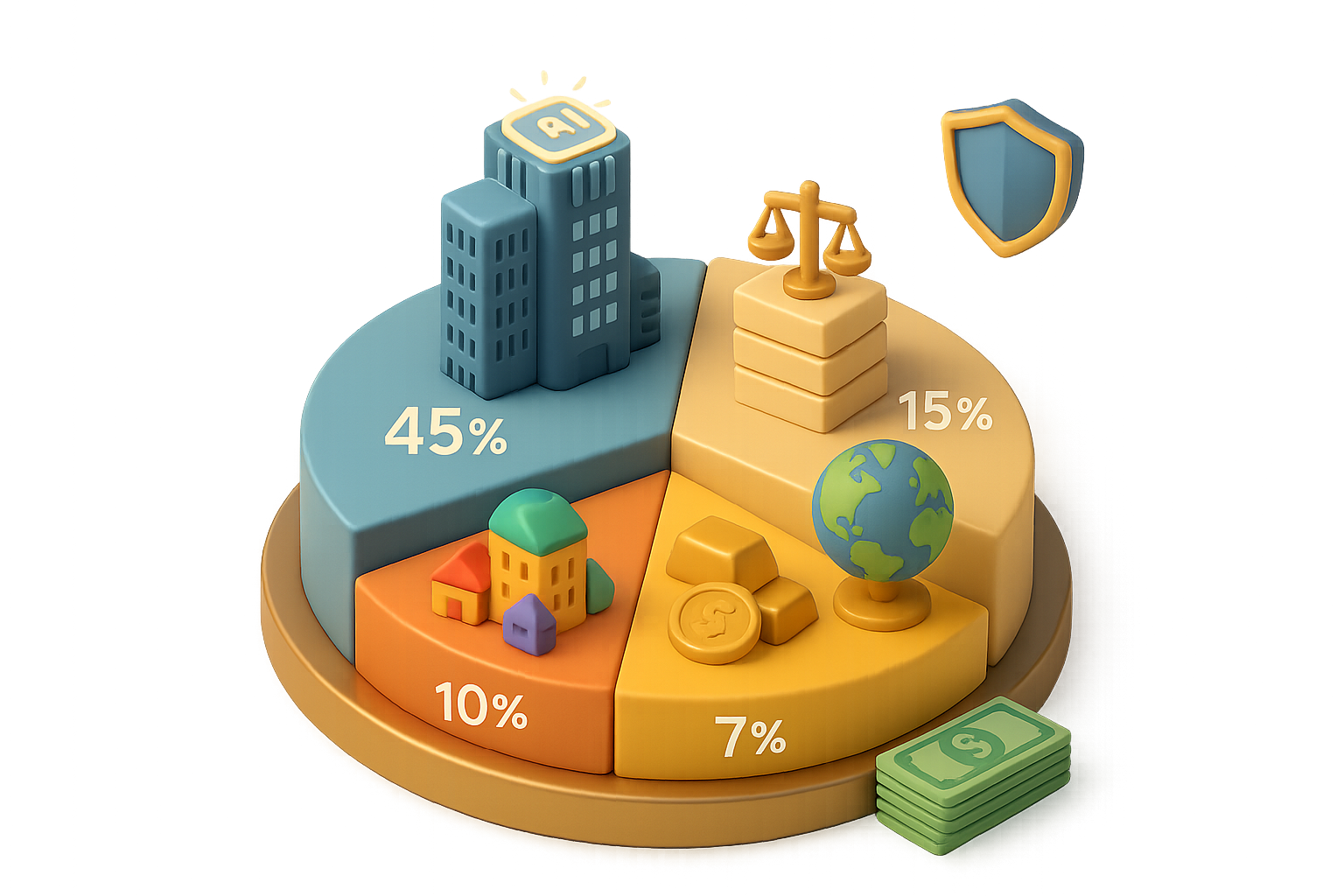
Here’s my current allocation
- 45% Market-cap-weighted S&P 500
- 15% Equal-weighted S&P 500
- 20% Global all-world equity fund (e.g., VWRP)
- 10% Small-/mid-cap & private AI opportunities
- 7% Gold (physical + ETF)
- 3% Cash & cash-equivalents
Why this mix works: it keeps core exposure, lowers single-theme risk, gains global optionality, and preserves optionality with cash and gold.
Checklist before you act
- Did you trim the S&P without abandoning it?
- Do you hold a true global fund, not just another U.S. ticker?
- Is a small portion in overlooked names giving you asymmetric upside?
- Do you own a physical or ETF-backed slice of gold?
- Do you have deployable cash for opportunities?
You don’t need to panic. Tweak, diversify, and keep optionality. Try trimming 10% from market-cap S&P exposure this quarter, funnel that into equal-weight and global funds, and set a small, disciplined allocation to overlooked names.
If you want to learn practical AI basics before shifting allocations, start with the beginner-friendly AI learning platform tixu.ai — get grounded in what AI can (and can’t) do before you reposition your portfolio.
Ready when you are.

Leave a Reply