
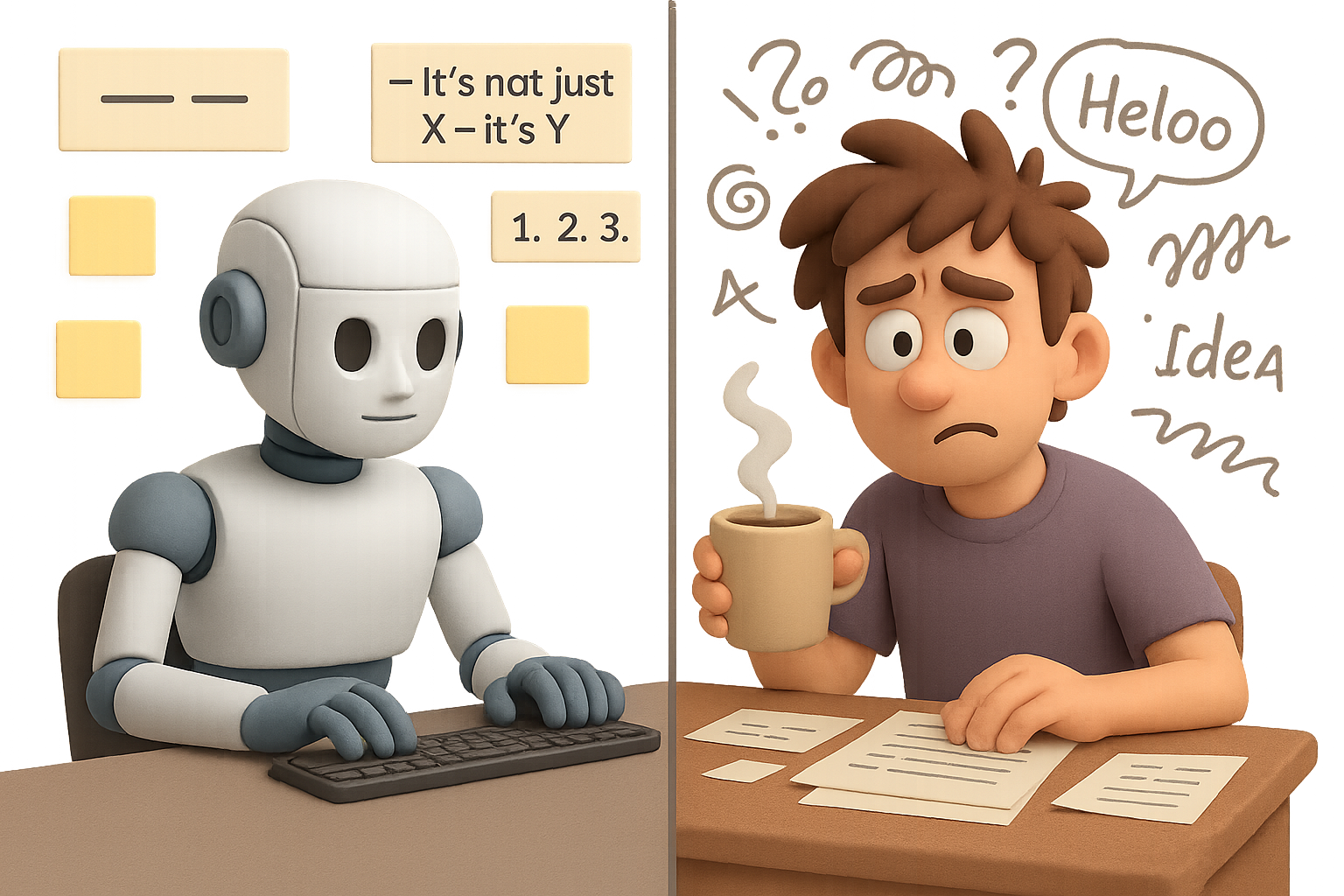
How to Spot AI-Generated Writing in 2025 (Without Fancy Tools)
You’ve probably read AI-generated text this week—maybe even today. And you didn’t flinch. That’s how slick it’s gotten. But here’s the thing: even the best bots leave breadcrumbs. If you know what to look for, you’ll start seeing patterns faster than ChatGPT can say “Let me explain.”
Welcome to your updated field guide for spotting robot prose in the wild.
Ready when you are.

Know the Tell: Em Dashes Gone Wild
The em dash (—) is a beautiful bit of punctuation. But here’s a quirky truth: most people don’t know how to actually type it.
Robots? They can’t get enough.
So when you see a sudden flurry of em dashes—especially in places you’d least expect, like TikTok captions or half-baked email pitches—that’s your first flag. One dash is fine. Six in a paragraph? Mm-hmm.

Pattern Alert: The “It’s Not Just X — It’s Y” Formula
Robotic writers love a setup with drama:
“It’s not just X — it’s Y.”
Examples:
- “It’s not just style — it’s personal branding.”
- “It’s not just a newsletter — it’s a movement.”
Human? Maybe. But AI? Definitely had this in its training data sandwich.
Watch for this structure. If you see it paired with other patterns, the scales tip bot-ward.

Spot the Rule of Three (or Five)
Humans dig odd-numbered lists. Copywriters exploit this. LLMs? They cling to it like a safety net.
So when you spot:
- Three benefits in perfect symmetry
- Five emojis, one per bullet
- Lists that fit just a little too neatly?
Ask yourself who had the time (or lacked the humanity) to craft it.
That Vibe: Hollowness in High-Def
Ever read something that makes sense but leaves you… empty? Like eating air-puffed chips that promise spice but taste like cardboard?
You’re not crazy. You’ve likely just brushed up against AI-speak. Here’s what to watch for:
- Buzzwords strung together with zero detail (“innovative solutions,” “seamless integration”)
- Broad claims + zero receipts (“More jobs! Better lives! The future is now!”)
- Smooth grammar, no soul
If it feels like plastic fruit—shiny but tasteless—you’re onto something.

Lightning Round: 3 Smaller Red Flags
- Excessive praise
“Your post is absolutely phenomenal and an inspiration to mankind.” Thanks… I think? - Bizarre analogies
“Reading AI text is like sipping tea brewed by electrons in a thunderstorm.” What now? - History lessons no one asked for
Ask for one fact, get six paragraphs of background. Cheers for the info overload, Skynet.

What Real Human Writing Looks Like
Here’s how to spot the true-blue stuff:
Context. Quirks. Chaos.
Maybe it’s a tangent about grandma’s soup in the middle of a tech thread. Or a typo that’s too specific to fake. Or a regional phrase you haven’t heard since 2008.
Like this gem:
“As a northerner I’d never tried jellied eels; honestly, the vinegar was the only thing that saved me.”
Could an AI generate that? Possibly. Would it? Probably not—it’s messy, personal, and a little weird.
And that’s the secret sauce.

Humans Wander. Bots March.
One big giveaway? Flow.
You ramble. You escalate, then sidetrack, then circle back. Welcome to the spaghetti logic of real thinking.
AI likes crisp intro–middle–end paths. Humans zig-zag, overshare, and forget where we started, mid-sentence. That organic messiness is weirdly tough to fake.
Let it be your compass.
Quick-Scan Cheat Sheet
Looking to make a snap call on a piece of text? Here’s your back-pocket reference:
Probable Bot
- Em dashes in every paragraph
- “It’s not just X — it’s Y” phrasing
- Lists of exactly three or five points
- Fluffy praise + zero substance
- Surreal similes or over-contextualized replies
Probably Human
- Tangents, small contradictions, or cultural flavor
- Specifics over slogans
- A typo or two (bless them)
- Anything that makes you laugh uncomfortably or go “Oof, me too”

Final Takeaway
Yes, AI is getting better. Yes, the lines will blur. But here’s your edge: bots still fake nuance, connection, and imperfection. Your lived experience—the way you fold in memory, side-eye, slang, and ADHD tangents—is still hard to mimic.
So next time you get that uncanny valley feeling, pause.
Then run the dashes, formulas, and filler through your internal vibe-check.
Odds are, you’re spot-on.
Want to sharpen your radar—and gain some friendly skills in beginner-friendly AI? Check out Tixu – a practical, zero-fluff way to get AI-literate without drowning in jargon.
Leave a Reply