
Why Your Prompts Flop (and How to Fix Them)
You fire up ChatGPT or Gemini, toss in a quick “analyze my site” or “give me ad ideas,” and…meh.
Vague input, vague output.
Meanwhile, over at Microsoft and Google, the same models are tripling productivity. Spoiler: it’s not because they have secret AI sauce. It’s because they know how to talk to the machines.
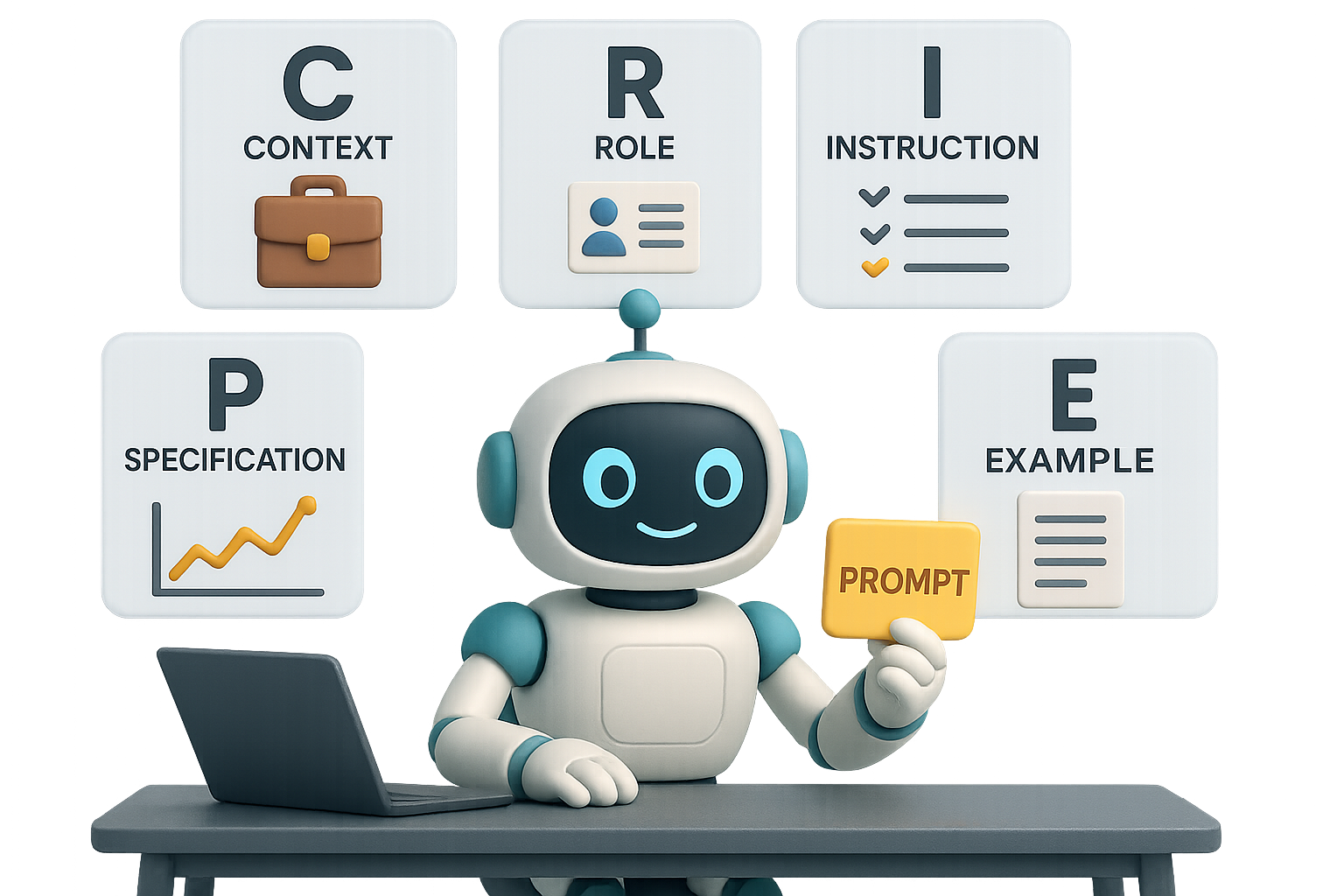
They feed the AI what it actually needs: context, constraints, and clarity. That’s where CRISPE comes in.

Write Prompts That Actually Work: Meet CRISPE
Let’s cut through the noise. If you want usable results from AI, you need structure. After hundreds of trial runs, we’ve landed on a six-part framework that consistently delivers.
The CRISPE Method:
- C – Context
Set the scene. What’s your business? Who’s your audience? Goals, struggles, anything you’d tell a human consultant. - R – Role
Assign the model a persona. Be painfully specific:
“Act as a senior data analyst with 15 years in healthcare” eats “be an analyst” for breakfast. - I – Instruction
Clearly state the task and why it matters. The model isn’t psychic—it needs a mission with meaning. - S – Specification
Go for clarity: output format, tone, length. Msg bullet points? Executive report? You call it, not the bot. - P – Performance
Define what good looks like. KPIs, deadlines, pitfalls to avoid—set the bar high and clear. - E – Example
Models learn fast from patterns. Show them a snippet of A+ work or link a reference. Total game changer.

Let’s See CRISPE in Action
Scenario: You’re running an online education marketplace. Stable traffic, but sales just dropped 20%.
Here’s a CRISPE-style prompt that doesn’t waste time:
- C – “We run an e-learning marketplace with stable traffic but a 20% drop in paid enrollments.”
- R – “Act as a senior e-commerce data analyst specializing in conversion optimization.”
- I – “Identify causes of the drop and produce an action plan to restore and exceed previous sales.”
- S – “Deliver three sections: 1) Key findings (bullets) 2) Detailed diagnosis (short paragraphs) 3) Prioritized recommendations. Tone: clear, non-jargon.”
- P – “All actions must be doable within 30 days and include expected impact (%) and resource estimate (hours or $).”
- E – “Structure and visual clarity similar to McKinsey’s ‘Quick-Win Growth Audit’ report, but focus on immediate steps.”
Plug that into ChatGPT or Gemini and you won’t get fluffy guesses—you’ll get crisp hypotheses, actionable metrics, and prioritized next steps.
Micro Tweaks, Mega Impact
Want to level up even more? These small moves go a long way:
- Let the model ask questions. If it wants clarity, give it. Every answer reduces AI guesswork and upgrades accuracy.
- Stack multiple examples. One is fine. Three is magic. Contrast good vs. bad so it knows what not to do too.
- Treat the first draft as a prototype. Tweak your CRISPE prompt, rerun it, polish. Most top-tier outputs hit in round two.
- Update your success bar. The tools are getting better—your asks should evolve too. Demand more depth, more brevity, less fluff.

Why CRISPE Works (Science > Vibes)
Here’s the deal: language models don’t “think” like humans. They predict the next word based on what you feed them. CRISPE crams the prompt window full of high-signal information.
Microsoft? They’ve clocked a 3× productivity lift using this structure.
Google? Gmail drafts saw 40% better quality.
Amazon? Their customer-facing AI runs on similar rules.
Pattern = proven. Results = repeatable.

Your Move: Structure to Scale
You’ve got ideas. You’ve got AI tools. Now the real leverage is in how you ask.
Pick something you’re working on—strategy doc, churn analysis, blog planning. Write a CRISPE prompt, drop it into your model of choice, and refine.
Yes, it takes five minutes more up front. But you just might save two hours of rework.
Want more beginner-friendly ways to master prompting? Check out Tixu—a no-fluff AI learning platform built for everyday pros.
Ready when you are.

Leave a Reply